
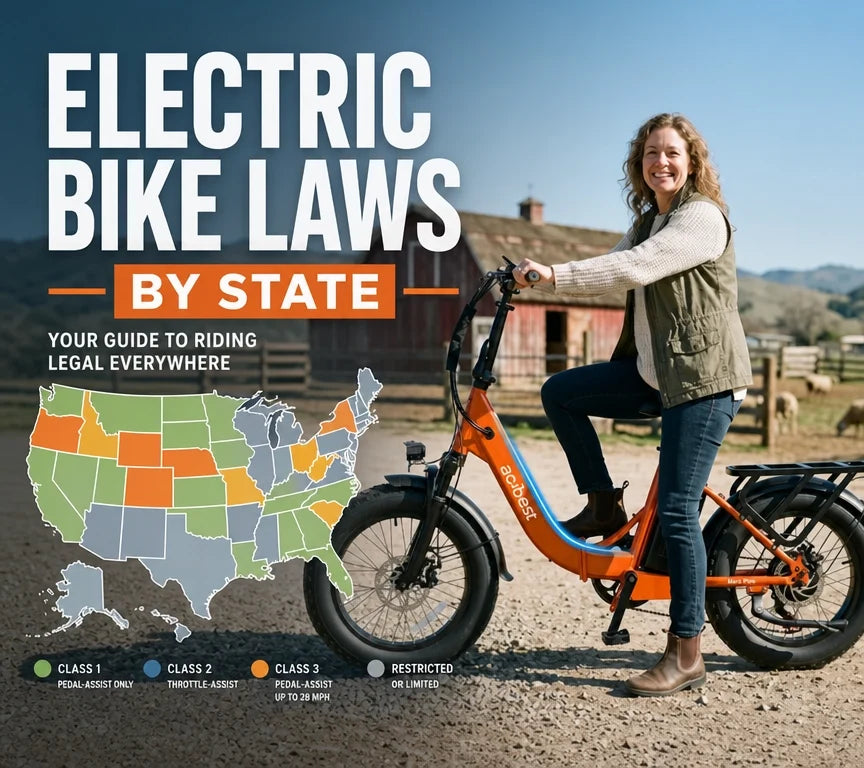
The Short Answer: Electric bike laws by state are not one national rule. Federal law defines a low-speed electric bicycle for product-safety purposes, while states decide how e-bikes are classified and operated. Cities, counties, parks, campuses, trail managers, and federal land agencies can add location-specific rules. In plain English: your bike may be legal on a road, restricted on a sidewalk, limited on a shared path, and prohibited on a particular trail on the same afternoon.

If you searched for e-bike laws by state, use this page to identify the questions that matter in your state, then open the primary source linked or cited in the row. If your bike is modified, has a high-power motor, uses a configurable speed mode, or looks more like a moped than a bicycle, start with the vehicle-class section before relying on bicycle access rules.
How Federal, State, and Local E-Bike Rules Work
Federal Product Definition and Safety Rules
The federal definition is a useful baseline, not a national riding permit. Under 16 CFR 1512.2, a low-speed electric bicycle has fully operable pedals, two or three wheels, and an electric motor of less than 750 watts. Its maximum speed when powered solely by the motor is less than 20 mph on a paved, level surface under the regulation's test conditions. The familiar 28 mph Class 3 ceiling comes from state classification systems, not from this federal product definition.
That definition sits inside a consumer-product safety regulation. It does not tell you whether you need a license, whether a city allows sidewalk riding, or whether a forest trail is open. Those answers come from the authority controlling the ride location. Federal public-land agencies can also use their own route designations and land-management decisions.
State Operating Rules
State e-bike laws usually cover the vehicle definition, class labels, motor rating, assisted speed, rider age, helmets, equipment, licensing, registration, insurance, and road access. Some states use the familiar three-class model. Others use terms such as electric-assisted bicycle, motorized bicycle, moped, or motor-driven cycle. A state may also preempt some local rules while leaving parks and trails under local or agency control.
The phrase electric bike laws by state is therefore a starting point for research, not a final answer. Read the statute and the current DMV or transportation-agency guidance together. If they appear to conflict, ask the agency before riding.
Local Ordinances and Land-Manager Rules
Local rules answer the practical question, where can you ride an e-bike? A city code may prohibit riding on a downtown sidewalk but allow it on a neighborhood path. A county greenway may allow Class 1 and Class 2 but exclude Class 3. A state park can apply a different trail rule from the state highway rule. BLM, the US Forest Service, and the National Park Service each rely on unit-level decisions, maps, signs, and closures.
The safest hierarchy is: current statute or regulation, official agency guidance, city or county code, park or trail-manager rule, posted sign or closure, then a reputable summary. Secondary sources help you find the right document. They do not outrank it.
Class 1, Class 2, and Class 3 E-Bikes
The common Class 1 2 3 e-bike laws model is helpful because it describes how assistance works. It is not adopted word-for-word everywhere. See Actbest's Class 1, Class 2, and Class 3 e-bike guide for a deeper explainer.
| Class | How the motor assists | Common assisted-speed ceiling | Questions to verify |
|---|---|---|---|
| Class 1 | Pedal assist only. The motor works while you pedal. | 20 mph | Is Class 1 allowed on this path or trail? Is a local speed cap lower? |
| Class 2 | Throttle can propel the bike, usually with pedal assist as well. | 20 mph | Is throttle operation treated differently from pedal assist here? |
| Class 3 | Pedal assist, usually to a higher assisted speed. | 28 mph | Is there a minimum age, helmet rule, speedometer requirement, or path restriction? |
Class 1
Class 1 is often the easiest category to place on a paved shared path because it behaves most like a conventional bicycle. That does not guarantee access. A trail manager can still prohibit all e-bikes, set a lower speed, close the route seasonally, or restrict natural-surface use. Check the facility rule, not just the class label.
Class 2
Class 2 adds throttle operation. Some states treat it like a bicycle on roads and paths; others give local agencies authority to restrict throttle-equipped bikes. On a crowded path, throttle control also changes the riding problem. A small thumb movement can produce more speed than a pedestrian expects, so leave room and keep your hand ready over the brake.
Class 3
Class 3 is where age, helmet, speedometer, and path restrictions show up most often. Several states limit Class 3 use on bicycle paths or require the local authority to opt in. Some also set minimum operator ages or special helmet rules. A Class 3 label is not a universal pass for every bike lane, rail trail, or mountain-bike route.
States Without the Three-Class System
Alaska, Massachusetts, and Kentucky illustrate why labels can mislead. Their statutes use different terms or treat some e-bikes as motorized bicycles. New Jersey now separates low-speed electric bicycles from motorized bicycles and requires registration for e-bikes. Hawaii's 2026 Act 259 updates definitions and creates a broader statewide framework. Always use the current state source rather than copying a class chart from another state.
Electric Bike Laws for All 50 States and DC
How to Use the State Matrix
Each row gives you five things: the state definition or class pattern, the usual paperwork position, age or helmet flags, where access commonly narrows, and a primary legal source to open. "Commonly" and "usually" are planning language. The cited statute, agency page, and posted local rule control. Verified August 29, 2026 means this editorial pass checked the current source path and known 2026 developments; because laws can change after publication, recheck before a trip.
Alabama Through Kentucky
| State | Definition and class snapshot | License, registration, insurance | Age and helmet flags | Sidewalk, path, and trail note | Primary source to verify |
|---|---|---|---|---|---|
| Alabama | Three classes, generally 20 mph for Class 1/2 and 28 mph for Class 3. | Not treated like a motor vehicle for licensing, registration, or insurance under the cited e-bike provisions. | Class 3 and riders under 16 have helmet rules. Under 16 cannot operate Class 3. | Bicycle and multi-use paths are generally open, but local governments can restrict. | Ala. Code §§ 32-1-1.1, 32-5A-267, 32-12-20, 32-12A-1. |
| Alaska | Does not use the standard three-class framework in the same way; e-bike treatment can track motorized-bicycle language. | Operator licensing can be required; registration and insurance treatment differs by category. | Minimum age and equipment rules need a current code check. | Sidewalk and bike-path access is restricted in the state summary. Verify the exact facility. | Alaska Stat. § 28.90.990 and current Alaska DMV guidance. |
| Arizona | Three classes, usually within the 750W and 20/28 mph framework. | Generally no motor-vehicle license, registration, or insurance for a compliant e-bike. | No statewide e-bike helmet or minimum-age rule in the cited summary, but local and youth rules may apply. | Sidewalks and bike paths are generally allowed. State parks restrict e-bikes to roadways and designated motorized trails. | Ariz. Rev. Stat. §§ 28-101, 28-819, 28-256 and Arizona State Parks rules. |
| Arkansas | Three classes. | Generally no motor-vehicle license, registration, or insurance. | Class 3 operator minimum age and under-21 helmet requirements apply. | State Parks allow Class 1 where conventional bikes are allowed; other trails require manager confirmation. | Ark. Code §§ 27-20-101, 27-20-106 and Arkansas State Parks. |
| California | Three classes under Vehicle Code § 312.5. | Compliant e-bikes are generally treated as bicycles, not registered motor vehicles. | Class 3 helmets are required; riders under 16 may not operate Class 3. | Class 3 access can be restricted by facility or local rule. State Parks have class-specific access rules. | Cal. Veh. Code §§ 312.5, 21200-21212, 21207.5, 24016. |
| Colorado | Three classes with a 750W framework. | Generally no license, registration, or insurance for a compliant e-bike. | Class 3 helmet rule under 21; under 16 cannot ride Class 3. | Class 1 and 2 are allowed where bicycles are permitted in Colorado State Parks; local path rules still apply. | Colo. Rev. Stat. §§ 42-1-102, 42-4-111, 42-4-1412 and Colorado Parks rules. |
| Connecticut | Three classes. | Generally no motor-vehicle license, registration, or insurance. | Helmets apply to all classes; under 16 cannot operate Class 3 except as a passenger. | Class 3 is not allowed on bicycle or multi-use paths unless the local authority authorizes it. | Conn. Public Act 18-165 and current Connecticut DOT code. |
| Delaware | Three classes. | Generally no motor-vehicle license, registration, or insurance. | Under 16 cannot operate Class 3; Class 3 helmet rule applies. | State law allows bicycle-lane and path use, but Delaware State Parks have separate trail restrictions. | Del. Code tit. 21 §§ 1-101, 4198 and Delaware State Parks. |
| Florida | Three classes. | Generally no motor-vehicle license, registration, or insurance. | Riders and passengers under 16 must wear helmets. | E-bikes may be ridden where bicycles are allowed, including bicycle and multi-use paths, subject to local rules. | Fla. Stat. §§ 261.03, 316.008, 316.2065, 316.20655. |
| Georgia | Three classes. | Generally no motor-vehicle license, registration, or insurance. | Class 3 operator minimum age is 15; under-15 riders may be passengers where the bike is designed for it. | Class 3 path use is restricted unless the path is within or adjacent to a roadway or specifically authorized. | Ga. Code § 40-1-1 and current Georgia DOT provisions. |
| Hawaii | 2026 Act 259 updates the definition of electric bicycle and related device rules. | Registration, labeling, school, and enforcement provisions now need an effective-date check. | Act 259 adds youth operating restrictions and helmet standards for minors. | Sidewalk, bicycle-facility, school, and high-speed-device rules changed in 2026. | Hawaii HB 2021, Act 259, and current county transportation rules. |
| Idaho | Three classes. | Generally no motor-vehicle license, registration, or insurance. | Class 3 age and helmet details should be checked in current code. | Bike paths are generally allowed, but local governments can restrict. State Parks distinguish Class 1 and 2 access. | Idaho Code §§ 40-616, 49-106, 49-114, 49-725 to 49-729. |
| Illinois | Three classes under 625 ILCS 5. | Compliant e-bikes are generally outside motor-vehicle licensing and insurance rules; 2026 title and registration legislation requires category review. | Class 3 age and helmet provisions apply; check current Illinois code. | Bike-path access is common, but local and park rules control. | 625 ILCS 5/1-140 and Public Act 104-0854. |
| Indiana | Three classes. | Generally no motor-vehicle license, registration, or insurance. | Class 3 operator minimum age is 15; Class 3 riders under 18 have helmet requirements. | Class 3 is not allowed on a trail, bicycle path, or multipurpose path under the cited rule. | Ind. Code §§ 9-13-2, 9-21-11-13.1, 14-8-2-185. |
| Iowa | Three classes. | Generally no motor-vehicle license, registration, or insurance. | Under 16 cannot operate Class 3. | Bicycle and multi-use paths are generally open, but local agencies can restrict; Iowa DNR trail policy requires checking. | Iowa Code § 321.1 and current Iowa DNR rules. |
| Kansas | Three classes. | Generally no motor-vehicle license, registration, or insurance. | Under 16 cannot operate Class 3, but may ride as a passenger. | E-bikes are allowed on bicycle and multi-use paths unless a local government restricts them. | Kan. Stat. §§ 8-1489, 8-1592b and local code. |
| Kentucky | Uses a bicycle or motorized-bicycle definition rather than a clean three-class operating system. | Generally not subject to motor-vehicle registration, licensing, or insurance when the vehicle fits the bicycle definition. | No statewide age or helmet minimum in the cited summary; local and youth rules may differ. | Sidewalk and bike-path access are generally allowed; state-park trail policy is separate. | Ky. Admin. Reg. 601 KAR 14:020 and Kentucky State Parks. |
Louisiana Through New Mexico
| State | Definition and class snapshot | License, registration, insurance | Age and helmet flags | Sidewalk, path, and trail note | Primary source to verify |
|---|---|---|---|---|---|
| Louisiana | Three classes. | Generally no motor-vehicle license, registration, or insurance. | Class 3 operator minimum age is 12 unless the bike is designed for passengers; Class 3 helmets apply. | Classes 1, 2, and 3 may ride where bicycles are allowed, including lanes and multi-use paths, except where local rules say otherwise. | La. Rev. Stat. §§ 32:1(95), 32:204 and local code. |
| Maine | Three classes. | Generally no motor-vehicle license, registration, or insurance. | Helmets apply under 16; under 16 cannot operate Class 2 or 3. | Class 3 may not use a bike path unless it is within a roadway or locally authorized. | Me. Rev. Stat. tit. 29-A §§ 101, 2063. |
| Maryland | Three classes. | Generally no motor-vehicle license, registration, or insurance. | Class 3 operator minimum age is 16; under-16 riders may be passengers. | Class 3 path use is limited unless adjacent to a highway or specifically authorized; e-bikes are not on sidewalks unless expressly allowed. | Md. Code, Transp. §§ 11-117.1, 21-1205.1, 21-1205.2, 22-420. |
| Massachusetts | Uses a motorized-bicycle definition and a 25 mph ceiling rather than the standard three-class treatment. | Operator license and registration requirements can apply; insurance treatment differs from registration. | Helmets required; minimum operator age is 16. | E-bikes are not generally allowed on sidewalks or bike paths under the cited state rule; DCR has specific Class 1 improved-trail permissions. | Mass. Gen. Laws ch. 90 §§ 1, 1B-1D and MassDCR rules. |
| Michigan | Three classes. | Generally no motor-vehicle license, registration, or insurance. | Class 3 helmet under 18; under 14 cannot ride Class 3 except as passenger. | Class 1 is allowed on bike paths and linear trails; Class 2 and 3 need local authorization. | Mich. Comp. Laws §§ 257.32b, 257.312a, 257.801e, 750.419 and Michigan DNR. |
| Minnesota | Three classes. | Generally no motor-vehicle license, registration, or insurance. | Class 3 age and helmet rules depend on current code and local facility. | Bike paths and trails can be open, but city, county, and park managers may restrict. | Minn. Stat. §§ 169.011, 169.222 and Minnesota DNR. |
| Mississippi | Three classes. | Generally no motor-vehicle license, registration, or insurance. | Under 16 cannot operate Class 3. | Bicycle and multi-use paths are generally open, subject to local restrictions; state trail policy is not uniform. | Miss. Code §§ 63-3-1315, 17-17-403, 21-37-3 and current agency rules. |
| Missouri | Three classes. | Generally no motor-vehicle license, registration, or insurance. | Under 16 cannot operate Class 3. | All classes can use bicycle or multi-use paths unless local governments restrict; Missouri State Parks have separate Class 1 and 2 guidance. | Mo. Rev. Stat. §§ 300.010, 301.010, 307.194. |
| Montana | Uses an electrically assisted bicycle definition with a 20 mph ceiling. | Generally no motor-vehicle license, registration, or insurance. | No statewide age or helmet minimum in the cited summary. | Sidewalk and bike-path access are generally allowed; trail managers control natural surfaces. | Mont. Code § 61-8-102(2)(g) and local rules. |
| Nebraska | 2023 legislation recognizes e-bikes and three classes. | Generally no motor-vehicle license, registration, or insurance. | Check current age and Class 3 helmet requirements in the updated statute. | Sidewalk and bike-path use are generally allowed; Nebraska Game and Parks had no uniform eMTB policy in the cited source. | Nebraska LB 138 (2023) and Nebraska Game and Parks. |
| Nevada | Three classes. | Generally no motor-vehicle license, registration, or insurance. | Check current Class 3 age and helmet language. | Bike lanes, bicycle paths, and shared-use paths are generally addressed as bicycle facilities, with local control. | Nev. Rev. Stat. §§ 482.0287, 483.067, 484B.017. |
| New Hampshire | Three classes in the state summary. | Generally no motor-vehicle license, registration, or insurance. | Class 3 age and helmet rules require a current code check. | Bureau of Trails informally allows Class 1 where bikes are allowed; confirm current route policy. | N.H. Rev. Stat. chs. 259, 265 and NH Bureau of Trails. |
| New Jersey | 2026 law distinguishes low-speed electric bicycles from motorized bicycles. | All e-bikes must be registered with NJMVC. Low-speed e-bikes do not require insurance; motorized bicycles do. | Riders must be at least 15 and have an e-bike license or valid driver license under current MVC guidance. | Class and category determine path, road, and equipment rules; do not apply old bicycle assumptions. | NJ MVC e-bike requirements, P.L.2025 c.285. |
| New Mexico | 2023 legislation adopted a three-class framework. | Generally outside motor-vehicle licensing, registration, and insurance when compliant. | Class 3 operator minimum age is 16. | Class 1 can use bicycle or shared paths where bicycles are permitted; cities may authorize Class 2 and 3. State Parks treat e-bikes as motorized. | New Mexico SB 69 (2023), NMSA Ch. 66 and New Mexico State Parks. |
New York Through South Dakota
| State | Definition and class snapshot | License, registration, insurance | Age and helmet flags | Sidewalk, path, and trail note | Primary source to verify |
|---|---|---|---|---|---|
| New York | Three classes, with special Class 3 rules in New York City. | Class 1 and 2 are generally not subject to motor-vehicle licensing, registration, or insurance; category matters. | Helmets and reflective clothing can apply by class, age, and location. | State and city rules differ; New York City has additional Class 3 operating requirements. | N.Y. Veh. & Traf. Law §§ 34-D, 102-c, 114-e, 125, 1238, 1242, 1243. |
| North Carolina | Three-class treatment is used for e-bike definitions. | Generally no motor-vehicle license, registration, or insurance. | Check Class 3 age and helmet rules in current code. | Sidewalks may be allowed where bicycles are allowed; local path and trail rules control. | N.C. Gen. Stat. §§ 20-4.01 and 20-175.2. |
| North Dakota | Three classes. | Generally no motor-vehicle license, registration, or insurance. | Under 18 on Class 3 requires a helmet. | Bicycle and multi-use paths are generally open, but local agencies and parks control. | N.D. Cent. Code §§ 39-01-01(48), 39-06-14.1. |
| Ohio | Three classes. | Generally no motor-vehicle license, registration, or insurance. | Class 3 riders and passengers have helmet requirements. | E-bikes are allowed on bike paths, but local governments and Ohio State Parks can restrict. | Ohio Rev. Code §§ 4501.01, 4509.01, 4511.01, 4511.522. |
| Oklahoma | Three classes. | Generally no motor-vehicle license, registration, or insurance. | Class 3 operator minimum age is 16. | Class 3 is restricted on bicycle or multi-use paths unless a roadway or local authorization exception applies. | Okla. Stat. tit. 47 §§ 1-104, 1-134, 11-1103, 11-1209, 12-701. |
| Oregon | E-bike classes and separate bicycle definitions are used. | Generally no motor-vehicle license, registration, or insurance for a compliant e-bike. | Check current Class 1 to 3 age and helmet provisions. | E-bikes may use bike paths but sidewalk rules are more restrictive and city-specific. | Or. Rev. Stat. chs. 801, 814 and Oregon Parks rules. |
| Pennsylvania | Uses a low-speed electric bicycle definition with bicycle-style road treatment. | Usually no driver's license or insurance for a compliant e-bike; registration and title questions can change by category. | Helmet and youth rules depend on age and local facility. | Bike-path and sidewalk access can be limited by local government or park operator. | 75 Pa. Cons. Stat. §§ 102, 3501, 3510 and PennDOT guidance. |
| Rhode Island | E-bike access is generally tied to bicycle rules and path policy. | Verify whether the vehicle fits the state bicycle definition before assuming no paperwork. | Check youth helmet and Class 3 provisions in current code. | Bike paths can be open, but the individual trail manager controls. | R.I. Gen. Laws tit. 31 and Rhode Island DOT. |
| South Carolina | Vehicle definitions and rules of the road apply; class treatment needs current code review. | Do not assume a high-power model is exempt from motor-vehicle rules. | Helmet, age, and access requirements vary by category and local rule. | Confirm bicycle-path permission with the jurisdiction. | S.C. Code §§ 56-1-10 and 56-5-3230 series. |
| South Dakota | Three classes. | Generally no motor-vehicle license, registration, or insurance. | Under 16 cannot ride Class 3 except as passenger. | Class 1 and 2 may use bicycle or multi-use paths; local governments can still restrict. | S.D. Codified Laws ch. 32-20B and local code. |
Tennessee Through Wyoming and Washington, DC
| State or district | Definition and class snapshot | License, registration, insurance | Age and helmet flags | Sidewalk, path, and trail note | Primary source to verify |
|---|---|---|---|---|---|
| Tennessee | Three classes. | Generally no motor-vehicle license, registration, or insurance. | Under 14 cannot ride Class 3. | Sidewalk rules are restrictive; bike paths can be open where bicycles are allowed. | Tenn. Code tit. 55 and local ordinances. |
| Texas | Three classes. | Generally no motor-vehicle license, registration, or insurance. | Class 3 operator minimum age is 15; younger riders may be passengers on a suitable tandem or passenger-capable bike. | Local governments and parks can set path and trail restrictions. | Tex. Transp. Code §§ 502.143, 541.201, 551.001, 551.106. |
| Utah | Three classes and 2026 amendments affecting electric assisted bicycles and other devices. | Compliant e-bikes are generally treated as bicycles, but category and equipment rules matter. | An individual under 14 may not operate with the motor engaged under current Utah Code. | Bike paths are generally allowed; sidewalks are generally restricted. 2026 amendments add enforcement and device distinctions. | Utah Code §§ 41-6a-102, 41-6a-1115.5, 41-6a-1505 and 2026 HB 381/HB 403. |
| Vermont | Three classes. | Generally no motor-vehicle license, registration, or insurance. | Under 16 cannot operate Class 3 except as passenger. | Bicycle and multi-use paths are generally open, subject to local rules; State Parks require a current check. | Vt. Stat. Ann. tit. 23 §§ 4(45)(A), 4(46), 1136. |
| Virginia | Three classes. | Generally no motor-vehicle license, registration, or insurance. | Class 3 minimum operator age is 14; Class 3 operators and passengers must wear helmets. | Bike lanes and multi-use paths are allowed where bicycles are permitted, subject to local restrictions. | Va. Code §§ 46.2-100, 46.2-904.1, 46.2-906.1, 46.2-908.1. |
| Washington | Three classes. | Generally no motor-vehicle license, registration, or insurance. | Under 16 cannot ride Class 3 except as passenger. | Class 1 and 2 are generally allowed on bike paths and improved trails; Class 3 needs local authorization. State Parks have specific singletrack rules. | RCW §§ 46.04.169, 46.04.071, 46.61.710 and Washington State Parks. |
| West Virginia | Three classes. | Generally no motor-vehicle license, registration, or insurance. | Under 15 passengers on Class 3 need the required adult rider arrangement; operators and passengers under 15 need helmets. | Class 1 and 2 may use paths and trails where non-electric bikes are allowed; Class 3 needs express permission. | West Virginia HB 2062 (2023) and State Parks rules. |
| Wisconsin | Three classes. | Generally no motor-vehicle license, registration, or insurance. | Under 16 cannot operate Class 3. | Bike paths and sidewalks depend on local government and facility rules. | Wis. Stat. § 340.01(5s) and local ordinances. |
| Wyoming | E-bikes are generally regulated like bicycles under a three-class framework. | Generally no motor-vehicle license, registration, or insurance. | Check current Class 3 age and helmet provisions. | Bike paths are generally available, but state and federal land managers control natural-surface trails. | Wyo. Stat. tit. 31 and Wyoming State Parks. |
| Washington, DC | District e-bike rules use class and bicycle-route definitions. | Generally no motor-vehicle license, registration, or insurance for compliant e-bikes. | Minimum age and helmet requirements apply under DC code. | E-bikes may operate on sidewalks, off-street paths, and bicycle routes where the District and park rules allow; NPS units have separate compendiums. | D.C. Code §§ 18:99-01, 50:1501.01-03 and NPS park rules. |
Matrix limitation: Several state rows rely on a statute citation plus an agency source path because access rules are often promulgated outside the vehicle statute. PeopleForBikes' state-law finder is a useful discovery index, but open the cited state code, DMV or DOT page, park rule, and current local ordinance before treating a row as permission.
License, Registration, Insurance, Age, and Helmet Requirements
Electric Bike License Requirements: Do You Need a License or Registration?
For a compliant low-speed e-bike, many states treat the rider like a bicycle operator rather than a motor-vehicle driver. New Jersey is an important 2026 exception: the NJ Motor Vehicle Commission says all e-bikes must be registered, and riders must meet the current licensing and minimum-age rules. Massachusetts also uses a motorized-bicycle framework that can trigger an operator license and registration.
The legal answer changes when a bike exceeds the state's power or assisted-speed definition. Read Actbest's guide on whether your state requires an e-bike license, then check the state row and agency source.
Is Insurance Required?
Most states do not require liability insurance for a compliant e-bike classified as a bicycle. That does not mean insurance is useless. Homeowners or renters policies may cover theft subject to exclusions, and specialty coverage can protect against liability or damage. If the vehicle is legally a moped, motor-driven cycle, or motorcycle, insurance requirements can apply. Ask the DMV or insurer using the legal category, not the marketing name. A search for e-bike registration by state should always include that category check.
Minimum Age and Helmet Rules
Age and helmet rules are often class-specific. Common patterns include a minimum age for Class 3 operation, helmets for Class 3 riders under a certain age, or helmets for every rider under 16 or 18. California, Colorado, Arkansas, Virginia, and several other states have class or youth rules summarized in the matrix. Local parks and school campuses can impose stricter requirements. That is why e-bike helmet laws deserve a state-and-facility check, not a one-size-fits-all answer. Carry a properly fitted helmet even where the statute does not require one. Pavement has no sympathy for technical distinctions.
Passengers and Child Seats
Passenger rules depend on whether the e-bike is designed and equipped to carry another person, the passenger's age, and the state's bicycle-equipment law. A rear rack is not automatically a passenger seat. Use a child seat or trailer only when the product instructions and local law permit it. For an Actbest cargo-capable model, confirm the accessory's load rating and the state or park's passenger rule before carrying a child.
Where Can You Ride an E-Bike?
Public Roads and Bike Lanes
On ordinary roads, a compliant e-bike is often treated like a bicycle. Ride in the required direction, obey signals, use the lane or shoulder lawfully, and meet equipment rules for lights, reflectors, brakes, and bells. E-bike bike lane rules still depend on class, speed, and the road authority. Highways, bridges, tunnels, and controlled-access roads can have separate prohibitions. Check the road owner and posted signs.
Sidewalks
E-bike sidewalk laws are usually local. A city may allow a Class 1 bike on a residential sidewalk, ban all riding in a downtown district, or allow riding only below walking speed with pedestrian priority. Never assume that a dangerous road creates a legal sidewalk exception. When riding is prohibited, walk the bike, use a lower-traffic street, or find a signed path.
Paved Multi-Use Paths
Class 1 often receives the broadest access on paved shared paths, but Class 2 and Class 3 rules vary. Managers can post speed limits, restrict throttles, require yielding, close sections seasonally, or limit use to certain hours. Search the facility's own page for "e-bike," "electric bicycle," and the class number. Do not rely on a map app's bicycle icon.
Natural-Surface and Mountain-Bike Trails
E-bike trail access depends on whether the route is managed as motorized, nonmotorized, or a special eMTB route. The individual trail manager controls. Soil, wildlife, fire, erosion, and wet-weather closures can override a general seasonal policy. A bike with 4-inch tires and suspension may be mechanically comfortable on a trail and still be legally excluded.
State Parks, Federal Land, Campuses, and Private Property
Use a four-part check: state vehicle definition, facility rule, land manager, and current sign or closure. State parks can differ from state highways. A national park unit can differ from another unit. A university or private campground can apply a property rule that is stricter than state law. Save the page and the verification date before you travel.
Classify Your Actbest E-Bike Before You Ride
The Four Specifications to Verify
Before asking whether an Actbest bike is legal in a location, record:
- Continuous or nominal motor rating. A peak figure is not always the legal rating used by a statute or land agency.
- Throttle behavior. Note whether the throttle can propel the bike without pedaling and how the manual describes it.
- Maximum assisted speed. Record the factory setting and any mode that changes assistance.
- Configurable or off-road modes. A mode that changes speed or motor behavior can change the legal analysis.
Match the Specifications to the State Rule

Here is a practical example, not a legal classification. The Actbest Core ST 2.0 Plus 27.5-inch commuter e-bike is listed in the product knowledge base as Class 3, with a torque sensor, thumb throttle, 28 mph top speed, and 1200W peak motor. A commuter should compare the current manual and product label with the state's definition, then ask the path manager whether the model's throttle and motor rating fit the facility rule.

The same check matters even more for the Actbest Mars Plus ST folding utility e-bike, listed with an 1800W peak motor, 32+ mph top speed, 20 x 4.0-inch tires, and a 440 lb maximum payload. The Ranger ST 2.0 all-terrain e-bike is listed with an 1800W peak motor and 36+ mph top speed. Those specifications explain the bikes' intended performance. They do not prove bicycle-trail access, and they may place the vehicle outside a state's low-speed e-bike category.
High-Power, Modified, and Moped-Style Models
Removing a speed limiter, changing a controller, increasing power, or altering throttle behavior can change the legal category. Read the current modified e-bike laws guidance before making changes, and never use a modification to bypass a trail rule. A step-through frame, long seat, headlight, or fat tire does not by itself make a bike a moped. The legal test can include pedals, speed, motor rating, throttle, equipment, and labeling. For the category boundary, see Actbest's moped-style e-bike legal rules.
Documentation to Carry or Save
Keep the current user manual, class label, receipt, product page, and the state or facility rule on your phone. If an authority asks what the bike is, show the documentation and explain any configurable mode honestly. Documentation cannot legalize a nonconforming vehicle, but it can prevent a simple category question from becoming an argument at the trailhead.
Major 2026 E-Bike Law Changes to Recheck
Changes Already in Effect
New Jersey: P.L.2025 c.285 was enacted in January 2026. NJMVC began appointments on June 26, 2026, and its current page says all e-bikes must be registered. Riders must be at least 15 and hold an e-bike license or valid driver license. Low-speed electric bicycles do not require insurance; motorized bicycles do. Read the live MVC page for the category details.
Hawaii: Governor Josh Green signed HB 2021 as Act 259 in 2026. The act updates electric-bicycle and micromobility definitions, adds labeling and safety standards, creates youth operating and helmet rules, and strengthens enforcement for nonconforming or high-speed devices. Effective dates and county implementation matter, so use the current Hawaii statute and county transportation page.
Utah: 2026 legislation amended provisions for electric assisted bicycles and related devices. Utah Code § 41-6a-1115.5 now includes a restriction on operating an electric assisted bicycle with the motor engaged for a person under 14. Read the enacted text and current code for the complete path, sidewalk, enforcement, and device definitions.
Passed but Not Yet Effective or Still Being Implemented
Illinois: Public Act 104-0854, from SB 3484, addresses title and registration language for electric-powered motor-driven cycles and related vehicles. The act's scope is category-specific. Do not assume it automatically converts every ordinary low-speed e-bike into a titled motorcycle. Check the current Illinois Secretary of State and General Assembly implementation materials before operating a high-power or motor-driven-cycle configuration on public highways.
Proposed Legislation
Bills change quickly and should not be presented as current law. When you see a 2026 proposal, record the bill number, last action, committee status, and effective date if enacted. Until the official legislature page shows passage and the effective date has arrived, treat the proposal as a watch item only.
How to Verify the Rule Where You Plan to Ride
Source Hierarchy
Start with the current state statute or regulation. Next read the official DMV, DOT, parks, or natural-resources guidance. Then check the city or county code, the park or trail-manager page, and the current closure or alert. Use PeopleForBikes and NCSL for discovery and cross-checking. A retailer blog can explain a concept; it cannot override a posted trail rule.
Five Questions to Ask
- What exact vehicle category does this bike meet today?
- What facility will I use: road, lane, sidewalk, path, trail, park road, or federal route?
- Which authority controls that segment?
- What class, speed, age, helmet, equipment, or paperwork limits apply?
- When was the source last updated, and is there a current closure or seasonal notice?
What to Do When Sources Conflict
Do not choose the interpretation that is most convenient. Save both sources, call the responsible agency, and ask for a written clarification if possible. Until the conflict is resolved, use another route. A ten-minute phone call beats discovering at mile 12 that the two agencies were talking about different sections of trail.
Common E-Bike Law Mistakes
- Confusing federal product law with riding law. The federal low-speed definition helps describe the product category. Your state and the facility manager decide where it may operate.
- Assuming every state uses three classes. Many do, but Alaska, Massachusetts, Kentucky, Hawaii, New Jersey, and others use different language or additional categories.
- Treating peak watts as the only classification factor. Statutes may use continuous or nominal power, assisted speed, throttle behavior, pedals, labeling, or a combined test.
- Ignoring local e-bike rules. A state bicycle rule does not automatically open every sidewalk, trail, park, campus, or greenway.
- Relying on an undated blog summary. For fast-changing local e-bike rules, the date and source matter as much as the sentence itself.
Frequently Asked Questions
Which state has the strictest e-bike laws?
There is no honest single winner without defining "strictest." New Jersey now stands out for statewide registration and licensing requirements for e-bikes. Massachusetts uses a motorized-bicycle framework with licensing and registration implications. Other states are strict about Class 3 paths, youth operation, helmets, or local trail access. Compare the exact issue you care about, then read the current state source.
What happens if you ride an illegal electric bike?
The vehicle may be treated as a moped, motor-driven cycle, motorcycle, or off-highway vehicle rather than an e-bike. That can trigger licensing, registration, insurance, equipment, age, and road-access requirements. Penalties vary by jurisdiction. Stop using bicycle guidance and contact the relevant DMV, DOT, or land manager.
Can a Class 2 e-bike go faster than 20 mph?
The motor may stop assisting at the class ceiling while the rider continues faster through human power or downhill momentum. If the motor continues assisting beyond the statutory limit, the vehicle may no longer fit the Class 2 definition. Check the state's wording and the manufacturer's actual settings.
Do you need a driver's license for an electric bike?
Often not for a compliant bicycle-class e-bike, but New Jersey and Massachusetts show why a national yes-or-no answer is unsafe. A high-power, modified, or moped-style vehicle can require a license even where a standard Class 1 bike does not. Start with your state row and the current DMV page. See Actbest's license article.
Can you ride an e-bike on a sidewalk or bike path?
Sometimes. Sidewalk access is usually municipal. Bike-path access can depend on class, throttle, speed, and the trail manager. Class 3 is restricted on paths in several states. Look for the city code, facility rule, posted sign, and current closure before entering.
Are modified or unlocked e-bikes still legal?
Maybe, but the modification can change the legal category. A speed-cap removal, higher-power controller, throttle change, or missing label can move the vehicle outside the e-bike definition. Review the current law before modifying or riding, and do not assume the original Class 1, 2, or 3 label still controls.
Conclusion: Check the Rule Before Every New Riding Area
The practical way to use state e-bike laws is to check three layers: the bike, the place, and the authority. Confirm the vehicle's legal category from the current manual and state definition. Confirm the exact road, sidewalk, path, trail, park, campus, or federal route. Then confirm the current sign, closure, class limit, age rule, helmet requirement, and paperwork.
Actbest commuter models such as the Core ST 2.0 Plus are designed around controlled city riding, while the Mars Plus ST and Ranger ST 2.0 offer more power and rough-surface capability. Match the bike to the places you actually plan to ride, save the official source, and recheck whenever you cross a state line, change a mode, or enter a new trail system. For riding technique after the legal check, read how to ride an electric bike safely.
Share:
Throttle vs Pedal Assist: Which E-Bike Control Is Better?
How to Charge an E-Bike Battery Safely