
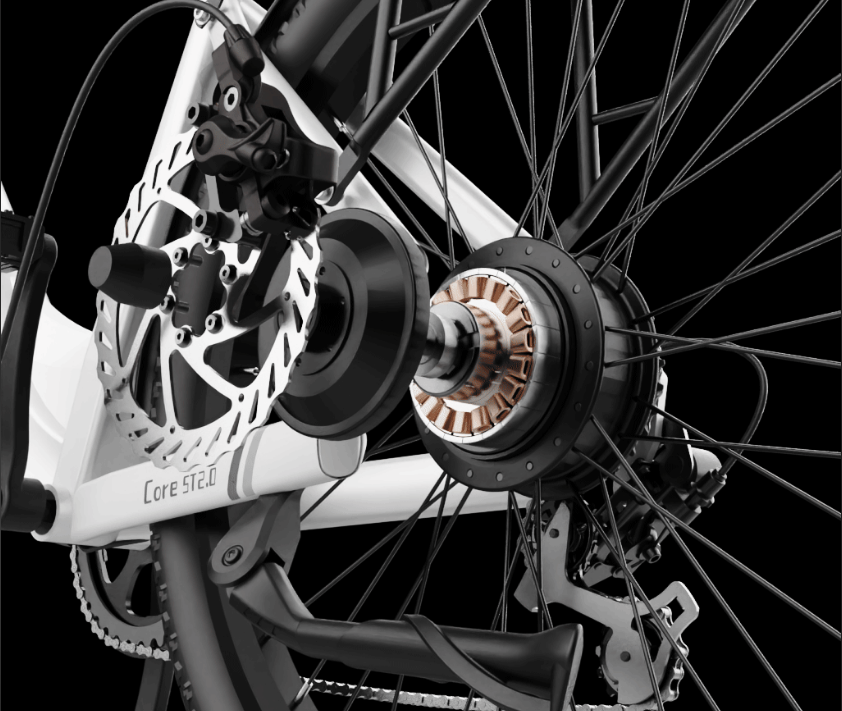
Many electric bike owners ask the same question: how can I make my eBike faster? Start with the simple things: correct tire pressure, a clean drivetrain, sensible riding habits, and a bike that is working as it should. These changes may help you recover lost performance or maintain speed with less effort. They do not raise the speed at which your motor stops helping.

Before buying parts or changing settings, check your exact model, riding mode, and local rules. The best place to start is often a maintenance check, not a bigger motor.
What Do You Mean by Faster?
Your eBike's assistance cutoff is the speed at which its motor stops providing help. That is different from your actual road speed, which can also come from pedaling or riding downhill.
There are three different goals to think about:
- Get back to normal performance. Your bike used to feel stronger, but now it struggles on a familiar ride. Start with the checks below.
- Use a manufacturer-supported riding mode. Check whether that mode is approved for your exact bike and allowed where you ride. A setting on the display is not proof of either.
- Pedal beyond the assistance cutoff. Suitable gearing may help you keep pedaling comfortably, but the motor's limit stays the same. Road speed limits and riding conditions still apply.
None of these requires a tuning chip, a false wheel-size setting, or bypassing a safety sensor.
Know Your Bike and Local eBike Laws First
Start with your model name, version, and Actbest user manual. Check the stated riding modes and whether a speed figure refers to throttle use or pedal assist. Do not borrow another model's display settings just because the screens look alike.
A Common U.S. Class System: California's Example
As a state-specific example, California law describes three eBike classes:
- Class 1: Pedal assistance, with motor help ending at 20 mph.
- Class 2: Throttle-capable operation, with motor help ending at 20 mph.
- Class 3: Pedal assistance, with motor help ending at 28 mph.
These categories have other requirements too. The speeds above are assistance limits, not a promise that every bike will reach them on every hill or permission to ride that fast on every path. The three-class system is not a nationwide rule.
For example, New Jersey's MVC lists eBike rules effective in July 2026, including registration and licensing requirements for resident riders. Rental and visitor rules need separate attention. The federal low-speed bicycle product definition is a separate issue from state and local riding permission.
How to check: Look up your state motor-vehicle agency's current rules, then check the road or trail authority for your route. Confirm equipment, rider-age, helmet, licensing, and access requirements where applicable. These examples were checked on September 22, 2026; check again before changing your bike's configuration.
Why Is Your eBike Slower Than Expected?
First ask whether something has changed. Comparing a calm, flat ride with a windy uphill ride will not tell you much about the bike.
| What you notice | What to check first | What to do next |
|---|---|---|
| It has never reached the speed you expected | Exact model, advertised riding mode, manual, and whether the display uses mph or km/h | Ask support to confirm the expected configuration before changing settings |
| It recently feels slower on the same route | Tire pressure, extra cargo, wind, hills, battery charge, and operating temperature | Address routine maintenance within the manual's instructions |
| Throttle speed differs from pedal-assist speed | The model's documented throttle and pedal-assist limits | Treat them as separate modes, not automatically as a fault |
| The bike is harder to pedal, or you hear scraping | Tire condition, visible rubbing, and drivetrain condition | Have a bike shop check persistent drag or brake problems |
| Power cuts out, an error appears, or acceleration becomes unpredictable | The symptoms you have already observed | Stop riding and contact support; do not bypass sensors or keep testing at speed |
Battery warning signs come first. If a battery becomes unusually hot, changes shape, leaks, smells unusual, makes odd noises, or smokes, stop using it. Do not charge it or handle it to collect details. Move away and seek emergency help; call 911 in the U.S. for a suspected battery emergency. See FDNY's battery safety guidance.
If the problem followed water exposure, use our eBike rain-protection and after-ride care guide before attempting to charge or restart the bike.
6 Practical Ways to Improve eBike Efficiency
These checks can reduce wasted effort or help restore normal operation. There is no universal mph gain, and they do not change the assistance cutoff.
1. Get Your Tires and Tire Pressure Right
Underinflated tires can make a ride feel sluggish. But pumping every tire to the maximum number on its sidewall is not the answer.

How to do it: Use a pump with a gauge and follow the bike, tire, and rim manufacturers' compatible pressure guidance. Account for your weight, cargo, tire size, and riding surface. If the limits conflict or are unclear, ask a bike shop.
Schwalbe's tire-pressure guidance explains why load, tire size, grip, and comfort matter. The right pressure is a suitable setting within the permitted limits, not simply the highest possible number.
If you mostly ride on pavement, a compatible road or commuter tread may be worth considering. Check wheel and tire size, rim compatibility, load rating, and frame clearance first. Narrower is not automatically better. Choose a tire for the ride, not a promised speed increase.
2. Make Your Riding Position Comfortable and Efficient
Wind can make the same route feel very different from one day to the next. A comfortable riding position and clothing that does not flap excessively are simple places to start.
How to do it: Keep your shoulders relaxed and your hands where you can steer and brake confidently. Choose clothing that stays clear of moving parts. Do not lower the handlebars just to chase speed if it limits your view, comfort, or control.
For a bigger fit change, ask a bike shop to check the setup, including cable length and component compatibility.
3. Keep Your Drivetrain Clean and Use Your Gears
A gritty chain and poor shifting make pedaling harder than it needs to be. Clean and lubricate the chain as directed by your manual and the lubricant maker, then wipe away excess lubricant. Keep it off brake discs and pads.

How to do it: Use an easier gear before a climb and choose a gear that lets you pedal smoothly. Avoid forcing a shift while pushing hard on the pedals.
If you run out of comfortable pedaling gears, talk to a bike shop about compatibility. A gearing change affects your pedaling; on a mid-drive system it also affects how motor power reaches the wheel. It does not change the electronic assistance cutoff. A rear-hub motor does not gain extra output just because you fit a different cassette.
4. Carry What You Need, Without Unnecessary Weight
Extra cargo adds to the load you move, especially when starting or climbing. Before spending money on lightweight parts, check what you carry every day.
What to do: Remove items you do not need for that trip and secure the rest properly. Stay within the bike's and rack's stated load limits.
Keep essential safety equipment, required lights and reflectors, and a suitable lock. Saving a little weight is not a good reason to compromise safety or replace structural parts without checking compatibility.
5. Follow Your Battery's Care Instructions
Battery charge, temperature, and condition can affect available assistance. A lower charge reading does not automatically mean the battery needs replacing, and a slow ride is not a reason to change its voltage.

How to do it: Check the model's operating and charging guidance. Use the specified compatible battery and charger, and follow its storage instructions. Storage advice is not the same as your everyday charging routine.
If performance has changed suddenly, report the conditions to support before buying a replacement. Do not open the battery or use an adapter to make an unapproved pack fit. FDNY's battery guidance also stresses using the manufacturer's compatible battery and charging equipment.
6. Check for Brake Rub and Other Mechanical Drag
A rubbing brake or damaged wheel can make the bike harder to pedal. This is a maintenance problem, not something to solve by adding motor power.
How to do it: With the system switched off, check for obvious damage and listen for unusual scraping while walking the bike. If it is difficult to move, the brakes feel wrong, or rubbing persists, have a qualified bike shop inspect it.
Do not loosen brake parts, disconnect brake sensors, or ride with reduced braking just to make the wheels turn more freely.
Before Upgrading Tires, Gearing, or Electrical Parts
An upgrade should solve a specific problem. Better comfort on pavement, easier pedaling uphill, and a higher motor-assisted speed are different goals.
Before ordering anything, ask:
- Will it fit? Confirm the exact model, version, part specification, clearance, and load requirements.
- Is the change approved? Ask Actbest support about electrical parts, display settings, or changes not covered by your manual. A matching plug is not enough.
- Can I use it where I ride? A manufacturer-supported configuration still needs to meet the applicable local rules.
- What are the tradeoffs? Consider handling, braking, range, maintenance cost, and warranty terms, not just a claimed speed increase.
Read the Actbest warranty policy before making changes. Damage caused by unauthorized modifications may be excluded. That is different from saying every third-party part automatically cancels every warranty right. The FTC's warranty guidance explains the distinction between requiring branded parts and excluding damage a replacement part causes.
Avoid tuning chips, altered speed-sensor readings, and unsupported motor or controller changes. They can change the bike's classification and operating demands. The fact that a modification is possible does not establish its legality, safety, or warranty coverage.
Still Feels Slow? Send Support a Useful Record
Start by matching the paperwork to your bike. Here is one example from the Actbest manual directory, checked on September 22, 2026:
| Model check | What to use |
|---|---|
| Core ST 2.0 | The directory links to manual AT49_20250514.pdf |
| Core ST 2.0 Plus | Use its separate directory entry; do not substitute the Core ST 2.0 document |
| Unsure about the version or a riding mode | Give support your full model name, country of purchase, and manual link before applying settings |
Similar names do not make settings interchangeable. Ask support to confirm the expected throttle and pedal-assist behavior, plus any proposed setting or part change, for your exact bike.
When you contact Actbest support, include:
- Bike: Exact model/version, country and date of purchase, and the manual link or filename.
- Concern: Always slower than expected, recently slower, intermittent power loss, or a display mismatch.
- Expected versus observed speed: The speed you expected and where you saw it, plus any speed already observed during normal riding. Include mph or km/h and the riding mode; leave unknowns blank.
- Riding conditions: Throttle or pedal assist, assist level, battery reading, hills, wind, temperature, and approximate rider/cargo load.
- What changed: Recent maintenance, a new part, a display-setting change, a fall, or water exposure.
- What you already checked: Tire pressure, visible rubbing, chain condition, and any error message already seen.
Use observations from normal riding. Do not make a high-speed test run or ride again to reproduce a fault. Share serial numbers and purchase information privately with support, not in public comments.
Frequently Asked Questions
Q1: Why does my eBike only go 20 mph on the throttle?
That may be the intended limit for its throttle mode. Check the exact model and manual; a pedal-assist speed figure does not necessarily apply to the throttle. If performance has changed or the bike shows an error, contact support rather than altering hidden settings.
Q2: Will a bigger battery make my eBike faster?
Not simply because it has more capacity. At the same voltage, a higher amp-hour rating means more stored energy, not a higher programmed assistance limit. Compatibility still matters. A higher-voltage battery is a different electrical change, not a safe shortcut to more speed.
Q3: Can I legally install a more powerful motor?
There is no single U.S. answer for every bike and riding location. The new configuration may change its legal classification and requirements. Check current state and local rules, and get model-specific manufacturer guidance before buying parts. A motor's advertised wattage alone does not settle the question.
Q4: How much faster will new tires make my eBike?
There is no reliable universal number. Results depend on the tires, pressure, load, surface, and the bike's existing condition. Choose tires for compatible fit and your actual riding needs. They may change rolling feel and effort, but they do not raise the motor's assistance cutoff.
Q5: Can I pedal faster than the motor's assistance limit?
An assistance cutoff is not a mechanical brake on the bicycle. You may be able to pedal faster after motor help ends, but local speed limits, access rules, and safe riding conditions still apply. That is different from modifying the motor to keep assisting above its permitted limit.
Get More from the Bike You Already Have
Start with the basics, check one issue at a time, and ask for help when a fault or compatibility question appears. A well-maintained eBike can be easier and more enjoyable to ride without turning a simple performance concern into an unnecessary electrical upgrade.
Share:
Electric Bike Waterproofing: Practical Tips for Rainy Rides
How to Charge an E-Bike Battery Safely