
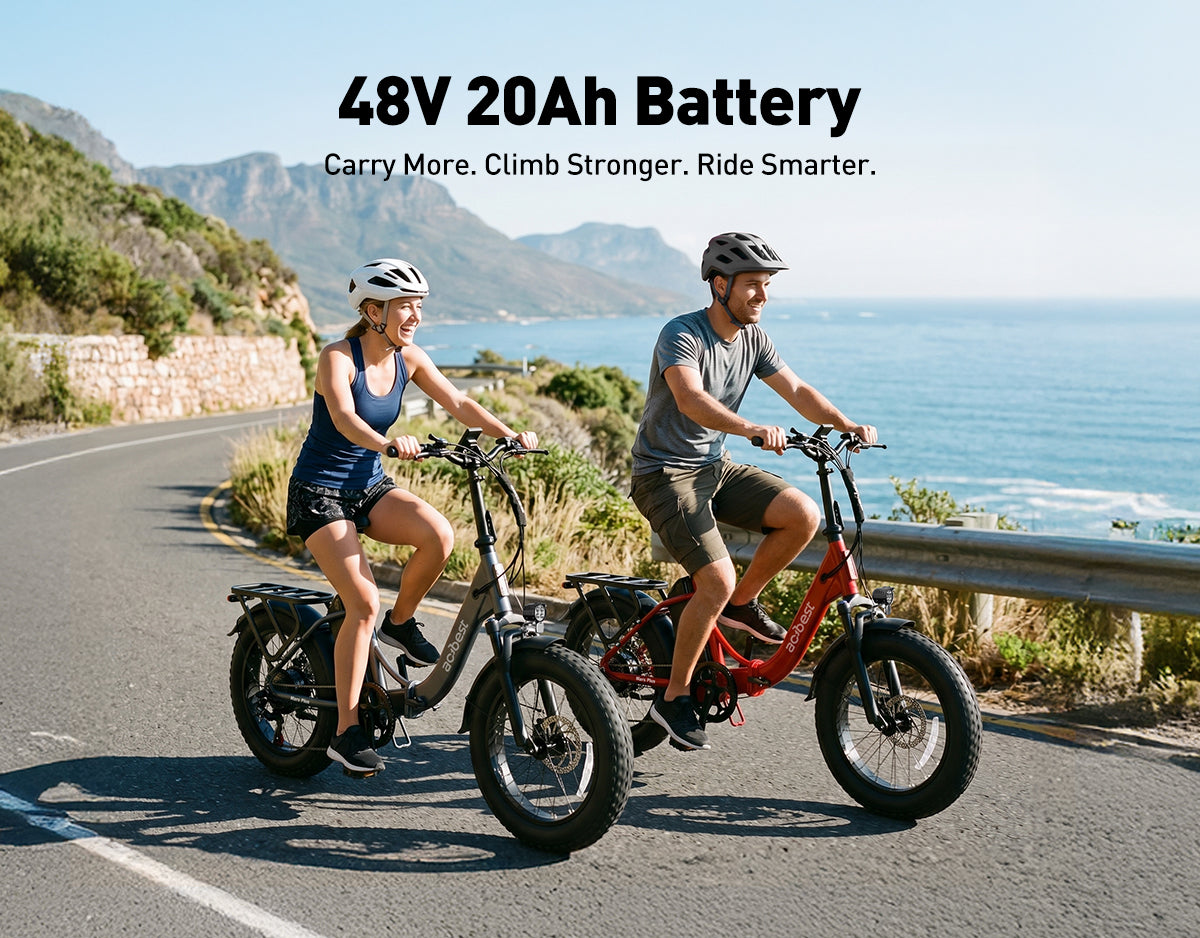
An electric bike doesn’t just need to handle your average route without any issues. It needs to be able to handle the rider themselves. If you’re a heavier rider, that can be difficult, as every e-bike comes with a specific payload limit. Thankfully, there are plenty of specialist electric bikes for heavier riders.
It’s important not to just think about body weight. Even if you weigh less than the payload limit, add in clothing, locks, bags, accessories, and any other cargo, and the overall weight can soon tick up.
The right heavy-duty electric bike isn’t necessarily the one with the largest payload or motor figure, however. You’ll also want to consider the bike’s rider height range, support, weight, braking, and suspension system. Never exceed the manufacturer’s verified payload or component limits.
Best Electric Bikes for Heavy Riders: Quick Picks
At-a-Glance Comparison Table
ActBest offers a range of electric bikes for heavier riders. From folding models to three-wheelers, you’ll find a model suited to both your body and your daily riding.
|
Model |
Total payload |
Rider height |
Frame access |
Motor |
Brakes |
Tires |
Weight |
Claimed range |
Price |
Best use |
|
440 lb |
5'1"–6'2" |
Folding step-through |
Hub, 1,800W peak |
Disc |
20 × 4.0 in |
79.4 lb |
Up to 85 miles |
$699 |
Folding utility and cargo |
|
|
400 lb* |
5'0"–6'2" |
Folding step-through |
Hub, 1,200W peak |
Disc |
20 × 3.0 in |
69.4 lb |
Up to 65 miles |
$549 |
Folding on a lower budget |
|
|
400 lb |
5'1"–6'3" |
Folding low-step trike |
Hub, 1,200W peak |
Disc |
18 × 3.0 in |
101.4 lb |
Up to 55 miles |
$649 |
Stability and errands |
|
|
Up to 350 lb* |
5'3"–6'2" |
Step-through |
Hub, 1,200W peak |
Disc |
26 × 2.1 in |
62.4 lb |
Up to 55 miles |
$599 |
Daily commuting |
|
|
500 lb |
5'7"–6'5" |
Low-step |
Hub, 1,800W peak |
Hydraulic |
26 × 4.0 in |
84.2 lb |
Up to 90 miles |
$899 |
Taller riders and mixed terrain |
Quick Recommendations by Rider Need
- Highest verified payload: The Blazer ST Ultra supports up to 500 lb, providing more room for heavier riders and cargo.
- Easiest mounting: The Mars Plus ST has a low 15.35-inch step-through height.
- Best folding option: The Mars Plus ST folds to 42.52 × 20.87 × 32.28 inches, although its 79.4 lb weight may make lifting difficult.
- Best stability: The Triker uses three wheels for greater balance during slower rides.
- Best daily commuter: The Core ST 2.0 combines step-through access, a 62.4 lb frame, and up to 55 miles of manufacturer-rated range.
What Makes an E-Bike Suitable for a Heavy Rider?
Total Payload Is Not the Same as Rider Weight
Total payload is the entire weight you add to the e-bike. It includes the rider’s weight, but it also includes everything else: bags, clothing, locks, accessories, and any other cargo.
Use this equation:
Rider + clothing + lock + bags + accessories + cargo = total payload
For example, if you weigh around 300 lb and carry 25 lb of clothing, equipment, and cargo, the total payload is 325 lb.
The total payload should not automatically be treated as the maximum permitted rider weight, nor should you load the e-bike right to this limit. Doing so can impair the bike’s function and range.
Frame, Wheels, Brakes, and Contact Points
Payload is only one factor.
A truly heavy-duty electric bike must also be built to handle a heavier person on roads, trails, hills, and other difficult terrain. That covers the frame, seatpost, and strong rims capable of withstanding the extra strain.
Less often thought about are the brakes and suspension. Adding a heavier payload increases the momentum of the e-bike at high speeds. The bike must be able to stop predictably and absorb bumps over uneven ground without damaging the frame or wheels.
There’s no single component that proves the entire bike is suitable. Wide tires, a powerful motor, or a reinforced-looking frame cannot compensate for an inadequate total-payload rating. Instead, it’s the combination of all these factors that makes a difference.
Why Added Weight Changes Performance
Pushing something heavier is harder than pushing something lighter. This much is obvious. For an e-bike, the extra weight places greater strain on the motor, requiring more energy from the battery. That’s especially true during acceleration and hill climbing.
If the motor and battery are constantly under this demand, the expected range will fall. Most advertised ranges assume a lighter rider unless otherwise stated.
The other factor is braking. Braking distances are likely to increase for a heavier rider. It’s hard to predict a specific stopping distance, as it depends on the terrain and speed. It’s sensible to test this out before you take the bike on the roads. Brakes will also experience greater wear, alongside the tires, spokes, and suspension.
How to Choose an Electric Bike for a Larger Rider
Leave a Real Payload Safety Buffer
The total payload is not a goal to hit. It’s the upper limit the e-bike has been rated to carry. To get the most from your e-bike, it’s best to leave a safe payload buffer.
Calculate the expected load, including anything regularly carried, and choose a bike with enough verified capacity left for realistic changes in clothing, luggage, and cargo.
Here’s an example:
- Rider: 300 lb
- Clothing and helmet: 8 lb
- Lock and bag: 12 lb
- Groceries or equipment: 20 lb
- Total payload: 340 lb
An e-bike rated for 350 lb would leave only 10 lb of unused capacity. A higher-payload e-bike would provide greater flexibility, just in case you need to carry more cargo one day.
Check Height, Inseam, Reach, and Mounting Access
Heavier riders are sometimes taller as well. That creates two sets of requirements: the bike must withstand the weight and be the right size to ride.
Most e-bikes have a listed rider height range. Even if the seat and handlebars are adjustable, they will only extend to a certain point. You’ll want to ask some basic questions:
- Does the rider fall within the published height range?
- Can the saddle be adjusted to the correct pedaling height?
- Can the rider comfortably reach the handlebars and controls?
- Can they place a foot down confidently when stopping?
- Does the riding position remain comfortable over longer distances?
You don’t have to go for the standard frame type. Choosing the right e-bike for your body type might mean going for something non-standard.
Compare Torque and Power Without Chasing Peak Watts
Power isn’t always the deciding factor for an e-bike. However, for heavier riders, it’s something you definitely want to consider. The question is how peak and rated power differ, and where torque fits in:
- Rated power: Output the system is designed to provide continuously under specified conditions.
- Peak power: Higher output available for shorter periods.
- Motor torque: Rotational force that influences initial pull and hill-climbing behavior.
Brands want to give the best impression of their products, often listing the peak power first. Peak power is important. It can give you the extra power needed when accelerating or going uphill — the main pressure points for heavier riders.
That said, torque can also matter a lot. You want a bike that can exert strong rotational force to move the added weight of your body. Balance these figures as you settle on the right electric bike for a heavier rider.
Prioritize Predictable Braking
Braking becomes increasingly important as total system weight rises. The biggest choice is between mechanical and hydraulic brakes.
Hydraulic brakes are generally more expensive, but usually require less hand pressure and offer smoother modulation. That doesn’t automatically mean a shorter stopping distance, but it does mean you don’t have to slam on the brakes every time you go downhill.
If you’ve got a new heavy-duty e-bike, it’s best to give it a test run before heading out. See how the brakes feel, how responsive they are, and what your typical stopping distance is. It’s also worth performing the same test in wet conditions.
Inspect Tires, Rims, and Spokes
All of the e-bike’s weight and stress go through the wheels: the tires, rims, and spokes. They’re the load-bearing components. You should perform a quick inspection:
1. Tires: Check tire width, load suitability, condition, and approved pressure range.
2. Rims: Look for damage, deformation, or other signs of excessive stress.
3. Spokes: Check for looseness, damage, or changes in wheel alignment.
Many heavier riders opt for wider (or fat) tires. The logic is simple. More rubber helps spread the weight and reduce pressure on the tire as a whole. Tire width alone does not establish wheel strength, though it can improve comfort and traction.
Choose Suspension and Contact Points for Comfort
Comfort isn’t just about fitting the biggest, softest saddle you can find. A wider saddle can help, but only if it supports you in the right places.
Adjust the suspension for your weight and the terrain, then check that the seatpost stays within its marked limits. The grips should feel natural in your hands, while the handlebar height and reach should let you sit comfortably without hunching or stretching. Good support, posture, and pressure distribution matter just as much as cushioning.
Which ActBest Models Fit Different Heavy-Rider Needs?
Transparent Inclusion Method
Below, we’ve compiled the best electric bikes for heavy riders. Only ActBest models were used, as these are the bikes we know best. We looked at the payload, range, and motor figures, alongside any available test data to determine which type of rider would benefit from a particular e-bike. Price was also a factor.
No model was selected solely because it has a high-power motor. Rather, it was a combination of factors that earned it a place on the list.
Verified ActBest Comparison Matrix
|
Model |
Payload |
Bike weight |
Rider height |
Frame |
Folded dimensions |
Motor output |
Battery |
Brakes |
Tires |
Warranty |
Price |
|
440 lb |
79.4 lb |
5'1"–6'2" |
Folding step-through |
42.52 × 20.87 × 32.28 in |
Rated not listed; 1,800W peak |
48V 20Ah |
Disc |
20 × 4.0 in |
$699 |
||
|
400 lb* |
69.4 lb |
5'0"–6'2" |
Folding step-through |
Not published |
Rated not listed; 1,200W peak |
48V 13.5Ah |
Disc |
20 × 3.0 in |
$549 |
||
|
400 lb |
101.4 lb |
5'1"–6'3" |
Folding low-step trike |
31.5 in folded length; full dimensions not published |
Rated not listed; 1,200W peak |
48V 10.4Ah |
Disc |
18 × 3.0 in |
$649 |
||
|
Up to 350 lb* |
62.4 lb |
5'3"–6'2" |
Step-through |
Not foldable |
Rated not listed; 1,200W peak |
48V 10.4Ah |
Disc |
26 × 2.1 in |
$599 |
||
|
500 lb |
84.2 lb |
5'7"–6'5" |
Low-step |
Not foldable |
Rated not listed; 1,800W peak |
48V 20Ah |
Hydraulic |
26 × 4.0 in |
$899 |
ActBest Mars Plus ST
Want a folding e-bike without giving up most of the carrying capacity? The ActBest Mars Plus ST is probably the best fit. It supports up to 440 lb, while the low step-through frame makes it easier to get on and off.
 The wide tires, front suspension, and extended rack also suit everyday errands and rougher streets. The only catch is the weight. Although it folds for storage, it still weighs 79.4 lb.
ActBest Mars

If you don’t need the extra capacity of the Mars Plus ST, the ActBest Mars is a lighter, cheaper alternative. Its specifications list a 400 lb payload, while the step-through frame fits riders from 5'0" to 6'2". At 69.4 lb, it’s also around 10 lb lighter than the Plus. You’ll have to accept a smaller battery, narrower tires, and lower peak motor output, but it should be plenty for everyday rides.
ActBest Triker
 Some riders simply feel more comfortable with three wheels. That’s where the ActBest Triker comes in. It supports up to 400 lb, including anything carried on its 120 lb rear rack. The low-step frame and wide seat also make it a practical choice for errands and relaxed rides. Just remember that a trike corners differently and needs more storage space. At 101.4 lb, it won’t be easy to lift either.
ActBest Core ST 2.0
 Not everyone needs fat tires, three wheels, or a folding frame. The ActBest Core ST 2.0 is a straightforward commuter with step-through access and up to 55 miles of manufacturer-rated range. It’s also the lightest bike here at 62.4 lb.
The maximum payload is listed as 350 lb, so it may suit a 300 lb rider, provided their clothing, lock, bags, and cargo keep the total below that limit.
ActBest Blazer ST Ultra
 What if carrying capacity is your main concern? The ActBest Blazer ST Ultra supports up to 500 lb and fits riders from 5'7" to 6'5". It also comes with hydraulic brakes, full suspension, and 26 × 4-inch tires, making it the strongest mixed-terrain option in the group.
The main drawback is its size. It weighs 84.2 lb, doesn’t fold, and is unlikely to suit anyone much shorter than the recommended height range.
Match the Model to the Rider, Cargo, and Route
|
Main need |
What matters most |
Best match |
Main trade-off |
|
Daily commuting |
Easy mounting, manageable weight, and practical range |
Core ST 2.0 |
The lowest payload in the group |
|
Folding and storage |
Folded size without excessive lifting weight |
Mars |
Folded dimensions are not published |
|
Utility and cargo |
More payload allowance and folding storage |
Mars Plus ST |
It still weighs nearly 80 lb |
|
Three-wheel stability |
Low-speed confidence and cargo space |
Triker |
At 101.4 lb, it is difficult to lift |
|
Hills and mixed terrain |
Payload, torque, hydraulic brakes, and fat tires |
Blazer ST Ultra |
Larger, heavier, and the most expensive |
Rider Weight and Cargo Allowance Worksheet
Calculate Total System Load
To start, you’re going to need to know how much your entire payload weighs. As we’ve established, that includes everything you’re adding to the bike, including your own weight. It’s a complicated calculation. Just add everything together.
Don’t base it only on your average day. For instance, if you have to pack something extra every two weeks, it’s worth factoring that in. Once you’ve got the total payload, you can calculate the payload allowance.
Payload allowance = verified e-bike weight capacity − total payload
The payload allowance is the remaining capacity available after everything already carried has been included. It’s also worth checking whether the bike rack has a limit — it can be lower than the bike’s total capacity. Try not to assume too many of the values. Together, those assumptions can leave you significantly off the actual payload.
Three Buyer Scenarios
So, how does this work in practice? Below, we’ve listed a few potential options to give you an idea of what your total payload might look like.
|
Buyer |
Rider |
Clothing and helmet |
Lock |
Bags and accessories |
Cargo |
Total payload |
|
Larger recreational rider |
250 lb |
10 lb |
5 lb |
10 lb |
20 lb |
295 lb |
|
E-bike for a 300 lb rider |
300 lb |
10 lb |
5 lb |
10 lb |
25 lb |
350 lb |
|
E-bike for a 400 lb rider |
400 lb |
10 lb |
5 lb |
10 lb |
25 lb |
450 lb |
When the Margin Is Too Small
What happens if your complete load reaches or exceeds the stated maximum? The simple answer is don’t use that model. You’ll most likely need to invest in an e-bike with a higher payload capacity. The other option is to slim down what you bring on the bike. That’s normally much more inconvenient than opting for a higher-capacity model.
Don’t be tempted to just ignore the maximum capacity. The bike isn’t designed to carry more than the limit, and doing so can damage the motor or the bike itself.
How Extra Load Changes Range, Handling, and Maintenance
Publish a Reproducible Loaded-Test Method
The manufacturer-rated range is useful, but it doesn’t tell you exactly how far a particular rider will travel. So, what would a fair test look like? You’d load the bike with your normal clothing, equipment, and cargo, then record the following:
|
Test variable |
What to record |
|
Total load |
Rider, equipment, and cargo |
|
Route |
Distance, surface, and elevation |
|
Conditions |
Temperature, weather, and wind |
|
Tires |
Condition and pressure |
|
Assistance |
Assist level and throttle use |
|
Speed |
Average and maximum |
|
Battery |
Starting and finishing charge |
Repeat the same route under similar conditions to make the results comparable. Until ActBest publishes this kind of loaded testing, treat its quoted ranges as manufacturer-rated estimates rather than guaranteed real-world figures.
Range, Hills, and Starts
During short trips or on flat surfaces, your e-bike might function reasonably well. The motor can get you moving, especially with some pedal power, and the bike performs as expected. However, it’s on longer journeys or hills that the motor may start to struggle.
Extra load increases battery consumption, reducing the achievable range. That’s especially true if you use higher assist levels, where the motor has to push a heavier weight.
On hills, the motor is also put to the test. The greater the weight, the harder the motor must work to counteract gravity. Often, people increase the assist level to compensate, but this will further drain the battery.
It’s impossible to say exactly how much less range you can expect. But it’s best to opt for an e-bike with significantly more range than you may need.
Braking and Low-Speed Handling
Stopping distance is affected by speed and mass. The heavier the payload, the longer it takes to bring the bike to a standstill. That’s why some people opt for hydraulic brakes, as they give them more control without having to pull the levers as hard.
Handling is also impacted. More weight increases momentum, making it harder to corner. Some people may prefer a trike as they find that low-speed balance more reassuring. The downside is that the added width makes cornering even more difficult.
Heavy-Load Maintenance Checklist
So, what are you looking for with a heavy-load electric bike? And what should you check before you head out on the road? Here’s a quick checklist:
- Check tire pressure and inspect the tread.
- Look for loose or damaged spokes.
- Monitor brake pad and rotor condition.
- Check important fasteners.
- Inspect suspension components and adjust them appropriately.
- Confirm that the saddle and seatpost remain secure.
- Inspect racks, baskets, and attachment points.
- Investigate new noises, wheel movement, or changes in handling.
Performing a quick visual inspection every time you ride can help you stay on top of heavy-duty e-bike maintenance. It doesn’t take more than a few minutes and can highlight potential problems.
Best Type of E-Bike by Use Case
Daily Commuting
Prioritize a comfortable bike with predictable brakes and a practical range. Depending on whether it’s a short or longer daily commute, the actual range and comfort requirements can change significantly. Other factors include lights, fenders, carrying options, and easy mounting. Due to the stop-start nature of most commutes, many people prefer a step-through e-bike.
Cargo and Errands
You’ll want an e-bike with a much higher total payload if you’re carrying extra cargo. Look for separate rack capacity and stable cargo placement. As mentioned, the higher payload can make braking more difficult. That makes it something worth focusing on.
Folding and Apartment Storage
As a heavier rider, it can be difficult to balance convenience and payload capacity. Thankfully, folding e-bikes let you choose something with reasonable power and range that fits neatly under your stairs or in a spare cupboard.
Just remember, folding reduces physical size but doesn’t necessarily make the bike any lighter. You may find it a struggle to carry upstairs or onto public transport if you’re relying on it for your daily commute.
Stability and Three-Wheel Riding
Not everyone feels comfortable on two thin wheels. Some riders want stability above all. It’s worth considering a fat-tire e-bike. The thicker tires can provide extra cushioning and stability, even if they do make the bike more cumbersome overall.
Trikes are another option. They suit riders prioritizing low-speed balance, but they corner differently and occupy more space.
Either way, a more stable e-bike will often be a heavier e-bike.
Hills and Mixed Terrain
If your commute regularly features hills or you like taking the e-bike out on the trail, motor power, torque, and battery capacity become more important. Heavier riders, in particular, need to factor in how the added weight will impact the motor. Always check the rated and peak power. You’ll only get the latter for short bursts.
In addition, a bigger battery can help compensate for the energy spent climbing hills or heading over rugged terrain. The trade-offs may include greater bike weight, more maintenance, and more difficult transport.
Common Heavy-Rider Buying Mistakes
Buying an e-bike for a heavier rider adds a few extra complications. As an e-bike is a significant investment, the last thing you want is to discover it’s not suitable for your body or route after you’ve bought it.
Here are the most common mistakes:
Treating payload as rider weight. If an e-bike supports 400 lb, that doesn’t necessarily mean it suits a 400 lb rider. Clothing, helmet, lock, bags, accessories, and cargo all count towards the total.
Chasing the biggest motor. A huge peak-watt figure looks impressive, but it tells you little about fit, braking, wheel strength, comfort, or how the motor performs over a full ride.
Assuming capacity means comfort. You can be safely under the weight limit and still find the bike awkward. Check the reach, seat adjustment, standover height, and how easily you can get on and off.
Forgetting how heavy the bike is. Folding and step-through models can still weigh 70 lb or more. Think about stairs, storage, vehicle racks, and whether you can lift it when needed.
Overloading the rack. Racks often have their own lower limit. A high bike payload also doesn’t mean the rack or frame is approved for carrying a passenger.
Taking the advertised range literally. Rider weight, cargo, hills, speed, assist level, temperature, and tire pressure can all reduce it.
Frequently Asked Questions
What is the best e-bike for an overweight person?
There’s no single best model for every person. The best e-bike will have a payload that can accommodate the person’s weight as well as any cargo. Beyond that, it should have features relevant to the person’s riding style, route, and usage.
Can a 300 lb person ride an electric bike?
Yes, if the e-bike is built to handle more than 300 lb once clothing and cargo are added. The listed payload is the total payload capacity. That includes the rider, their clothing, accessories, equipment, and any cargo. Always calculate the total payload before assuming an electric bike is up to the task.
What electric bike can support a 400 lb rider?
From the ActBest range, the Mars Plus ST and Blazer ST Ultra have payload capacities above 400 lb. The Blazer ST Ultra, in particular, can handle up to 500 lb.
Does rider weight reduce e-bike range?
Yes. Heavier loads require more energy during starts, climbs, and acceleration. Stated ranges are usually tested or calculated based on a lighter rider. The actual range you can expect in real-world conditions is typically less, but also depends on speed, assist level, weather, tire pressure, and battery condition.
Is a fat-tire e-bike automatically better for a heavy rider?
Not necessarily. Fat tires can improve traction, cushioning, and confidence on some surfaces. However, these tires add further weight to the bike and increase rolling resistance, further reducing the e-bike’s overall range. It’s a trade-off.
Are step-through frames suitable for heavier riders?
A step-through frame lacks the top bar found on most bikes. That makes the bike easier to mount and can be useful for riders with restricted hip or knee movement. The frame style alone does not establish payload capacity, stiffness, fit, or comfort.
How much payload buffer should I leave?
There’s no universal percentage that’s best. The complete payload must remain below the verified maximum, with enough practical allowance for clothing, locks, bags, and expected cargo.
What parts wear faster under a heavier load?
Several components may wear faster under a heavier load. These include the tires, brake pads, spokes, rims, suspension components, saddles, and seatposts.
However, wear also depends on route, maintenance, tire pressure, and riding style. Perform regular maintenance to ensure your bike is in optimal condition.
Final Verdict
Which electric bike should you choose? Well, the biggest motor or widest tires don’t automatically make a bike the best option for a heavier rider.
Start with the boring bit: add up your weight, clothing, lock, bags, accessories, and anything else you plan to carry. Then check whether the bike actually fits you.
Once those basics are covered, you can compare the motor, brakes, suspension, range, weight, and storage. ActBest has models for everything from commuting to mixed-terrain riding. The right one is simply the bike that fits your body, your load, and the way you intend to ride it.
Share:
How to Charge an E-Bike Battery Safely
How Much Does an E-Bike Really Cost to Own?