
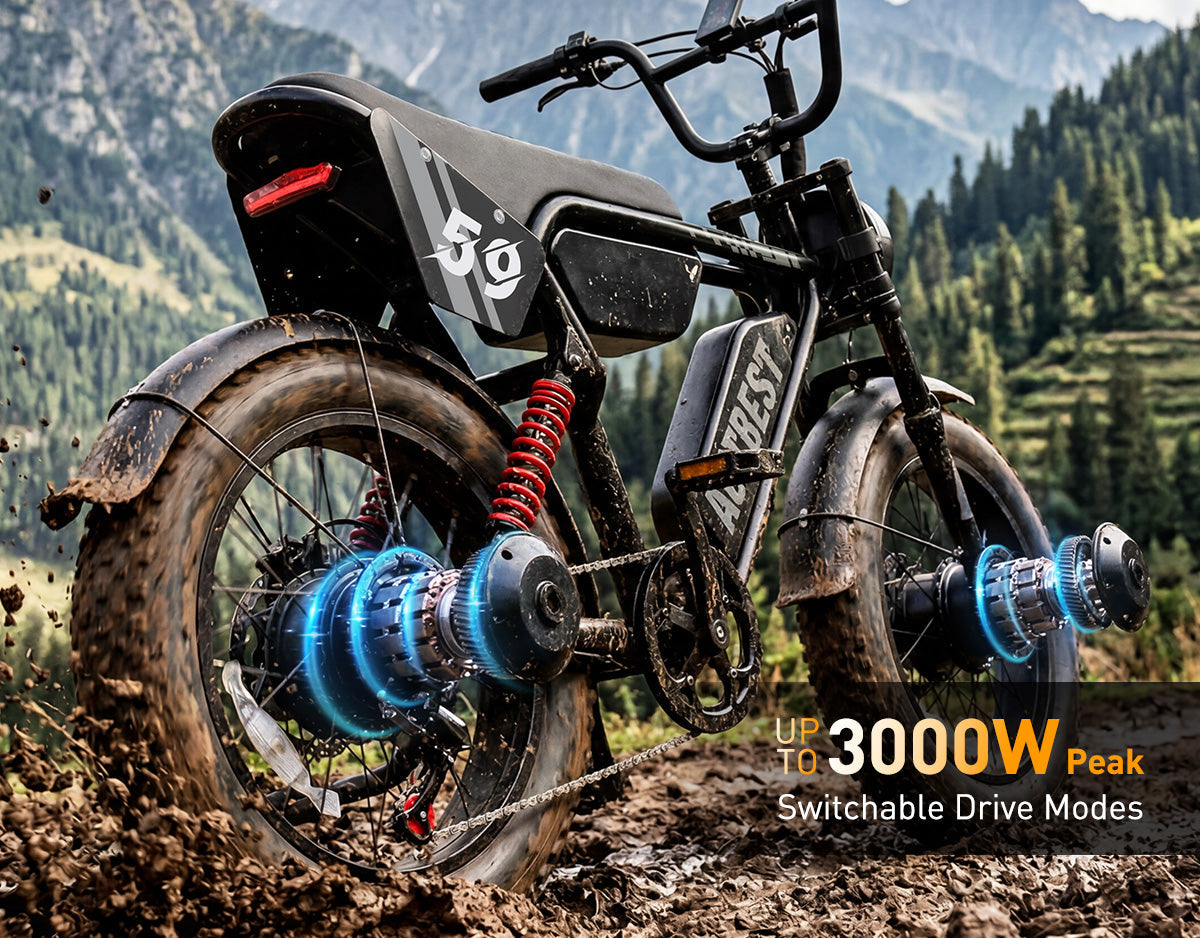
When you start shopping for a moped-style ebike, you'll see a lot of numbers to get your head around. One of the most important numbers is the bike's peak wattage. You'll come across numbers like 1500W, 2000W, and even 3000W. These numbers look simple, but they only tell part of the story. A 2000W peak motor and a 2000W nominal motor are not the same thing, and mixing them up can lead you to buying the wrong bike, or to the wrong assumptions about what's legal to ride on the road.
This guide breaks down what peak watts and nominal watts really mean, why torque and voltage matter just as much, and how to read a spec sheet the way someone who knows what they're looking at would.
Why Wattage Confuses Shoppers
Moped-style ebikes are marketed on power, so it makes sense that watts get top billing in the listing. A big number next to the motor makes an ebike sound more capable, and shoppers reasonably assume that more watts mean more speed, better hill-climbing ability, and greater range. Sometimes that's true. Sometimes it isn't.
The number you see advertised is almost always peak watts, which is not the same as the motor's continuous output. Torque, battery voltage, controller current, and the bike's gearing all affect how a motor performs in practice, regardless of the watts you see on the spec sheet. Two ebikes with "2000W" can feel completely different to ride.
Peak Watts Explained
Peak watts is the maximum power a motor can put out for a short burst, usually a few seconds, during acceleration, a hill start, or a heavy load. It's not a number the motor can sustain, and it isn't meant to be.
This is where the confusion starts. A motor pushing peak watts is drawing more current than it can handle for long periods, and the controller and battery only allow that for a short window before things start to heat up. It is common for brands to advertise peak watts because it's the biggest, most impressive number, even though it only applies to a fraction of your ride.
Peak power matters most in specific moments, such as pulling away from a stop sign, powering up a short, steep ramp, climbing a brief hill, or pushing through loose sand or gravel. In these situations, a higher peak rating gives you a real advantage. But it says very little about how the bike performs once you're cruising at a steady speed.
Nominal or Continuous Watts Explained
Nominal watts, sometimes called continuous or rated watts, is a different number from peak watts. This is the output a motor can sustain over a longer period without overheating. It's a more accurate indication of how a bike performs on a long climb or over a sustained ride. Nominal watts also sit closer to what a legal wattage limit is measuring in the first place.
Most ebike brands don't publish a nominal wattage figure, and actbest is no exception on its current lineup. If you can't find nominal watts listed on a spec sheet, it's best to say the number isn't listed instead of guessing at it. Assuming a nominal figure based on the peak number is a common mistake, since the relationship between the two varies from motor to motor and controller to controller.
So, if you're comparing two ebikes and only one lists a nominal figure, that doesn't necessarily mean the other has a weaker motor. It might just be the more transparent listing.
Torque, Voltage, Current, and Tuning
Watts alone don't tell you how a motor feels to ride. Torque, voltage, and controller tuning matter just as much, sometimes more.
Torque is the twisting force a motor produces, and it's what gets you moving from a stop and up a hill. A motor with high torque and a modest peak wattage figure can out-climb a motor with a huge peak number and low torque. This is part of why the actbest Striker Plus, with 140N·m of torque, pulls harder on a steep grade than its peak wattage figure alone would suggest.
Voltage and current work together to determine how much power the motor receives. A higher-voltage battery, like the 52V ones you'll find on the Striker Plus and Striker Max, delivers power more efficiently than a 48V battery at the same wattage. This is partly why those bikes can sustain higher speeds and are better for carrying heavier loads. The bike's built-in controller manages how much current flows to the motor at any given moment. This is one of the things that affects whether a bike accelerates aggressively off the line or pulls away more gently.

The quality of the bike's brakes and its weight matter more as power goes up, too. A bike with a 2000W or 3000W motor needs brakes that can cope with that speed and weight. With this in mind, higher-output actbest models, like the Striker Plus, step up from mechanical disc brakes to hydraulic ones.
A Spec-Reading Worksheet for Actbest Ebikes
Instead of judging an ebike on peak watts alone, it helps to read the whole spec sheet. Here's what to check on a moped-style ebike before you buy:
- Peak watts, and whether a nominal or continuous rating is listed
- Torque, measured in N·m, since this affects hill starts more than peak watts does
- Battery voltage and amp-hours, since these determine both power delivery and range
- Class mode, since this tells you the bike's compliant top speed
- Brake type, mechanical or hydraulic, since stopping power should scale with motor power
- Bike weight, since a heavier bike needs more power just to move itself
Run through this list on any moped-style ebike, actbest or otherwise, and you'll get a much clearer picture than the headline watts number gives you on its own.
What Watts Really Predict
It can be tricky to determine how an ebike will perform based solely on its peak watts. So, here's a rough guide to what each part of the system connects to:
- Acceleration off the line comes down to torque and controller current more than peak watts.
- Hill starts depend on torque and how the controller manages current under load.
Heat build-up happens when peak watts are used for too long, not during normal steady riding. - The range depends on battery voltage and amp-hours, plus how much you ride in a high-power mode, not on the peak wattage figure.
- Legal settings depend on the bike's governed speed in its compliant mode, not on peak watts.
So, a bigger peak number doesn't automatically mean better acceleration, better hill climbing, longer range, or a faster legal top speed. Each of those depends on a different part of the system.
Actbest Models Compared
A quick look across the actbest range shows how these numbers move together, not separately.
The Blaze has a 1500W peak motor, a 48V 10.4Ah battery, and 70N·m of torque, good for a 25+ mph top speed. The Blaze Plus steps up to a 2000W peak motor and a larger 48V 15.6Ah battery, with 85N·m of torque and a 30+ mph top speed. Move to the 20-inch Striker, and you get an 1800W peak motor, the same 15.6Ah battery capacity, 85N·m of torque, and a 35+ mph top speed.

The Striker Plus uses a 52V battery, which boosts torque to 140N·m even though its peak wattage is only 2000W, the same as the Blaze Plus. This is a good example of why peak watts alone doesn't tell the full story: two actbest models share the same peak wattage number, but the Striker Plus's higher voltage and torque make it a noticeably stronger climber. The Striker Max tops the range with a dual motor system, a 3000W peak rating, a 52V 40Ah battery, and 200N·m of torque.
Check the current specs and manual for any model before you buy, since actbest updates its lineup and battery options from time to time.
How Wattage Relates to Law
The federal definition of a low-speed electric bicycle includes a motor under 750W, which is where a lot of the "is 2000W legal" confusion comes from. But that 750W figure isn't necessarily measuring peak watts, and it isn't the only thing that decides legality.
Assisted speed, throttle behavior, product labels, and your specific state's rules all make a difference, too, on top of the motor's wattage. A moped-style ebike with a 2000W or 3000W peak motor can still come with a mode that keeps its governed speed within your state's Class 1, 2, or 3 limit. The peak wattage figure describes what the motor is capable of, not what mode it's riding in at the time.
This means a high peak wattage number by itself doesn't make a bike illegal, and a lower one doesn't automatically make a bike legal either. What decides it is the governed speed in whatever mode the bike is set to. For the full breakdown of class limits, license requirements, and state-by-state rules, see our guide on moped-style ebike legality.
FAQ
Is 2000W peak legal?
Yes, in most cases. Peak wattage describes what the motor can do in short bursts, not the bike's legal status. Legality comes down to the governed speed in whichever mode you're riding in, not the number on the spec sheet.
Is 750W enough for hills?
A 750W motor with strong torque climbs a moderate hill without much drama. But if you put that same 750W behind weak torque, a steep grade will bog it down fast.
Do more watts always mean more range?
No. Range comes down to how much energy the battery holds and how hard you're riding on any given day: throttle use, assist level, terrain. If you push a high-wattage motor hard, it can run out of battery power faster than a smaller motor ridden gently.
What matters more, watts or torque?
Torque, for most everyday riding. It's the force that gets you off the line and up a hill. Peak watts is more about how much the motor can draw for a moment; torque is what you feel under you.
Final Thoughts
The peak watts of an ebike is an easy number to lead with in a listing, but it's the least useful one for judging how a moped-style ebike performs day to day. Torque, voltage, and controller tuning tell you far more.
Peak wattage and legal road use are separate questions, too. A high-output motor doesn't rule out a fully compliant road mode, so don't let a big number talk you out of a bike, or into one, before checking the spec sheet underneath it.
Browse the full moped style ebike range from actbest and compare the full spec sheet, not just the watts, before you choose.
Share:
Is Full Suspension Worth It on a Moped-Style Ebike?
Best Moped Style Ebike Under $1000