
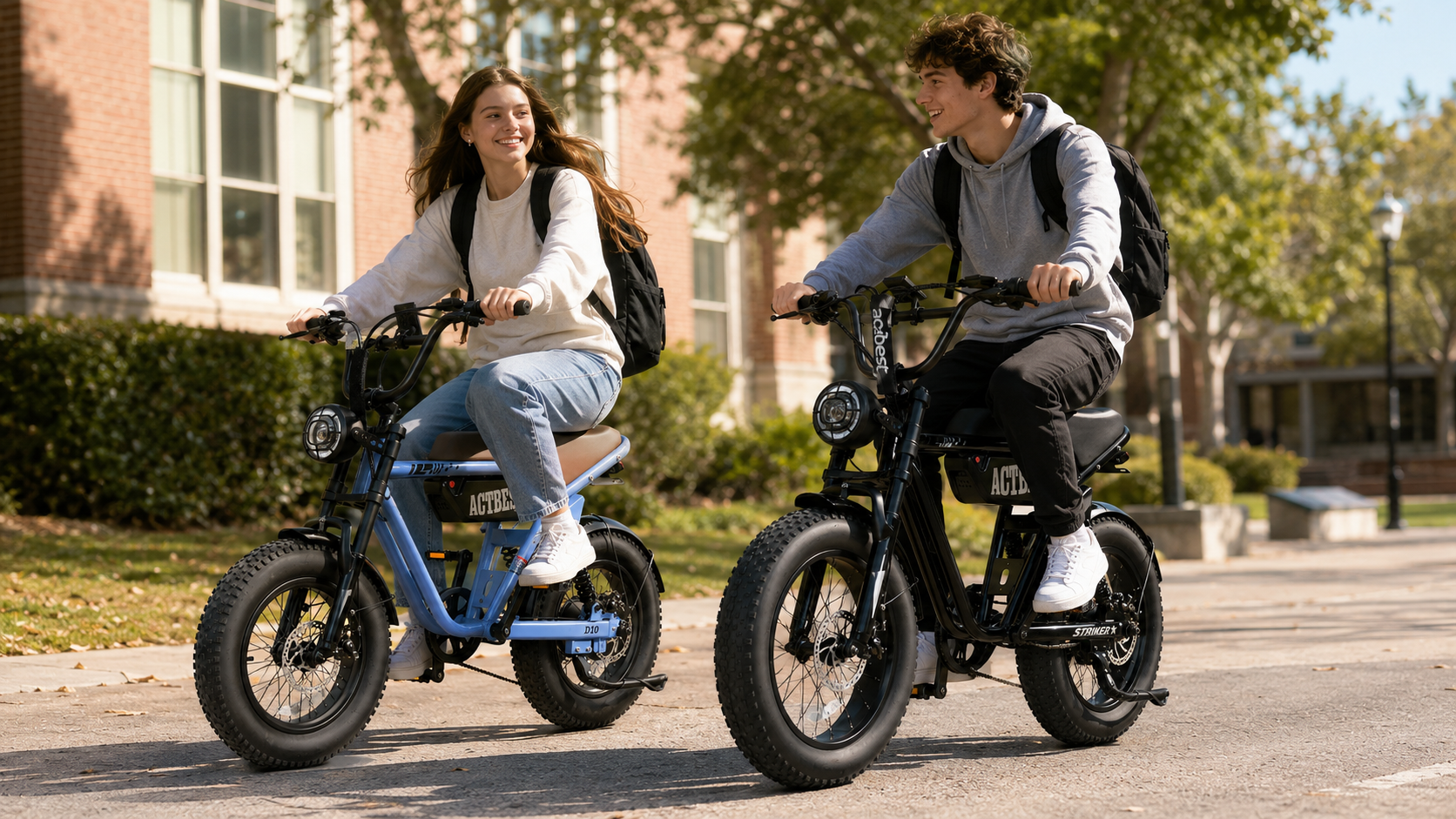
You can get a properly good moped-style ebike for under $1000 right now, but the market is full of bikes that look great in the description but are not so good in real life. This guide covers what to expect at this price point, what to check before you buy, and which actbest models are worth considering.
Quick Picks and Buying Rule
When you're buying an ebike for under $1,000, there's a simple rule you must follow to ensure you get a good one. You need to prioritize support, brakes, battery, and fit. You'll often come across an electric bike with no clear battery spec, no warranty information, and vague details about the brakes and range. You'd be better off buying an ebike with modest numbers on the spec sheet and proper support than one with overly exaggerated figures or one where the figures are not entirely clear.
Right now, the actbest Blaze, Blaze Plus, Striker, and Striker Plus all sit under $1000. That won't always be the case, as prices often change with promotions and sales, so it's a good idea to check the current price on each product page before you commit. All four of these electric bikes are worth considering, depending on your budget and what kind of riding you're planning to do.
What You Can Expect Under $1000
For under $1000, you can expect a moto-inspired electric bike with fat tires. Most budget ebikes are moped-style ebikes, since a wide tire and a moto-shaped frame don't cost much more to produce than a standard one, and they are pretty appealing for anyone on this budget. You'll find 16-inch and 20-inch wheel options across most brands, with the 16-inch frames typically lighter and more compact, and the 20-inch frames offering more stability and a bigger presence on the road.
What varies more is the stuff underneath. Premium suspension, torque sensors, hydraulic brakes, and large batteries are unlikely on bikes under $1000, and some brands cut corners here without making it obvious in the listing. A bike that photographs well and has an aggressive-looking frame can still have a mediocre battery or brakes that aren't up to the job, so don't get tempted by just looks alone.
You'll also find that bikes at this price tend to be heavier than premium models. They often weigh between 75 and 95 lbs, depending on the frame size and spec level. The weight of an electric bike matters for storage and carrying, not just for the ride itself, so it's a good idea to factor that in if you don't have ground-floor storage.
Range figures should be treated as optimistic rather than exact. A bike that claims 75 miles for under $1000 is not unusual, but don't expect to get 75 miles every time you ride, if ever. Manufacturers measure range under ideal conditions, using a light rider, on flat terrain, and low assist levels, none of which reflect how most people ride day to day. It's best to budget for 60 to 70 percent of the claimed figure in real-world conditions, and you'll have a realistic picture of whether the bike is suitable for your needs.
Budget Comparison Criteria
Battery Capacity
Battery capacity is one of, if not the most important, numbers to pay attention to, and it's measured in watt-hours. A 48V 10.4Ah battery works out to around 500Wh. A 48V 15.6Ah battery is around 750Wh. The bigger the number, the more range you'll get from your battery. With this in mind, we recommend checking if replacement batteries are still available for the model you're considering. Some budget brands stop stocking parts within a year or two, and a battery you can't replace when it degrades isn't much of a bargain.
Brakes
Brake type is a cost trade-off. Mechanical disc brakes are the cheaper option to manufacture and do the job for most riders, which is why they're common on the lowest-priced bikes. Hydraulic brakes make the bike more expensive, but give you more stopping power for less hand effort on a heavier bike at speed. Once you're up around 30 mph, the difference between mechanical and hydraulic braking becomes obvious, especially in the wet, so decide upfront if that upgrade is where your extra budget should go rather than on a bigger battery or more motor power.
Motor Power
Motor wattage is the number brands put the most emphasis on, but it's the most inflated figure on a budget spec sheet and the easiest to overpay for without getting anything extra. Two bikes at the same price can show the same peak wattage, while one climbs hills comfortably and the other struggles, and torque is usually the reason. If an ebike's spec sheet gives you a torque figure in Newton-meters alongside the wattage, that's a sign the brand has nothing to hide on performance. If torque is missing entirely, treat the wattage number with some suspicion, since a big number with no supporting detail is often there to justify the price rather than describe the ride.
Frame Fit
Frame fit costs nothing extra to check, and it's the easiest way to avoid wasting your budget entirely. A bike that's technically cheap but doesn't suit your height ends up sitting in a garage because it is uncomfortable to ride, making it the most expensive purchase in this whole comparison. If your height is near the edge of what a listing gives, look at the minimum seat height specifically, rather than the rough height range. This is because that single figure tells you more than the height range ever will, and it costs nothing to check before you buy.
Lights
Lights front and rear should be included in the price, not something you pay extra for later. If a listing doesn't mention lights at all, treat that as a hidden cost you'll need to add later, and factor it into the real price you're comparing against other bikes.
Warranty
Warranty length is another line item to weigh directly against price. A $569 bike with a proper year-long warranty and a real support contact is a better value than a $500 bike with no warranty mentioned anywhere, even though the second one looks cheaper on the surface. The $69 you save upfront can cost far more than that the first time something goes wrong, and there's nobody to call.
|
Model |
Motor |
Torque |
Battery |
Top Speed |
Range (claimed) |
Brakes |
Weight |
Price |
|
Blaze |
1500W peak |
70Nm |
48V 10.4Ah |
25+ mph |
Up to 55 miles |
Mechanical disc |
77.2 lbs |
$569 |
|
Blaze Plus |
2000W peak |
110Nm |
48V 15.6Ah |
30+ mph |
Up to 75 miles |
Disc |
77.2 lbs |
$649 |
|
Striker |
1800W peak |
85Nm |
48V 15.6Ah |
35+ mph |
Up to 75 miles |
Mechanical disc |
84.9 lbs |
$709 |
|
Striker Plus |
2000W peak |
100Nm |
52V 20Ah |
38+ mph |
Up to 90 miles |
Hydraulic |
92.6 lbs |
$999 |
Prices and specs are correct at the time of writing, but can change, so check the current product page before you buy.
actbest Models to Consider
The actbest Blaze is the lowest-priced compact 16x4 option in the range at $569. It's a good starting point if your budget is tight and you're a shorter rider, or you just want the smaller, more manageable frame. The 1500W peak motor and mechanical disc brakes are basic but do the job, and the claimed 55-mile range holds up reasonably well once you account for real-world conditions. At 77.2 lbs, it's also one of the lighter bikes here, useful to keep in mind if storage or carrying is a concern.

The Blaze Plus at $649 is the compact upgrade. The bigger 48V 15.6Ah battery and 2000W peak motor give you more range and more power than the standard Blaze, and it's still a sensible pick for smaller riders who want more performance without moving up to the bigger 20-inch frame. The extra $80 over the standard Blaze buys a real jump in both battery capacity and motor output, so it's a sensible step up if you can stretch to it.

Next we have the Striker at $709, this is the adult 20x4 value option. It's heavier and bigger than the Blaze models, with a 1800W peak motor, full suspension, and mechanical disc brakes. If you fit the larger frame and want genuine off-road capability alongside the moped look, this is the one to check out first at this price. Full suspension isn't always a given at this level, and it makes a real difference on rougher roads.

The Striker Plus sits right at $999, putting it at the very top of this budget and making it the strongest spec-for-dollar option if you can stretch that far. It has hydraulic brakes, a larger 52V 20Ah battery, and more torque than the standard Striker. All of these make a real difference, especially if you're a heavier rider or plan to ride hills often. This is the one to look at seriously if your budget allows, since going from mechanical to hydraulic brakes alone is a meaningful upgrade for the money.

Red Flags Before You Buy
A listing with no clear battery voltage or amp-hour rating is a warning sign. If a brand won't tell you the actual battery spec, it's usually because the figure isn't very good, and you're better off buying from a brand that's upfront about it. This is one of the easiest things to check before you buy, so treat "long-lasting battery" with no numbers attached as a reason to look elsewhere.
The same goes for missing charger details, warranty information, a real support channel, rider height guidance, or clarity on legal class. actbest publishes all of this on every product page, and the absence of it from any other brand is a red flag, not a minor oversight. A brand that's confident in its product usually wants to show you the details, not bury them under vague marketing copy.
A $500 bike claiming 45 mph and 100 miles of range, with no suspension mentioned and no battery capacity listed anywhere, should make you stop and think. Those numbers don't add up on their own, and the missing details are the giveaway. Stick with figures from a proper spec sheet, and if the marketing copy is doing all the talking with no numbers to back it up, take that as your cue to look elsewhere. A quick search for independent reviews on any budget brand you haven't heard of goes a long way here, too; a handful of real customer photos and comments will tell you more about how a bike holds up than the product page ever will.
The same goes for geometry. No minimum seat height, no rider height range, and no bike weight listed means you're buying blind on fit, and fit is just as important as the motor or battery for whether you'll enjoy the bike once it arrives.
Final Thoughts
The biggest number on the page isn't what makes a moped-style ebike good. A brand willing to show you the battery capacity, the brake type, and a working support line has already told you more than a flashy top speed ever will.
Tight on budget? Start with the Blaze. Want more range and power without a big jump in price? The Blaze Plus or Striker cover that. And if $999 is within reach, the Striker Plus gets you hydraulic brakes and a battery that's hard to beat at this price.
Browse the full moped-style e-bike range at actbest to compare current pricing and specs before you decide.
FAQ
Are under-$1000 moped-style ebikes reliable?
They can be, but reliability depends heavily on the brand, not just the price. Look for clear specs, proper certification, a real warranty, and available replacement parts. A cheap bike from a brand with no support is a worse bet than a mid-range bike from a brand that stands behind its products.
Can I get a full-suspension bike for under $1000?
Yes. Models like the actbest Striker and Striker Plus include full suspension at this price point, though it's a good idea to check the specifics of the suspension system rather than assuming all "full suspension" claims are equal.
Is a $999 high-power e-bike legal?
It depends on the bike's class configuration and your state's e-bike laws, not the price. A bike operating within Class 1, 2, or 3 limits in its standard public-road setting is generally treated as a bicycle in most states. Never assume an unlocked higher-speed mode is street legal without checking your state's rules.
What specs matter most under $1000?
Battery capacity, brake type, and motor torque matter more day to day than top speed. Fit and frame size matter just as much, since a bike that doesn't suit your height is a poor buy regardless of the rest of the spec sheet.
Share:
Peak Watts vs Nominal Watts on Moped Style Ebikes
Moped Style Ebike Fit Guide: Seat Height, Rider Height, and Comfort