
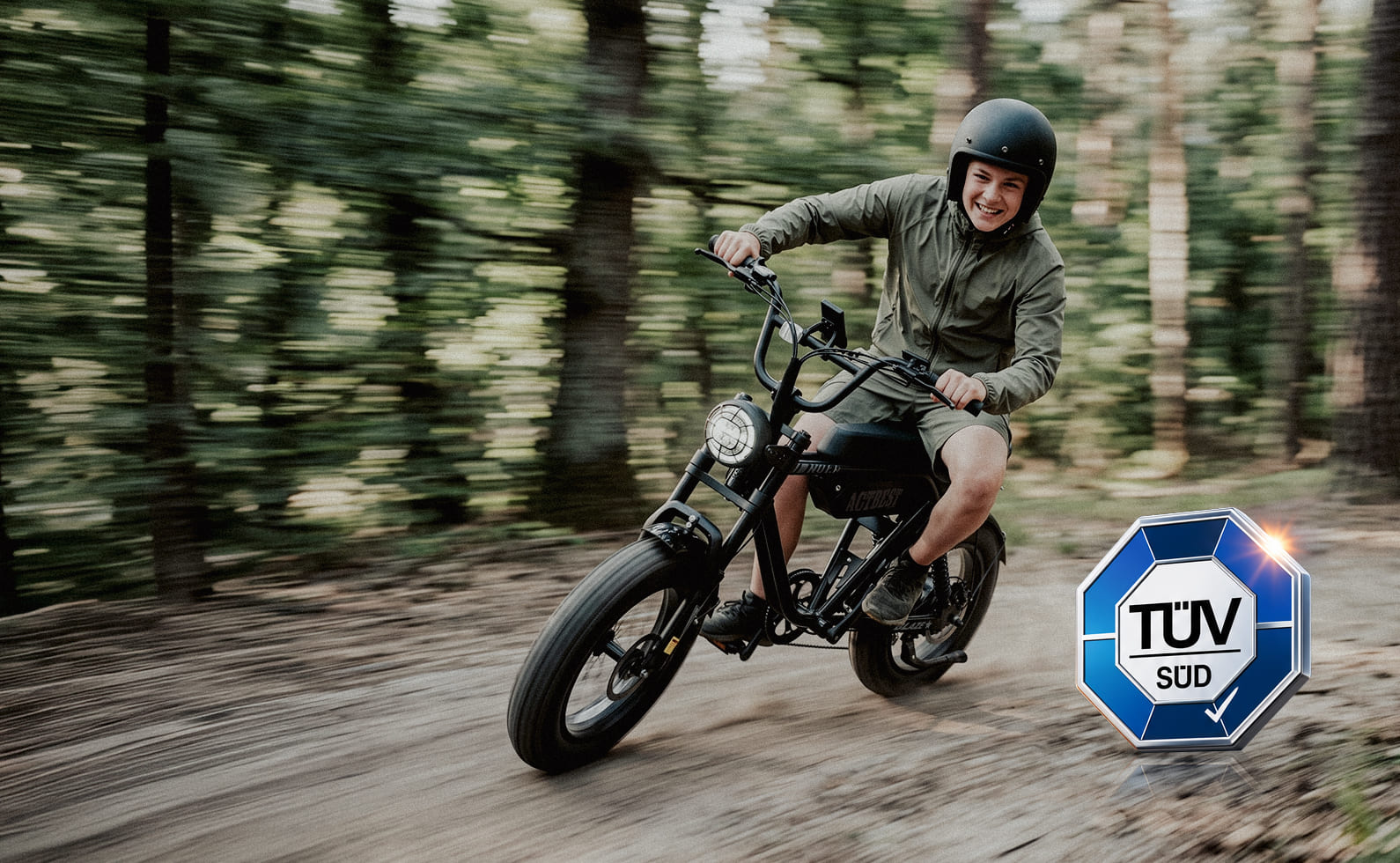
It is super-important to get the right fit on any bike. But there are a few things that don't work the same way on a moped-style ebike as they do on a road bike. What matters most is if you can mount, stop, and control this heavier style of bike confidently, and if the riding position feels comfortable enough that you'd want to be on it every day. This guide takes you through how to check the fit of a moped-style e-bike so you can ride safely and comfortably.

Why Moped Style Fit Is Different
There are a few defining characteristics of a moped-style ebike that make fitting a little different. The first thing is the long bench seat, which puts you in a relaxed, upright, moto-like position rather than the leaned-forward position you'd get on a road or hybrid bike. You're sitting back, feet forward, much closer to how you'd sit on a scooter than a bicycle.
Pedaling is less of a priority for people who ride moped-style ebikes, due to how they are used and their casual nature. Many people use the throttle or a high assist level far more than they pedal, so the traditional "knee slightly bent at the bottom of the stroke" fit rule doesn't carry the same weight it does on a bicycle. You still want to be able to pedal reasonably if you need to; it's just not the main thing you're optimizing for.
The next thing to consider is the bike's weight. A moped-style ebike weighs anywhere from around 77 lbs to well over 100 lbs, compared to 25 to 40 lbs for a typical bicycle. That weight doesn't matter much once you're moving, as the motor's doing the work. But it matters a great deal at low speed, when you're starting from a stop, walking the bike, or maneuvering it into a tight parking spot. The fit of these bikes isn't only about reach and seat height, but also about being able to control that weight confidently when you're not yet moving. This is because it makes a huge difference to the user experience.
You also need to be aware of tire width. The 4-inch fat tires that are commonly fitted to moped-style electric bikes give you a wider, more planted footprint than a standard bicycle tire. The advantage here is that they add stability, but the extra width changes how the bike responds to small balance adjustments and its maneuverability, which takes some getting used to.
The Three Fit Questions
Before you start researching seat height numbers and geometry charts, there are three practical questions you need to ask yourself to give you a good starting point when it comes to fit.
Can you mount, stop, and dismount with confidence?
This sounds basic, but it's the thing most buyers skip and then wish they had paid more attention to. Getting on and off a heavier bike with a bench seat is a different motion from swinging a leg over a regular bicycle top tube. So, you should sit on a few moped-style electric bikes to get a feel for what's out there before committing to a bike you like the look of.
Can you reach the bars and brakes without your arms being fully locked out?
When your arms are fully locked, your control is significantly reduced, making the ride tiring, especially over any real distance. When sitting on the bike, you want a slight, comfortable bend at the elbow, not a stretch.
Can you pedal enough for the riding style you plan to use?
This is important if you're planning to pedal regularly. If you're mostly going to ride with the throttle or a high assistance level, it doesn't matter as much, though it's still worth checking you're not cramped when you do pedal. You never know when you'll end up riding home with a flat battery.
Seat Height and Inseam
The minimum seat height is the first number to look at, not the overall rider height range. It tells you how low the seat goes, which determines whether you can confidently put a foot on the ground when you're on the seat. Standover height is also one of the most important geometry figures to look at, since it tells you how much clearance there is between you and the frame when you're straddling the bike. You really don't want the standover height to be too high.
You don't need to have both feet flat on the ground, the way some cyclists insist on with a bicycle. That's a characteristic of riding a road bike that doesn't fully apply here. A moped-style ebike's stability comes as much from its weight and wide tires as from your feet. But you should be able to get at least one foot down solidly and confidently at a stop, and ideally both feet with a slight bend at the knee.
Shorter riders generally do better on the compact 16-inch frame designs. Bikes like the actbest Blaze and Blaze Plus both have a minimum seat height that's noticeably lower than the 20-inch minimum seat height of the Striker range. This makes a difference if you're on the shorter side or prefer a smaller, more manageable bike. Taller riders need to think about more than just seat height, though. Bar reach and knee room are also important, as a compact frame that fits a shorter rider's inseam can still feel cramped for someone with longer legs, particularly when pedaling.
Before buying a bike, it's worth measuring your own inseam rather than relying purely on your overall height. This is because two riders of the same height can have very different leg lengths, and a rider's height range on a spec sheet is just an average figure.
To measure your inseam, stand flat-footed, and measure from the floor to your crotch in shoes you'd normally ride in. Then compare that figure to the bike's minimum seat height. If there's a comfortable gap, you're in good shape. If the numbers are close, there might be an issue, and it's a good reason to test-ride if you can.
Reach, Weight, and Low-Speed Handling
You're supposed to ride these bikes with a relaxed posture, but that doesn't mean any bar height works. Your shoulders should be down, and not hunched up towards your ears, and your wrists should be at a relaxed angle rather than sharply bent. If you find yourself reaching up and out awkwardly for the bars, or your wrists feel strained after a short ride, the bike probably doesn't fit you, regardless of what the height chart claims.
Another thing that's overlooked is brake lever reach. You need to be able to pull the brake fully and confidently without straining or repositioning your hand, especially in an emergency stop. This is worth testing at a standstill, before you ever take the bike on the road.
The weight of one of these bikes is important to consider in terms of practicality. A 77 to 110 lb e-bike needs to be stored somewhere, and if that's up a flight of stairs, through a narrow doorway, or up a ramp, it's worth thinking through carefully before you buy. Loading a heavier moped-style ebike onto a car rack is also a different proposition from loading a lightweight bicycle. Some riders manage it solo, others need a second pair of hands or a rack specifically rated for the extra weight. All this affects day-to-day ownership just as much as fit does, so it's worth thinking through before the bike arrives.
actbest Fit Examples
The actbest Blaze and Blaze Plus are the compact 16x4 examples in the range. The Blaze weighs 77.2 lbs, has a minimum seat height of around 27.5 inches, and actbest lists a rider height range of roughly 5'1" to 6'3". A minimum rider height of about 5'2" works best for a comfortable fit.

The Blaze Plus shares the same 77.2 lb weight but has a noticeably lower minimum seat height of around 19.7 inches, which makes it a good option for shorter or smaller riders who still want the moped look and feel. Neither of these numbers guarantees comfort on its own. They're a starting point for narrowing down which frame sizes are worth test-riding.
Next up, you have the Striker and Striker Plus, which are the larger adult 20x4 examples. Both have a rider height range of around 5'3" to 6'3" and a minimum seat height that is fixed or higher, closer to 22.8 inches on the Striker and around 27.5 inches on the Striker Plus. They're also considerably heavier, at 84.9 lbs and 92.6 lbs respectively, so the low-speed handling and storage considerations matter more here than they do with the Blaze.

The Striker Max sits at the performance end of the range, thanks to a dual-motor system. It has a similar 5'3" to 6'3" rider height listing, and a weight of 109.8 lbs. This is the model where weight and low-speed handling confidence matter most. It's a heavy machine, and while the geometry and seat height might suit the same rider height range as the Striker Plus, managing that extra weight at a stop, walking it, or lifting it onto a rack is quite different.

Who Should Look at Which Frame
Shorter riders, or anyone who wants a lighter, more manageable bike, are generally better off with the 16x4 Blaze or Blaze Plus. The lower seat height and lighter overall weight make a real difference to riding with confidence, particularly at low speeds or when maneuvering the bike into storage.
Taller or larger riders, or anyone who wants more range and power alongside the moped-style comfort, are better suited to the 20x4 Striker range. The higher minimum seat height and larger frame give more room to stretch out, and the extra weight is less of an issue if you're already comfortable handling a heavier bike day to day.
Riders who want maximum performance and don't mind the extra weight and bulk that come with it should consider the Striker Max. It's still worth test riding or at least trying the bike stationary before committing, given how much heavier it is than the rest of the range.
FAQ
Should I be able to flat-foot both feet on a moped-style e-bike?
Not necessarily. Unlike a road bike, stability on these bikes comes as much from their weight and wide tires as from your feet on the ground. You should be able to get at least one foot down confidently at a stop, and ideally both feet with a slight knee bend, but full flat-footing with both feet isn't a strict requirement, the way it is for some cycling styles.
Can a short rider use a 20x4 model like the Striker?
It depends on the rider's inseam and how the minimum seat height compares to it, not just their overall height. actbest lists a rider height range for each model, but that's a starting point, not a guarantee. If you're at the shorter end of a 20x4 model's range, it's worth checking the minimum seat height specifically and test-riding if you can before buying.
Are these bikes good for tall riders?
Generally, yes, particularly the Striker range, which has more room to stretch out than the compact 16-inch Blaze models. Taller riders should pay attention to bar reach and knee room when pedaling, not just seat height, since a bike that technically fits your height range can still feel cramped in other ways.
Can the seat be raised or replaced?
Some models allow limited seat adjustment, but moped-style bench seats are generally less adjustable than a standard bicycle saddle and seatpost. If seat height is borderline for your height, it's worth checking the specific adjustment range on the current product page rather than assuming it can be adjusted to fit.
Share:
Best Moped Style Ebike Under $1000
Are Moped Style Ebikes Legal? License, Registration, and Class Rules Explained