
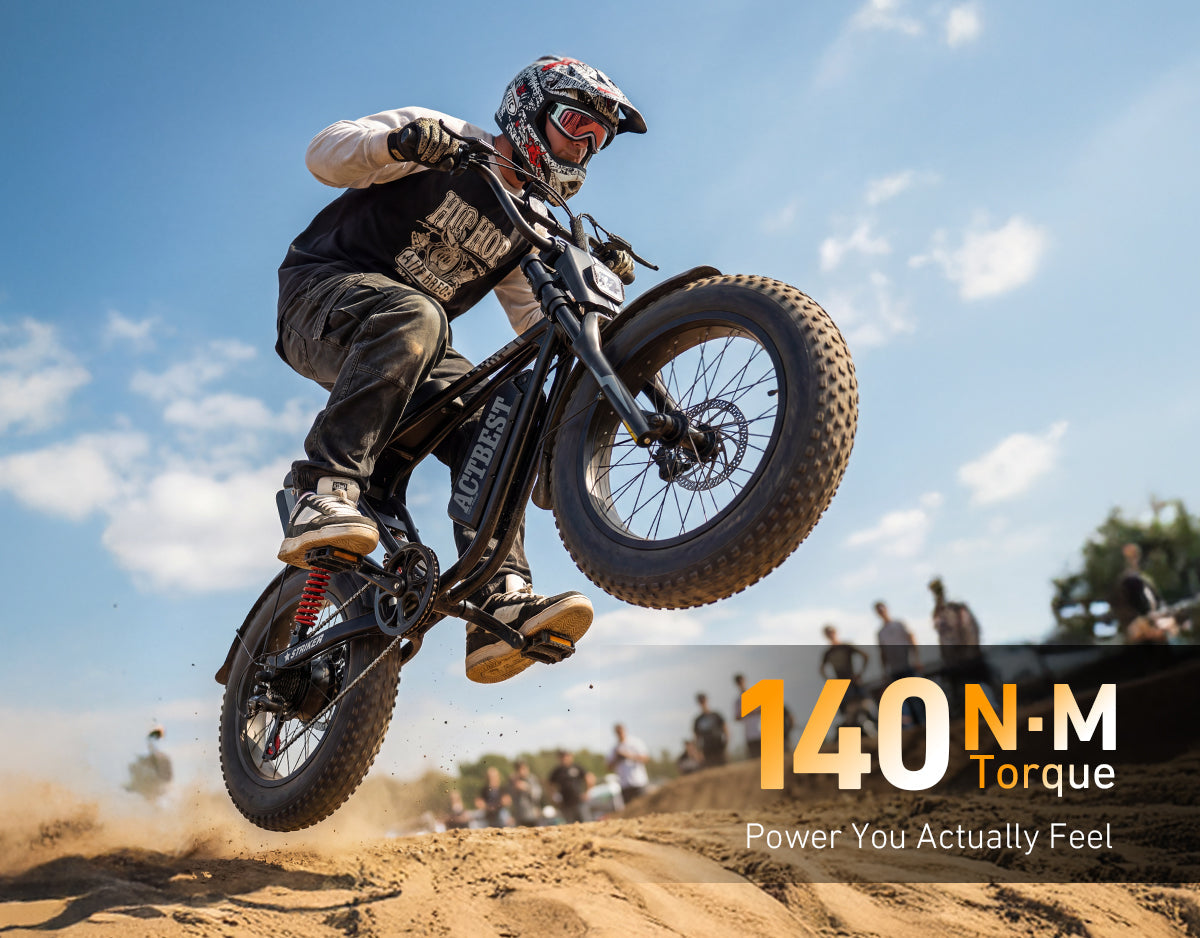
A moped style ebike looks very different from regular ebikes, almost to the point where you might expect it to need a license plate, due to its motorcycle-inspired looks. But its appearance has nothing to do with how it is classified as a vehicle. What matters is the motor, the top speed, and whether the pedals can be used to propel the bike, and once you know those three things, you know almost everything you need to.
This is general information, not legal advice, and the rules vary by state and change over time. Therefore, it is best to confirm the current law where you live before you ride to stay out of trouble.
The Short Answer
Most moped-style ebikes are legal to ride on public roads with no license, plate, or registration, the same as any other ebike. If you have an electric bike with pedals that work, a motor under a set wattage, and a governed top speed under a set limit, it gets treated as a bicycle. However, if you have a bike that exceeds those numbers in any mode, it is subject to a different set of rules.
With this in mind, you shouldn't take the bike's style and aesthetics into account when thinking about its legality.
The Federal Rule Every State Builds On
Nearly every state law starts from the same place: a federal definition from the Consumer Product Safety Commission:
"A low-speed electric bicycle has two or three wheels, pedals that work, a motor under 750W, and a top speed under 20 mph on motor power alone, no pedaling."
That's a product rule, and it only decides what a company is allowed to sell as an ebike. It says nothing about which roads you can use, what age you need to be, or how your city treats a shared trail. States handle all of that on their own, sometimes with cities and parks adding extra rules to suit the area.
A bike meeting the federal definition is a green light to sell it nationwide. It's not a green light to ride it however you want. It is common for people to mix those two up, which leads to a bike that needs a license the moment they cross a state line.
You need to pay attention to an ebike's peak wattage. This is the number ebike brands state in their spec sheets. This figure is the short burst a motor can hit under load. It's not what the motor puts out riding around town, and it's not the number that decides legality either. In the U.S., the governed speed does, and it can change depending on which mode you're riding in.
You can ride electric bikes with a throttle without pedaling. The motor on pedal-assist bikes only kicks in when you start pedaling. And you can get higher-output models that add a separate off-road mode that unlocks more speed than the road setting allows. This mode is only for use on private land, not the street outside your house.
Class 1, Class 2, and Class 3
Most states have adopted the 3-class system for classifying ebikes.
- Class 1 is pedal-assist only, with a 20 mph limited top assisted speed.
- Class 2 is also limited to 20 mph but adds a throttle so you can ride without pedaling.
- Class 3 lets pedal-assist run up to 28 mph and usually requires a helmet at that speed.
Many moped-style ebikes, including higher-output models, have a Class 3-compliant setting and a separate, faster mode for off-road riding only. That second mode is where most of the legal confusion starts. It's the rider's responsibility to know the difference before taking their ebike onto a public road.
The problem with the three-class system is that it isn't used everywhere, and that can catch ebike riders off guard. This is because a handful of states never adopted it and instead treat ebikes under their own motor vehicle or moped statutes. So, you may be in a state that requires a license or registration for a bike that can be legally ridden in a neighboring state without them.
A great example of this is New Jersey, which dropped the three-class model in 2026. It now treats ebikes as motorized bicycles, so you need a license and registration to ride them. Alaska files them under motorcycle rules. Massachusetts sets its own 30 mph cap under a motorized bicycle statute that has nothing to do with the Class 3 number most other states use.
You may also come across age restrictions and rules about riding ebikes on specific paths in different states, too. It is common for states to set a minimum age of 16 for Class 3 riders, though Class 1 and 2 usually have no age requirement at all. Some multi-use paths ban Class 3 ebikes outright unless the local jurisdiction opts back in. This means it's possible for a bike that's fine on the road in one county to be not allowed on a shared path one town over.
It's important to know that a shop selling an actbest Striker Plus in one state might legally sell the same bike in another state where it doesn't qualify as an ebike at all because of its top speed.
Do You Need a License or Registration?
For most riders, no. A compliant Class 1, 2, or 3 electric bike is a bicycle under the law, no matter how much it looks like a motorcycle.
Mopeds, scooters, and anything that falls outside the class limits is a different story. These vehicles often require registration, a license, and, in some cases, insurance. None of that has anything to do with a bench seat or a moto headlight.
Alabama, Alaska, Hawaii, Louisiana, Massachusetts, and New Jersey all require some form of license. So it is essential to look up the ebike laws wherever you ride.
A moped-style frame doesn't push a bike into that stricter category on its own, it's if the motor or top speed exceeds the class limits, or if the pedals don't work like real pedals (i.e., they are just footrests). Your state DMV page and city bicycle ordinances cover most of what you need to know, but trail and campus riding often comes with its own separate set of rules on top, and those local rules can end up stricter than anything the state requires.
Public-Road Mode vs Off-Road Mode
Many higher-output moped-style ebikes come with more than one riding mode, and that's where most of the confusion and the fines come from. You can choose from a couple of speed settings, usually via the display or an app. One of them is capped at the Class 3 limit, 28 mph, and riding in that setting keeps the bike legal on the road. Switch it into the faster, uncapped setting, and it's the exact same bike, but the law no longer treats it as a bicycle. If you ride it like this on a public road, you're breaking the law, no matter what the manufacturer calls that mode or how they market it.
actbest builds several models across this range, so it helps to know how they differ before you buy. The Blaze is the smaller of the two 16-inch models, with a 1500W peak motor good for 25+ mph, and it's built for shorter riders and short trips around town. The Blaze Plus keeps the same compact frame but steps up to a 2000W peak motor and 30+ mph. Move up to the 20-inch tires and the numbers climb again. The Striker has a 1800W peak motor that will take you to 35+ mph, while the Striker Plus and Striker Max both top out around 38+ mph, and the Max adds a second motor along with a battery good for up to 120 miles.

Whichever one you ride, always check the current mode settings and manual before you ride anywhere that isn't private property, because none of those top speeds mean anything legally by themselves.
If you're buying purely to commute, the extra speed of a Striker Plus or Max barely matters day to day, since you'll be riding in a compliant mode on public roads anyway. It only comes into play once the bike leaves the road entirely.
The Five-Step Legality Checklist
Before riding a moped-style ebike somewhere new, it helps to run through a short checklist:
- Check the spec sheet for the motor's wattage and the top motor-only speed.
- Confirm which mode the bike is set to before you leave.
- Look up your own state's law instead of assuming the three-class system applies everywhere.
- Check the access rules for wherever you're riding, whether that's a bike lane, trail, campus, or park.
- Save any faster or off-road mode for private land, and stick to the compliant setting everywhere else.
This only takes a few minutes, and it beats finding out the hard way from a police officer or a park ranger.
Trails, Campuses, and Parks Play by Their Own Rules
The same bike can be completely legal on one route and a real problem on the next, so it pays to think about how you'll use it day to day instead of judging the bike on its own.
Riding on a public road in a compliant setting is fine almost everywhere, with no license or registration needed. Although it can get more complicated in a handful of states, specifically Class 3, on bike lanes, as there are some exceptions.
Trails are normally governed by local rules more than state ones. Some systems allow Class 1 ebikes and ban Class 2 or 3 outright, and whatever's posted at the trailhead usually wins over the general state rule anyway. Campuses set their own policies, too, and it's often stricter than the city's.
National parks add another layer on top of this. Many allow Class 1 ebikes on roads and paths where regular bikes are permitted, but individual parks and specific trails inside them can still say no. The Forest Service and BLM also run their own rules, separate from whatever the Park Service decides. Private land is where the faster mode belongs, and nowhere else.
Most riders who get this wrong aren't trying to break a rule. They've simply assumed one set of rules covers everywhere they ride, and it rarely does.
If the rules for a specific trail, campus, or park aren't posted anywhere, it's best to send a quick email or make a call to confirm.
Moped-Style Ebike, Electric Scooter, or Electric Moped?
These three get mixed up all the time, and the mix-up changes where you're allowed to ride each one.
A moped-style ebike has working pedals and qualifies as a bicycle under Class 1-3 limits in most states. This means bike lanes, bike paths, and roads are all fair game, and you won't need to get plates or deal with paperwork.
An electric scooter is a different story, and the rules change from state to state. Stand-up models above certain power or speed thresholds often need registration and can be barred from bike lanes entirely, and these rules tend to swing more by city than ebike rules ever do.
An electric moped is a motor vehicle. So, you'll need registration, a license in most states, and insurance, and plenty of states won't let anyone under 16 near one. But it's worth knowing that a moped-style ebike can do a very similar job for most commuters without any hassle.
Battery certification is starting to matter here, too, separate from all of this. California now requires new ebikes sold there to carry a recognized safety certification, such as UL 2849, and other states are heading in the same direction. It has nothing to do with class, but it's becoming a condition of sale, so it's worth checking for regardless of speed or power. A few cities go further and require certification at the point of sale, in addition to whatever the state already requires.
FAQ
Do moped-style ebikes need license plates?
No, not if the bike meets Class 1, 2, or 3 limits in your state. Plates apply to mopeds, scooters, and anything outside the bicycle definition, not to compliant ebikes, no matter how they're styled.
Is 2000W peak legal?
Peak wattage alone doesn't answer that question. What matters is the motor-only top speed and which mode the bike is riding in. A 2000W peak motor can sit inside Class 3 limits in its compliant setting, while an unlocked faster mode on the same bike might not. Check the mode, not the number on the box.
Can I ride in bike lanes?
Usually yes for Class 1 and 2, and often Class 3 too, though a small number of states restrict Class 3 access to bike lanes specifically. Look up your own state, since this is one of the more inconsistent parts of ebike law.
Are moped-style ebikes legal for teens?
It depends on the class and the state. Classes 1 and 2 tend to have looser age requirements, while Class 3 often requires riders to be 16 or older. States without the three-class system set their own minimums, so it's worth confirming the age rule for the specific class before buying for a younger rider.
Final Thoughts
A moped-style ebike can be completely street-legal, and for most riders, buying a Class 1, 2, or 3-compliant model is. The frame was never the real question. Motor power, top speed, and the mode you're riding in are what decide it, every time.
Run through the checklist before you ride somewhere new. Keep off-road or unlocked modes on private land, and treat trail, campus, or park rules as separate from state law.
Browse the full moped style ebike range from actbest and check the current specs and compliant mode settings for each model before you buy.
Share:
Moped Style Ebike Fit Guide: Seat Height, Rider Height, and Comfort
Where Can You Ride an E-Bike? Roads, Trails, and Public Land