
Scope note: This is general educational information, not legal advice. E-bike access rules can change by state, city, park, trail manager, season, and vehicle configuration. Check the current official rule for the exact place and date of your ride.

There Is No Single Nationwide Answer
Where can you ride an e-bike? Usually, you start with ordinary roads and some bicycle facilities, but the real answer depends on four things: your bike's legal class, the facility you want to use, the state or local law, and the authority managing that road, path, trail, or park. A bicycle symbol on a map is not a permission slip. Verify locally before you roll.
That sounds fussy until you have pedaled three miles to a trailhead and met a "no motorized use" sign. I treat map-app bicycle icons as routing suggestions, not legal sources. The practical rule is simple: identify the bike, the place, and the authority, then check the current rule.
Where Can You Usually Ride an E-Bike? Quick Answer
Commonly Allowed, Sometimes Allowed, and Usually Restricted
The table below is a planning guide, not a nationwide legal conclusion. Every row ends with the same useful instruction: verify locally.
| Facility | Common planning pattern | What can change the answer |
|---|---|---|
| Ordinary public road | Often bicycle treatment. Verify locally. | Vehicle definition, equipment, age, speed, and signs. |
| Bike lane | Often open to qualifying e-bikes. Verify locally. | Class, direction, speed, and the road's own restrictions. |
| Sidewalk | Highly local. Verify locally. | Business districts, age exceptions, yielding, and pedestrian priority. |
| Paved shared-use path | Often allows selected classes. Verify locally. | Class, speed, seasons, closures, and signs. |
| Natural-surface or mountain-bike trail | Express permission may be required. Verify locally. | Motorized status, class, surface conditions, and closures. |
| Highway, freeway, bridge, or tunnel | Never assume access. Verify locally. | Road authority, shoulder policy, and posted prohibitions. |
| Wilderness | Do not assume bicycle-style access. Verify locally. | Exact boundary, road status, and federal rule. |
The Four Questions to Ask Before Riding
- What is the bike? Confirm its class, throttle behavior, assisted speed, motor labeling, and any modifications.
- What is the facility? A city street, sidewalk, rail trail, singletrack trail, and park road can have different rules.
- Who controls it? Look for the state, city, county, park, trail nonprofit, BLM field office, forest, or national park unit.
- What is posted today? Check signs, closure notices, seasonal restrictions, and the date on the official page. That is how you check e-bike rules without guessing.
Know Your E-Bike Class Before Checking Access
Class 1, Class 2, and Class 3 E-Bikes
The familiar Class 1, Class 2, and Class 3 e-bikes framework is useful shorthand used by many US states and agencies. It is not a universal federal operating law, and state definitions differ. Read our guide to e-bike classes 1, 2, and 3 for the deeper breakdown.
| Class | Assistance | Common assisted-speed cutoff |
|---|---|---|
| Class 1 | Motor assists only while you pedal. | 20 mph |
| Class 2 | A throttle can propel the bike without pedaling, usually with pedal assist too. | 20 mph |
| Class 3 | Motor assists while you pedal, usually with no throttle-only operation in the class definition. | 28 mph |
Treat the table as a starting point. PeopleForBikes' state-law finder is useful for discovery, but the controlling answer may be in a statute, city code, agency rule, or park page.

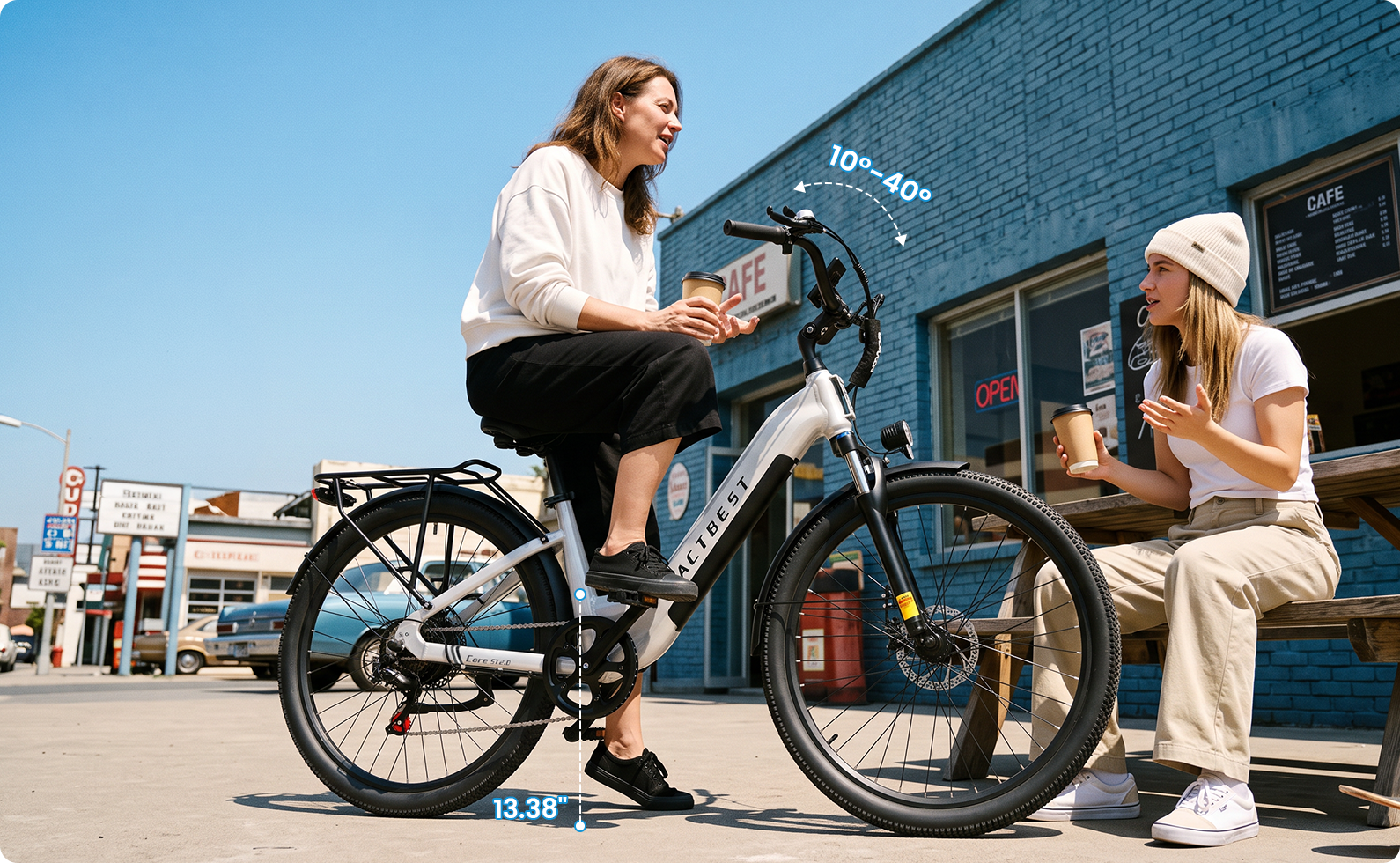
actbest's Core ST 2.0 Plus 27.5-inch commuter e-bike shows why the check matters. Its product page lists Class 3, a throttle, a 28 mph top speed, and a 1200W peak motor. Those are product facts, not a promise that every jurisdiction will classify it the same way. For example, the BLM definition uses a motor rating of no more than 750W. Because "peak" and legal motor-rating methods may not mean the same thing, I would confirm the documentation with the authority instead of doing wattage math at the trailhead.
Why Class Labels Do Not Guarantee Access
An e-bike can be legal to sell and still be restricted on a particular facility. A city may bar all e-bikes from a sidewalk downtown. A park may allow Class 1 on a paved path but exclude Class 3. A natural-surface trail may be designated nonmotorized even when the state allows e-bikes on roads. Those are e-bike class restrictions, not contradictions.

Power and speed matter too. Actbest's Mars Plus ST folding utility e-bike is listed at 1800W peak and 32+ mph. The Ranger ST 2.0 all-terrain e-bike is listed at 1800W peak and 36+ mph. Before using bicycle access guidance, confirm whether local law treats either configuration as an e-bike, moped, off-highway vehicle, or another category.
E-Bike Access Matrix by Facility and Class
National Planning Matrix
This is the fast version of the research process. "Often" means a common planning pattern, not a nationwide guarantee. Use the verification source in the last column before riding.
| Facility | Typical authority | Class 1 | Class 2 | Class 3 | Common restrictions and source to verify |
|---|---|---|---|---|---|
| Public road | State and local traffic code | Often bicycle treatment. Verify locally. | Often bicycle treatment. Verify locally. | Often allowed on roads, with extra limits in some places. Verify locally. | Direction, signals, equipment, age, speed, and posted signs. Start with the state code and PeopleForBikes state finder. |
| Protected bike lane | City or transportation agency | Often allowed. Verify locally. | Often allowed. Verify locally. | Sometimes restricted. Verify locally. | Facility design, class, speed, and local micromobility code. |
| Painted bike lane | State or city traffic code | Often allowed. Verify locally. | Often allowed. Verify locally. | Often allowed where road access is allowed. Verify locally. | A bike lane does not override a class or vehicle-category rule. |
| Sidewalk | City or county code | Sometimes allowed. Verify locally. | Sometimes allowed. Verify locally. | Commonly restricted. Verify locally. | Business districts, age exceptions, speed, yielding, and pedestrian priority. |
| Paved shared-use path | Park, county, city, or trail manager | Often the most widely accepted class. Verify locally. | Frequently allowed, sometimes with speed limits. Verify locally. | Often limited or excluded. Verify locally. | Signs, local speed caps, yielding, seasons, and manager policy. |
| Natural-surface trail | Land manager | May be allowed where expressly listed. Verify locally. | Often needs express permission. Verify locally. | Frequently restricted. Verify locally. | Motorized designation, soil, weather, closures, and class policy. |
| Mountain-bike trail | Land manager or park agency | Trail-specific permission only. Verify locally. | Trail-specific permission only. Verify locally. | Trail-specific permission only. Verify locally. | Check the individual trail, not just the park homepage. |
| State park road | State park agency plus traffic code | Often possible. Verify locally. | Often possible. Verify locally. | May have park-specific limits. Verify locally. | Park map, superintendent or agency rule, road signs, and seasonal closures. |
| State park trail | State park agency | Sometimes allowed. Verify locally. | Sometimes allowed. Verify locally. | Often limited. Verify locally. | Surface, class, speed, wildlife, and posted closure. |
| BLM road or trail | Bureau of Land Management field office | Allowed on routes where the BLM authorizes e-bikes. Verify locally. | Same rule. Verify locally. | Same rule, subject to route and local classification. Verify locally. | Use the BLM e-bike page and the specific field-office route decision. |
| National forest road or trail | US Forest Service and local forest unit | Route-specific. Verify locally. | Route-specific. Verify locally. | Route-specific. Verify locally. | Check the forest page and Motor Vehicle Use Map where relevant. |
| National park road or trail | National Park Service and park superintendent | Often allowed on roads and some paths. Verify locally. | Often allowed on roads and some paths. Verify locally. | May be restricted on specific paths. Verify locally. | Read the NPS e-bike guidance and the individual park rule. |
| Highway or freeway | State DOT, toll authority, or road owner | Do not assume access. Verify locally. | Do not assume access. Verify locally. | Do not assume access. Verify locally. | Posted prohibition, shoulder policy, bridge or tunnel rule, and alternate route. |
| Wilderness | Federal land manager and wilderness law | Mechanical transport is prohibited inside designated wilderness. Verify the boundary. | Same. Verify the boundary. | Same. Verify the boundary. | Check the exact boundary and the Wilderness Act restriction. |
How to Read the Matrix
Imagine the same Class 2 bike on three segments. Your city street may allow it under the state vehicle code. A paved shared path may allow it only below a posted speed and with yielding. A national forest trail may be open only if that route is specifically authorized for e-bike use. The bike did not change. The facility-specific e-bike rules did.
Can You Ride an E-Bike on Roads and Bike Lanes?
City Streets and Ordinary Public Roads
Can you ride an e-bike on the road? Often, yes, if the vehicle qualifies under the applicable state definition and you follow the same basic traffic duties as bicycle riders. Ride with traffic where required, obey signals, use the correct lane position, and meet local equipment rules for lights, reflectors, brakes, and helmets. Age limits, registration, insurance, and speed rules can vary. Check the state code and city traffic code for the exact road.
If your bike has a throttle, a high power rating, or a speed setting above the local e-bike definition, stop calling it "just a bicycle" until you check. That small distinction can change licensing, registration, equipment, and road-access requirements.
Painted, Buffered, and Protected Bike Lanes
You may be able to ride an e-bike in a bike lane, but a bike lane does not erase the rest of the law. Confirm that your class is allowed, use the direction shown by signs or markings, follow the posted speed, and yield where the lane crosses driveways or pedestrian crossings.
For a commuter, this is where a smooth bike pays off. The Core ST 2.0 Plus uses a torque sensor that responds to pedaling pressure, which can make starts easier to modulate. Its lights, disc brakes, front suspension, and rear rack are practical city features. The local rule still wins. Once access is sorted, review these e-bike safety tips for beginners.
Highways, Freeways, Bridges, and Tunnels
Can e-bikes ride on highways? It depends on the road authority and the exact segment. Freeways often prohibit bicycles, while a state highway may have a shoulder or a parallel route. Bridges and tunnels can have separate rules. Read the posted sign and the road owner's current guidance. If the route is unclear, choose the signed bicycle alternative rather than testing the shoulder with a truck at your elbow.
Can You Ride an E-Bike on the Sidewalk?
Why Sidewalk Rules Are Usually Local
Can you ride an e-bike on the sidewalk? Only if the city or county code allows it for your bike type and location. Sidewalk rules are commonly local because a downtown commercial district has different pedestrian pressure from a suburban block. Some ordinances create age exceptions, set a low speed, require a bell, or require yielding at every crossing. Others prohibit riding in a business district or prohibit e-bikes entirely.
Even where sidewalk riding is legal, pedestrians have priority. Slow before driveways and building entrances, watch for people stepping out between parked cars, and dismount when the space is crowded. No tire, motor, or frame design creates a sidewalk exception.
What to Do When the Road Feels Unsafe
Feeling unsafe does not automatically create a legal sidewalk exception. Plan a safe e-bike route using a lower-traffic street, a signed bike network, a permitted shared path, or a transit connection. Walking the bike for a short block may be legal where riding is not. If the only route is a prohibited highway segment, turn around and find the alternate route. It is less dramatic than a close call and much easier on your nerves.
E-Bikes on Multi-Use Paths and Natural-Surface Trails
Paved Shared-Use and Rail-Trail Access
Rules for e-bikes on multi-use paths and e-bikes on rail trails are often written by the city, county, park agency, or nonprofit that manages the route. Many managers distinguish among classes, set a speed limit, require yielding to pedestrians and horses, or close sections seasonally. Read the trail's own page and signs, not just a map app's bicycle icon.
On a busy path, I assume someone is about to make a surprising decision. Keep right where required, pass with warning, slow at blind corners, and leave space around dogs, children, and walkers. A motor that flattens a hill can also put you into a crowded corner faster than your brakes can get you out.
Mountain-Bike and Natural-Surface Trails
E-bikes on mountain-bike trails need express, trail-specific permission. A park may allow Class 1 on selected routes while keeping other singletrack nonmotorized. Another area may classify the route as motorized and allow more vehicle types. Soil conditions, wildlife closures, wet-weather policies, and erosion concerns can change access overnight.
This is where a bike's capability and legal access diverge most sharply. The Ranger ST 2.0's 26 x 4.0-inch tires and front suspension are designed for rougher surfaces, but the product listing also reports an 1800W peak motor and 36+ mph top speed. Those specs tell you what the machine is built to handle. They do not tell you which trail manager will admit it.
Trail Etiquette Does Not Replace Legal Access
E-bike trail etiquette is courtesy, not permission. Slow for blind corners, yield according to the posted order, stay on the tread, avoid wet trails when asked, and be honest about your speed. Do those things after you have confirmed the route is open to your vehicle class.
E-Bikes on Federal Public Land
Federal land is not one giant rulebook. BLM, the US Forest Service, and the National Park Service use different authorities and local decisions. Check the agency page and the unit-level page together.
Bureau of Land Management Land
For e-bikes on BLM land, start with the BLM e-bike guidance, then open the field-office or route page for the place you want to ride. BLM generally distinguishes routes managed for motorized use from routes managed for nonmotorized use, and a local decision can authorize e-bikes on a particular route. A broad recreation map is not enough. Confirm the route number, class or vehicle definition, seasonal closure, and any posted speed or group rule.
US Forest Service Roads and Trails
For e-bikes in national forests, read the US Forest Service e-bike guidance and the specific forest or grassland page. Where a Motor Vehicle Use Map applies, use it to understand which roads and trails are designated for motorized travel. The forest supervisor's local decision and current closure notice still control. Do not infer that every trail in a forest has the same status.
National Park Service Units
For e-bikes in national parks, start with the National Park Service e-bike page, then check the individual park's superintendent's compendium, alerts, maps, and signs. NPS rules can allow e-bikes where traditional bicycles are allowed, while still restricting particular trails, boardwalks, backcountry routes, or crowded areas. "The park allows e-bikes" is not the same as "every trail is open."
Wilderness and Other Protected Areas
For e-bikes in wilderness areas, the Wilderness Act prohibits motorized equipment and mechanical transport inside designated wilderness. Confirm the exact boundary before entering. A road, developed area, or adjacent forest trail may sit outside that boundary and follow a different rule. When the map and sign conflict, ask the responsible federal office.
State Parks, County Trails, and City Rules
Why State Law Is Only the Starting Point
The phrase e-bike laws by state is useful for research, but state law is only the first layer. A state may define the vehicle, while a park agency controls its trails, a county controls a greenway, and a city controls sidewalks. A private campground, resort, or rail-trail operator can add its own property policy. Check each layer.
Find the Controlling Local Authority
Use this source hierarchy:
- State statute or transportation agency rule for the vehicle definition.
- City or county code for roads, lanes, sidewalks, and local speed rules.
- Park, trail, or land-manager page for facility access.
- Posted signs, seasonal closure notices, and current alerts.
- A phone or email contact when the written sources conflict.
Search for the phrase local e-bike ordinance plus the city name, then confirm that the result is an official code or agency page. Search engines are good at finding a document and terrible at promising that it is still current.
Record the Verification Date
Save the source URL, route name, and the date you checked the current e-bike access rules. Recheck before a trip, after a storm, and after a bike change. A screenshot with the date is handy when you are offline at a trailhead, but the live page remains the authority.
Can I Ride Here? Five-Step Decision Tree
If you are asking where can I ride my e-bike, use this sequence instead of trying to memorize every rule.
Step 1: Identify the Vehicle
Write down the class listed by the manufacturer, assisted speed, throttle behavior, nominal and peak motor information, and whether anyone has modified it. Keep the manual or product page on your phone. If the bike is labeled Class 3 but has a high power rating or a 32+ mph setting, mark it "verify category" rather than assuming it fits the local definition.
Step 2: Identify the Facility
Break the route into segments: public road, protected lane, sidewalk, paved path, rail trail, natural-surface trail, park road, or backcountry route. A route planner often hides these transitions. Zoom in and look for the trail manager, road number, gate, bridge, or park boundary.
Step 3: Identify the Controlling Authority
For each segment, name the authority: state DOT, city, county, park agency, trail nonprofit, BLM field office, national forest, or national park. If you cannot name the authority, you are not ready to rely on the route.
Step 4: Check the Current Rule and Signs
Open the official access page, map, code, alerts, and closure notices. Search the page for "e-bike," "electric bicycle," "motorized," "Class 1," "Class 2," "Class 3," and "seasonal." At the trailhead, follow the newest sign even if an older web page says something else, then report the conflict to the manager.
Step 5: Apply Class, Speed, Age, and Equipment Limits
Check every limit that applies: class, assisted speed, throttle, rider age, helmet, lights, bell, registration, insurance, and maximum path speed. Also check weather and surface closures. A bike can be allowed in principle and still be barred today because the trail is saturated or under repair.
Final Go, Verify, or Do Not Enter Result
- Go: Your vehicle fits the definition, the facility is open to that category, and no sign or closure conflicts.
- Verify: A source is missing, the class or power is unclear, or two authorities disagree. Contact the manager before riding.
- Do not enter: The route is closed, prohibited, or outside the vehicle category. Turn around and use the legal alternative.
Printable checklist: bike class, throttle, top assisted speed, motor label, facility type, authority, official source, posted speed, age or equipment rule, closure date, contact, and verified-on date.
E-Bike, Modified E-Bike, Moped, or E-Moto?
When Modification Can Change the Legal Category
Removing a speed cap, adding a higher-power controller, changing throttle behavior, or altering required labeling can change how a jurisdiction classifies a vehicle. That is why modified e-bike laws deserve a fresh legal check. Do not rely on the original product label after a modification or use a modification to bypass a trail rule.
Why Moped-Style Appearance Is Not the Only Test
Step-through frames, small wheels, seats, lights, and fat tires can make a bike look like a moped. Appearance is only one clue. Moped-style e-bike legality may turn on speed, motor output, pedals, throttle operation, equipment, and the state's definition. See our guide to moped-style e-bike laws, then verify the controlling law.
When to Stop Using Bicycle Access Guidance
If the vehicle no longer qualifies as an e-bike, switch research tracks. Look for motor-vehicle, moped, off-highway-vehicle, registration, insurance, helmet, and road-access requirements. The question may now be electric motorcycle vs e-bike, and a bicycle trail is no longer the right default destination.
Verify an E-Bike Route Before You Leave
Primary-Source Verification Workflow
To verify an e-bike route, use this order:
- Map the entire route and split it at every road, trail, park, and land boundary.
- Identify the authority for each segment.
- Open the official access page, local code, map, and closure or alert page.
- Confirm the allowed class, speed, throttle rule, and any age or equipment requirement.
- Check the date of the source and save the contact for the manager.
- Recheck the day before travel, especially after storms, fires, construction, or policy changes.
Useful starting points include the PeopleForBikes state-law finder, the BLM field-office and route pages, the USFS forest pages and maps, the NPS park page, a state-park page, the local code, and the trail manager's own page. These are source doors, not universal answers. For multi-day logistics after the legal check, use our long-distance e-bike touring guide.
What to Record
Your e-bike route planner can be as simple as a note with one line per segment:
| Field | Record |
|---|---|
| Source URL | Official page or code section |
| Authority | City, county, park, BLM office, forest, or NPS unit |
| Facility | Road, lane, sidewalk, path, trail, or park road |
| Vehicle allowed | Class, power, throttle, or other category |
| Speed | Assisted cutoff and posted facility speed |
| Dates | Seasonal opening, closure, or alert dates |
| Contact | Phone, email, or ranger station |
| Verified on | Date you checked the source |
This takes five minutes and can save a whole afternoon. It also makes the next ride easier because you are building your own reliable access log.
Five Real-World Access Scenarios
These are hypothetical examples that show the decision process. The named product specifications come from Actbest's product knowledge base. The access outcome still depends on the local authority.
Class 2 Commuter on a City Street and Bike Lane
The rider checks the state definition, then the city's bike-lane and sidewalk code. The street and painted lane allow the vehicle class, while the downtown sidewalk does not. Result: Go on the road and lane, do not ride the sidewalk.
Class 3 Rider Approaching a Paved Shared Path
The rider confirms the path manager allows Class 3 and checks the posted speed. If the page allows only Class 1 and Class 2, the rider stays on the road or chooses another route. Result: Verify the class before the path entrance.
Class 1 E-MTB on a National Forest Trail
The rider finds the forest page, checks the Motor Vehicle Use Map where relevant, and reads the individual trail listing. If the trail is nonmotorized or the class is not named, the rider contacts the forest office. Result: The tire type does not decide access.
Traveler Entering a State Park with a Folding E-Bike
The traveler checks the state vehicle definition, the park's bicycle page, trail map, and current closure notice. Folding the bike for storage does not change its legal class. Result: Ride only on the listed roads or paths that allow the vehicle.
High-Powered Moped-Style Bike on a Bicycle Trail
The rider sees that a bike such as Actbest's Mars Plus ST is listed at 1800W peak and 32+ mph. Before using a bicycle trail, the rider confirms whether the local definition permits that output and speed. Result: If the trail rule is unclear or the vehicle falls outside the definition, do not enter.
Frequently Asked Questions
Can you ride an e-bike on the road without a license?
Often, a compliant e-bike is treated as a bicycle rather than a motor vehicle, but licensing rules vary by state and vehicle category. Check the state statute and local code. A high-power or modified bike may trigger different requirements. See the license guide.
Can you ride an e-bike in a bike lane?
Often, if your class is legal there and the lane is open to that vehicle category. Confirm the city's or state's rule, follow lane direction and speed limits, and obey signs. A bike lane does not override a moped or motor-vehicle classification.
Can you ride an e-bike on the sidewalk?
Only where the local code allows it. Sidewalk rules can change by city, district, age, speed, and pedestrian volume. When riding is allowed, yield to pedestrians and slow at every driveway and crossing. Do not assume a dangerous road creates an automatic exception.
Can you ride an e-bike on public land?
Sometimes. BLM, USFS, NPS, state agencies, counties, and cities can use different definitions and route rules. Check the responsible land manager's current page, map, signs, and closure notices for the exact facility.
Are e-bikes allowed in national parks?
Some national parks allow e-bikes on roads and on selected bicycle-accessible paths, but park-specific restrictions still apply. Read the NPS e-bike guidance and the individual park's superintendent's compendium or alerts. Do not generalize from one park to another.
Are e-bikes allowed on mountain-bike trails?
Only where the trail manager expressly allows the vehicle class. Check the individual trail policy, not just the park name. Class, motorized status, seasonal closures, wet-weather rules, and speed or yield requirements can all matter.
Can a Class 3 e-bike use a shared path?
Sometimes, but many shared paths limit or exclude Class 3. Read the trail manager's rule and posted speed limit. If your bike's power, throttle, or speed exceeds the local definition, confirm the category before relying on the Class 3 label.
What states do not use the three-class system?
Some states use different definitions or combine the three-class model with separate categories. Because statutes and agency guidance change, use the current PeopleForBikes state-law finder, then verify the controlling state source. This article intentionally avoids a static list that could go stale.
Final Rule: Check the Bike, Place, and Authority
The answer to where can you ride an e-bike comes from three checks: the bike's legal category, the facility's access rule, and the authority that controls it. Start with the state-law finder, then open the city, park, trail, BLM, USFS, or NPS source for the exact route. Save the page and verification date before you leave. A little paperwork is cheaper than a ticket, a closed gate, or a long walk back to the car.
If you are choosing a bike, match the machine to the places you actually plan to ride. Actbest commuter models such as the Core ST 2.0 Plus are built around city comfort and control, while the Mars Plus ST and Ranger ST 2.0 offer more power and rough-surface capability. In every case, read the local rule first, then enjoy the ride that the rule actually permits.
Share:
Are Moped Style Ebikes Legal? License, Registration, and Class Rules Explained
Throttle vs Pedal Assist: Which E-Bike Control Is Better?