
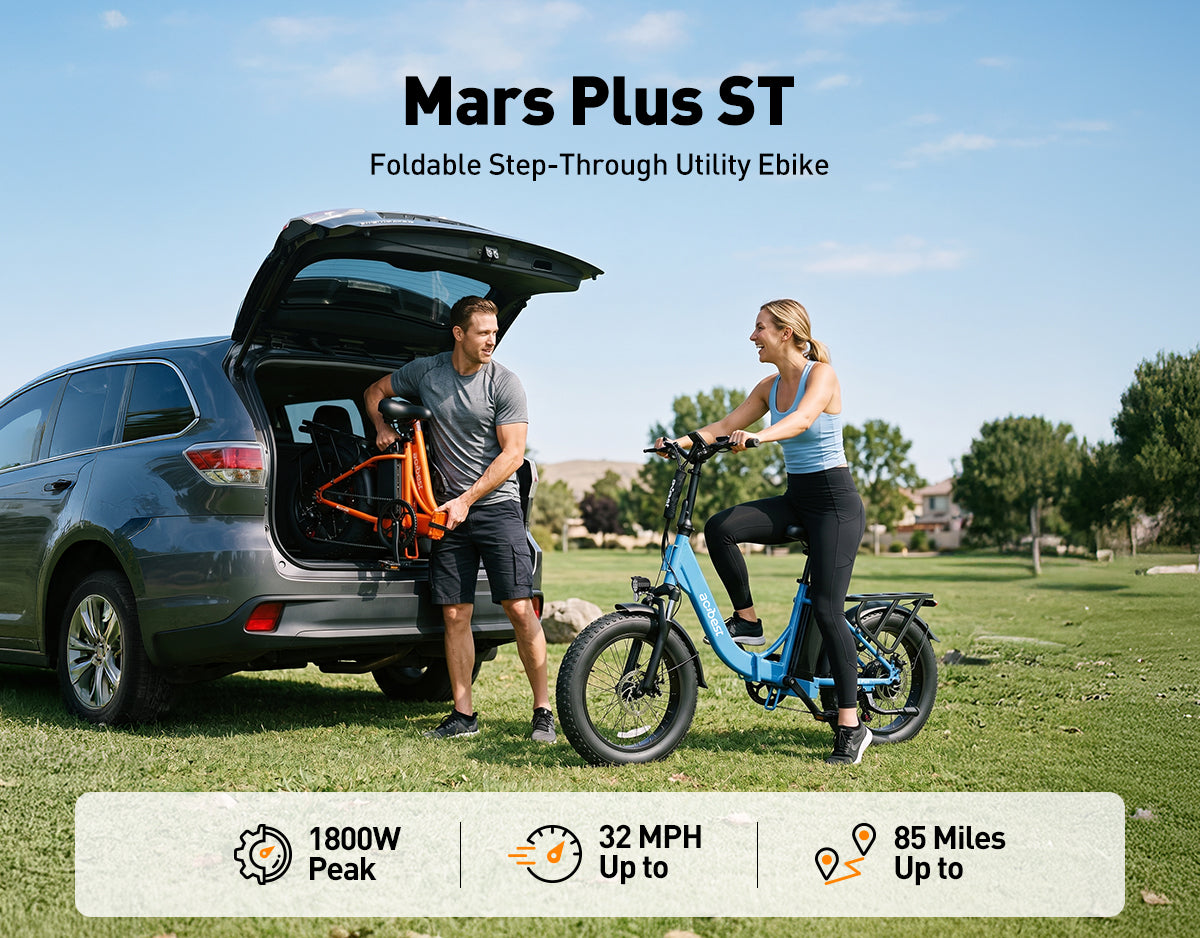
The motor and battery aren’t the only things to consider when buying an e-bike. It needs to actually fit your body. An e-bike size chart is a simple way to narrow down your options. You’ll want to know your inseam, each model’s recommended height range, and the minimum saddle height to feel comfortable.
Even if you’re buying an e-bike online, it’s still worth testing out a real frame in a shop. That can give you an idea of how big a bike you need. Take the measurements you get and compare them to the models online, creating a shortlist.
How to Measure Your Height and Inseam
Measure Total Height
To measure for an e-bike, you need to know your own height accurately. If you’re measuring yourself, remove your shoes. Stand on a hard, level floor with your back against a wall. Keep your legs straight and look straight ahead.
Place a flat book or level object across the top of your head. Hold it firmly in place, step forward, and mark where the lower edge meets the wall. Use a pencil, as it can always be erased.
Measure vertically from the floor to the mark.
Measure Inseam
Your inseam is the other key measurement. It helps determine if the saddle is the right height or not.
Here’s how to take an inseam measurement for e-bike sizing:
1. Stand barefoot against a wall with your feet placed naturally apart.
2. Place a hardcover book between the legs with its spine facing upwards.
3. Raise it firmly enough to simulate contact with a bicycle saddle.
4. Keep the book level.
5. Mark the wall at the top of the book.
6. Measure from the floor to the mark.
7. Repeat the process two or three times and use a consistent result.
Record Mobility and Riding Position
Even if a bike is the right height, you still need to be able to get on it. That means being able to swing your leg over a top tube, place a foot down quickly, and comfortably reach forwards to the handlebars.
If you think you might struggle, it’s best to go for a step-through frame. It doesn’t have a top bar and is better for stop-start riding.
Measurements That Need a Helper
You might also want to measure your torso and arm length. It’s only really necessary to determine reach. Most casual riders primarily need height, inseam, and mounting access.
Wheel Size, Frame Size, and Fit Are Not the Same Thing
|
Term |
What it means |
What it does not tell you |
|
Wheel size |
The nominal diameter category of the wheel or tire, such as 20, 24, or 26 inches |
The rider height or complete frame fit |
|
Frame size |
A frame measurement or manufacturer label such as Small, Medium, or Large |
That two bikes with the same label have identical geometry |
|
Bike fit |
How the rider’s body relates to the saddle, pedals, handlebars, and controls |
That height alone is enough to choose the bike |
Wheel Diameter
E-bike wheels fall into specific categories. You can see 20-, 24-, 26-, 27.5-, and 29-inch wheels. Usually, most brands offer either 20-inch or 26-inch e-bike wheels. A bigger wheel diameter doesn’t automatically mean an e-bike is better suited to a tall adult.
A 20-inch folding e-bike can still fit a relatively tall adult, or a 26-inch step-through may suit a shorter rider if its saddle and frame allow it.
What matters is the tire width, frame size, and overall construction as much as the wheel’s external dimensions.
Frame Geometry
The frame is the most important factor when it comes to bike measurements. Look for these measurements:
· Seat tube: The part supporting the seatpost. Its quoted length does not always equal minimum saddle height.
· Effective top tube: A horizontal measurement showing how long the bike may feel while seated.
· Reach: The horizontal distance from the bottom-bracket area to the top of the head-tube area, using the manufacturer’s geometry definition.
· Standover height: The distance from the ground to the relevant point on the top tube.
· Head tube and stack: Help describe front-end height.
· Wheelbase: The distance between the wheel axles.
Just to make things confusing, manufacturers may define or measure some fields differently, so use the accompanying diagram.
Contact-Point Adjustment
Riders only come into contact with three points on the bike: the saddle, handlebars and grips, and the pedals. The saddle and handlebars are usually adjustable. However, that adjustment has limits. You can raise the seat or handlebars, but you can’t go beyond the marked limit.
General E-Bike Size Chart by Height and Inseam
|
Rider height |
Height in centimeters |
Common inseam band |
Traditional frame sizes to investigate |
Confirm before buying |
|
Under 5'2" |
Under 157 cm |
Under approximately 28" / 71 cm |
XXS or XS |
Minimum saddle height, mounting clearance, and control reach |
|
5'2"–5'6" |
157–168 cm |
Approximately 27–31" / 69–79 cm |
XS or S |
Saddle range, standover, and brake-lever access |
|
5'6"–5'10" |
168–178 cm |
Approximately 29–33" / 74–84 cm |
S or M |
Reach, riding position, and saddle adjustment |
|
5'10"–6'1" |
178–185 cm |
Approximately 31–34" / 79–86 cm |
M or L |
Cockpit room, leg extension, and control position |
|
6'1"–6'4" |
185–193 cm |
Approximately 32–35" / 81–89 cm |
L or XL |
Maximum saddle height and handlebar reach |
|
Over 6'4" |
Over 193 cm |
Approximately 34"+ / 86+ cm |
XL, XXL, or model-specific |
Published rider limit, seatpost extension, and cockpit room |
How to Read the Chart
The chart isn’t comprehensive. It’s a starting point to help you understand the right kind of size for you. Match your height to the bands listed above. Check whether the inseam sits within the corresponding broad range.
You can then use the result to identify likely sizes. However, you’ll always want to check the actual geometry of the e-bike to see if it’s a good fit.
Rider Height and Inseam Ranges
Rider height is almost always listed in feet and inches. Inseam is a little more difficult. In the US, you’ll generally find it listed in inches, while European brands may use metric measurements. Both are listed above for your convenience.
Not every rider within a height band has the same inseam. Someone with shorter legs, for example, might require a lower minimum saddle height and standover even if they’re the same total height as another rider.
When the Chart Does Not Apply
The chart doesn’t apply to all e-bikes. One-size folding e-bikes, moped-style e-bikes, and trikes often sit outside the standard e-bike height classification. Folding e-bikes, for instance, often have seats that rise a lot higher than normal to accommodate a wide range of body sizes.
ActBest Model-by-Model Fit Matrix
Required Fit Fields
So, when you’re reviewing e-bikes for size, what are you looking for? It comes down to a few core characteristics:
· Recommended rider height. Is the bike actually suitable for your size?
· Minimum and maximum saddle height. Can the saddle be adjusted to accommodate you?
· Frame style. This mainly refers to step-over or step-through models.
· Wheel size. The height of the wheel as well as the tire thickness.
Other factors to consider include payload capacity, bike weight, reach, any cockpit notes, and the exact model and version (there can be subtle differences).
Commuter and Step-Through Models
Commuter e-bikes are usually straightforward to size, while step-through frames make mounting easier. Check that the saddle goes low enough and that you can comfortably reach the handlebars, brakes, and ground.
|
Model |
Frame and tires |
Rider height |
Saddle or clearance |
Weight |
Payload |
Main fit caveat |
|
Step-through, 26 × 2.1" |
5'3"–6'2" |
Saddle 29.5–37.8"; listed standover 32.6" |
62.4 lb |
350 lb |
Confirm how the standover figure relates to the low-step opening |
|
|
Step-over, 26 × 2.1" |
5'3"–6'2" |
Saddle 29.5–39.37" |
65.1 lb |
350 lb |
Check top-tube clearance as well as saddle height |
|
|
Step-through, 27.5" |
5'3"–6'2" |
Saddle 29.92–40.16" |
62.4 lb |
350 lb |
Step-through clearance and cockpit reach are not published |
|
|
Step-over, 27.5" |
5'3"–6'2" |
Saddle 31.49–40.16"; standover 27.16" |
65.1 lb |
350 lb |
Has a higher minimum saddle than the standard Core 2.0 |
|
|
Step-through, 24 × 3.0" |
5'1"–6'2" |
Saddle 29.5–38.58"; step-through 17.32" |
72.2 lb |
360 lb |
Lower frame access does not replace a reach check |
Folding and Fat-Tire Models
Folding e-bikes are generally more compact. The rider still needs a suitable saddle range and cockpit reach. Don’t be put off by the smaller wheels. They can affect steering and rider response but do not restrict the bike to shorter adults.
|
Model |
Frame and tires |
Rider height |
Saddle or clearance |
Weight |
Payload |
Main fit caveat |
|
Folding step-through, 20 × 3.0" |
5'0"–6'2" |
Minimum saddle 27.5" |
69.4 lb |
400 lb |
Other published geometry fields conflict and need confirmation |
|
|
Folding step-through, 20 × 4.0" |
5'1"–6'2" |
Saddle 31.1–40.16"; step-through 15.35" |
79.4 lb |
440 lb |
A low step-through does not guarantee a low enough saddle |
|
|
Folding step-over, 20 × 3.0" |
5'1"–6'3" |
Saddle 26–33.9"; standover 31.5" |
59.5 lb |
350 lb |
Conflicting rider-height ranges need resolving |
|
|
Folding step-over, 20 × 4.0" |
5'1"–6'2" |
Saddle range not published |
79.4 lb |
400 lb |
Confirm saddle range and standover before recommending it |
|
|
Step-over, 26 × 4.0" |
5'7"–6'5" |
Saddle 28.3–33.9"; standover 33.9" |
80.46 lb |
360 lb |
Intended for a comparatively tall published rider range |
|
|
Step-over, 26 × 4.0" |
5'7"–6'5" |
Saddle 31.5–37.4"; standover 31.5" |
77.2 lb |
500 lb |
Check mounting clearance rather than relying on payload |
|
|
Step-through, 26 × 4.0" |
5'7"–6'5" |
Saddle 31.5–37.4"; listed standover 31.5" |
77.2 lb |
500 lb |
The low-step opening is not separately quantified |
|
|
Step-over, 26 × 4.0" |
5'7"–6'5" |
Saddle 31.5–37.4"; standover 31.5" |
84.2 lb |
500 lb |
Confirm top-tube clearance and low-speed control |
|
|
Step-through, 26 × 4.0" |
5'7"–6'5" |
Saddle 31.5–37.4"; listed standover 31.5" |
84.2 lb |
500 lb |
Step-through clearance is not separately published |
Moped-Style and Fixed-Seat Models
Moped-style e-bikes need a different fit check. With less seat adjustment, make sure you can comfortably reach the pedals, handlebars, brake levers, and ground.
|
Model |
Frame and tires |
Rider height |
Seat information |
Weight |
Payload |
Main fit caveat |
|
Moped-style, 16 × 4.0" |
5'1"–6'3" |
Minimum seat 27.5"; listed standover 29.9" |
77.2 lb |
360 lb |
Seat position and control reach matter more than wheel size |
|
|
Moped-style, 16 × 4.0" |
5'1"–6'3" |
Seat 19.69–28.74"; seat length 22.83" |
77.2 lb |
350 lb |
Confirm reach to the pedals, brakes, and ground |
|
|
Moped-style, 20 × 4.0" |
5'3"–6'3" |
Listed seat height 22.8" |
105.6 lb |
360 lb |
Fixed-seat position makes control reach essential |
|
|
Moped-style, 20 × 4.0" |
5'3"–6'3" |
Listed seat 27.56–31.5"; seat length 25.2" |
92.6 lb |
360 lb |
Confirm seat adjustability and stopping confidence |
|
|
Moped-style, 20 × 4.0" |
5'3"–6'3" |
Listed seat 27.56–31.5"; seat length 25.2" |
109.8 lb |
360 lb |
Heavy lifting weight and fixed-seat-style fit both matter |
Trikes and Specialty Models
A trike removes the need to balance at a stop, but fit still matters. Check the seat position, step-in access, control reach, overall width, and turning space.
|
Model |
Frame and tires |
Rider height |
Saddle or clearance |
Weight |
Payload |
Main fit caveat |
|
Folding trike, 18 × 3.0" |
5'1"–6'3" |
Published seat field needs confirmation |
101.4 lb |
400 lb |
Check seat position, width, turning space, and lifting weight |
|
|
Folding trike, 20 × 3.0" |
5'4"–6'3" |
Listed standover 33.8"; saddle range not published |
101.4 lb |
410 lb |
Confirm saddle position and control reach before recommending it |
How Frame Style Changes E-Bike Fit
Step-Through and Step-Over Frames
Step-through frames reduce the height the rider must lift a leg over. The lower mounting barrier makes them the preferred option for shorter and older riders. They’re also a great choice for commuters dealing with stop-start riding. Plus, you can ride the bike more easily despite restrictive clothing.
Folding E-Bikes
 Folding e-bikes can often appear smaller, especially the wheels. While the configuration changes the steering and ride response, they’re still suitable for shorter and taller adults.
Check folded dimensions, overall bike weight, hinge position, handlebar adjustment, and whether folding changes how the bike can be carried.
Moped-Style E-Bikes
 The moped-style e-bike fit can differ quite radically from the more traditional frame. The fixed or minimally adjustable seat limits the ability to tune leg extension. That said, the longer saddle means riders can sit slightly further back to give their legs more room.
The rider should be able to turn the handlebars fully and operate the brakes without shifting their hands into an awkward position. Don’t settle for an ill-fitting bike. After a few miles, you’ll notice that the tension and aches can make riding extremely uncomfortable.
Trikes and Cargo-Oriented Models
 Trikes and cargo-oriented e-bikes are a completely different situation. The width, wheelbase, load placement, and turning space all matter alongside rider height.
Check step-in access, saddle position, and handlebar reach. The biggest issue for taller riders is knee placement. You can turn the pedals, but not without bashing your knees into part of the bike.
Find Your Fit With a Three-Step Decision Tree
Step 1 – Eliminate Models Outside Your Height and Inseam Range
You’ll want to ask five questions of each model:
- Is the rider inside the verified height range?
- Is the minimum saddle height compatible with the inseam and stopping needs?
- Does a step-over frame provide sufficient clearance?
- Can the rider remain within the seatpost adjustment markings?
- Is any required fit measurement missing or disputed?
If the answer to any of the first four is no, remove the model from the shortlist. Don’t be tempted to include it simply because you only miss the range by an inch. Height ranges are set for a reason. Even an inch can be a lot if the bike simply cannot accommodate your frame.
Step 2 – Match Frame Style to Mobility and Use
Once you’ve eliminated the models outside your range, select based on what you’ll actually need. Think about your daily route, how the e-bike will be used, and what features you might need.
For example, if you’re a long-distance commuter, comfort, range, and cargo might be important, whereas if you’re commuting in the city, a foldable option you can easily store could be better.
The frame can help you narrow down the choice, but it does not confirm it. It’s the combination of factors, including motor power, battery range, and more, that determines whether an e-bike is suitable.
Step 3 – Confirm Reach, Controls, and Low-Speed Confidence
Lastly, you’ll need to adjust the e-bike for your specific frame. That means tweaking the saddle height, checking you can reach both brake levers without stretching, and ensuring you have adequate knee and foot clearance.
If possible, a test ride can confirm if you can start, stop, place a foot down, and dismount confidently. Give the bike a light ride, test gentle turns and controlled braking, and get a feel for how it performs.
Adjust an E-Bike for a Better Fit
Saddle Height and Fore-Aft Position
The rider should have a comfortable amount of knee bend at the bottom of the pedal stroke rather than locking the leg or remaining excessively crouched. You should be able to make a full rotation comfortably.
It’s best to make small adjustments with the saddle until it’s perfect. Retest the pedaling so it’s just right. Avoid moving the saddle dramatically forwards merely to compensate for excessive handlebar reach.
Handlebar and Control Position
The handlebar position is one of the hardest to get right. You want a comfortable wrist position with slightly relaxed elbows and access to both brake levers (and throttle if present).
You should never feel any tension or strain while holding the handlebars. If necessary, raise the handlebars up to a comfortable height, but never go beyond the markings on the stem.
Components That Can Change Fit
It’s surprising how much of an e-bike you can adjust. The saddle width and shape, grips, stem, pedals, and even brake levers can all be swapped.
A new stem, in particular, can alter steering and cable requirements. Suspension settings can also be adjusted, but it’s best to follow the model or component instructions. Get qualified help whenever compatibility, torque, cable routing, or handling effects are uncertain. It’s very easy to get things misaligned.
Between Sizes, Too Big, or Too Small
|
Fit problem |
What the rider notices |
What to check |
Likely next step |
|
Bike may be too large |
Difficult mounting, excessive reach, poor control access |
Saddle minimum, standover, cockpit |
Adjust within limits or exchange |
|
Bike may be too small |
Cramped position, restricted extension, excessive seatpost height |
Saddle maximum, reach, component limits |
Larger geometry or fit check |
|
Between two sizes |
Both ranges include the rider |
Reach, inseam, use, handling preference |
Controlled comparison |
|
Adjustment cannot solve it |
Limits are reached |
Frame and component compatibility |
Exchange or professional assessment |
Signs the Bike May Be Too Large
A bike might be too big if:
- Difficulty stepping over or through the frame
- Saddle still too high at its minimum setting
- Insufficient top-tube clearance
- Excessive reach to the handlebars
- Difficulty operating brake levers
- Poor control during starts and stops
- Inability to turn the bars comfortably
- Rider repeatedly sliding forwards to reach the controls
Signs the Bike May Be Too Small
A bike might be too small if:
- Seatpost needing to exceed its maximum mark
- Restricted leg extension
- Cramped cockpit
- Knees approaching the handlebars
- Difficulty distributing weight comfortably
- An excessively upright or compressed posture not intended by the design
- Lack of room to adjust the saddle correctly
Choosing Between Two Sizes
How do you know which e-bike to pick if both options fit your body? A smaller option may offer shorter reach, lower standover, easier mounting, and more agile handling, whereas the larger option may offer more cockpit room and feel more planted.
The answer is usually to look at the other features. Consider the battery, motor, bike weight, and payload capacity, matching the bike to your everyday riding.
Adjust, Exchange, or Seek a Fit Check
Bought the bike but having problems? Follow these steps:
1. Make permitted saddle and control adjustments.
2. Repeat the controlled fit check.
3. Ask a qualified fitter or retailer if uncertainty remains.
4. Exchange the bike when the frame geometry remains unsuitable.
Real Rider Fit Examples
Shorter Riders
When choosing an e-bike for a 5'4" rider, don’t stop at whether 5'4" appears within the published range. Check the minimum saddle height, step-through or standover clearance, and distance to the handlebars.
You should be able to reach the brakes comfortably, start without wobbling, and stop under control. A step-through frame can make mounting easier, although it won’t automatically solve a saddle that sits too high or handlebars that feel too far away.
Mid-Range Riders
Sitting near the middle of the published height range usually gives you more options. It doesn’t mean every suitable model will feel the same.
A commuter step-through and a folding e-bike may both fit your height while placing the saddle, pedals, and handlebars differently. One might feel more natural to ride, while the other is easier to store. Compare posture, control reach, low-speed handling, bike weight, and folded size before deciding.
Taller Riders
An e-bike for a tall rider needs more than a high maximum saddle. You also need enough room through the cockpit so your knees don’t feel crowded and your arms aren’t forced into an awkward position.
Check the maximum saddle setting, leg extension, handlebar position, knee clearance, and brake-lever reach. None of the adjustable components should need to exceed their marked limits. Taller riders should also make a few slow turns to confirm that their knees remain clear of the bars.
Mobility or Balance Considerations
If mounting or balance is a concern, look closely at frame access, minimum saddle height, brake reach, and bike weight. You should feel comfortable getting on, setting off, stopping, and turning slowly.
A low step-through can make access easier, but no frame design can guarantee that a rider will not fall. For more guidance, read ActBest’s guide to how seniors can choose an e-bike.
Common E-Bike Sizing Mistakes
Choosing by Wheel Diameter Alone
Wheel diameter is not a reliable indicator of bike height. You should look at the actual height range and frame dimensions, rather than relying solely on the wheel diameter.
Trusting Height Without Inseam
Most e-bikes have a specific height range. But it’s not the only factor that matters. Inseam reflects how comfortable a saddle is and whether you can stand over the bike easily. This matters a lot for riders with shorter legs.
Ignoring Minimum Saddle Height
A broad rider-height range does not help if the saddle remains too high at its lowest permitted position. Always look at all the dimensions of an e-bike when measuring up.
Assuming One Geometry Fits Every Use
E-bikes come in all shapes and sizes. Most people will settle for a standard framed bike. However, opting for a step-through, folding, moped-style, or trike design can be beneficial, depending on your usage.
Overlooking Bike Weight and Mounting
It can be easy to fixate on bike size over everything else. But even if it fits your frame, if it remains difficult to mount, lift, or store, it can be impractical for daily use.
Using a Stale Model Chart
Rider ranges and published measurements can change. Verify the current product page and manual before buying.
Frequently Asked Questions
What size e-bike should I get for my height?
Look at the listed height range for each e-bike and select models that match. The height is just the starting point, however. Measure your inseam and then compare the exact model’s minimum saddle height, standover or step-through clearance, reach, and control position.
What size e-bike is right for a 5'4" rider?
There’s no universal size for every 5’4” rider. You want to look at the inseam, torso length, minimum saddle height, reach, and frame style to find the right bike for you. Use the recommended height range as a starting point.
What does a 20-, 24-, or 26-inch bike mean?
These numbers refer to the diameter of the wheel. They’re not directly related to the frame size, saddle height, standover or step-through clearance, reach, or control position.
Should I be able to put both feet flat on the ground?
That depends on the frame and saddle design. Just because you cannot put both feet flat on the ground doesn’t mean the bike isn’t the right fit. Confirm the intended setup for the exact model.
Is a step-through e-bike better for shorter riders?
A step-through can be a good option for shorter riders. It makes it easier to mount and dismount because there is no top bar. However, it doesn’t automatically mean a better fit. Minimum saddle height, reach, brake access, and the published rider range still matter.
Confirm the Model, Not Just the Chart
Finding the right e-bike comes down to four steps:
1. Measure your height and inseam.
2. Shortlist models using their verified rider ranges.
3. Compare the saddle range, frame clearance, reach, controls, and frame style.
4. Complete a controlled fit check or test ride.
The recommended height range is only a starting point. Your proportions, mobility, and preferred riding position all affect how a bike feels. Check the model’s full dimensions against your own measurements before making a final decision.
Read our guide to choosing an electric bike for adults to find the best overall model for your needs.
Share:
How Much Does an E-Bike Really Cost to Own?
E-Bike Maintenance Guide: Schedule, Checklist, and Safe DIY Care