
A folding electric bike can make a city commute easier to live with when storage space is tight or the ride connects with another mode of travel. But the best foldable electric bike for your commute isn't automatically the one with the smallest-looking fold. It has to fit you on the road, fit a permitted storage spot, and be manageable whenever you need to move it.
I'd start with the part of the trip that causes the most trouble. A bike you fold once a week on a ground floor has a different job from one you lift over a sedan's trunk lip twice a day. The hinge saves floor space; it doesn't make the bike lighter or guarantee it will pass through a car opening.
Why Foldable Electric Bikes Appeal to City Riders
Folding can help when a full-size frame takes up too much room in a permitted storage area, when you regularly put the bike in a vehicle, or when a transit operator allows your particular folded e-bike. It also lets some riders combine a ride to the station with a train journey and another ride at the far end. Check the operator's current bike, battery, size, and peak-hour rules before making that your commute. "Foldable" is not a transit pass.
Keeping a bike inside a workplace may reduce the time it sits unattended outdoors, but ask the workplace first. Parking and charging are separate permissions. The same goes for an apartment: available floor space does not override building rules or a model's storage instructions. For the Mars specifically, there is a conflict between the product listing and the linked manual that you need to resolve before counting on residential storage. I'll spell it out in the model comparison below.
What Makes a Foldable Electric Bike Good for Commuting?
Four checks matter most: folded size, weight, usable range, and riding comfort. Run them against the whole day, not just the ride from the front door.
Folded Size: Will It Work at Home, Work, or in a Car?
Measure the space where the bike would actually go, including doors, elevators, clearances around other belongings, and the room needed to unfold it. A published measurement may describe a particular folding configuration; a rack bag, basket, fender, handlebar position, or pedal can change the outline. An office desk or small apartment is not a standard-size test fixture.

Mars shown in riding configuration, not as a folded-size reference.
Two-axis folded figures and "fits most trunks" claims aren't enough to make a purchase decision. We don't have a confirmed three-axis folded measurement for the current Mars setup. The current Summit geometry section lists 37.4 inches long, 17.7 inches wide, and 30.3 inches high; the Mars Plus ST geometry section lists 42.52 x 20.87 x 32.28 inches in the same order. Those are manufacturer-listed folded figures, checked September 29, 2026, not measurements of your equipped bike. The Summit page has another field labeled "Product Dimensions"; don't substitute that field for the explicitly labeled folded dimensions.
Use these numbers to make a shortlist, then confirm the exact model, folding state, and accessories when the fit is tight. A photograph of a bike beside a trunk can't settle it.
Weight: Can You Handle Every Necessary Lift?
The listed weight matters most when the commute includes stairs, a transit transfer, or car loading. As checked on September 29, 2026, ACTBEST lists the Mars at 69.4 lb, the Summit at 59.5 lb, and the Mars Plus ST at 79.4 lb. They are manufacturer specifications, not our lifting tests. We haven't independently confirmed whether the quoted weights include batteries or every accessory.
Try to picture the actual movement, not just the number on a spec sheet: picking the folded bike up without grabbing cables, clearing the trunk lip, turning it into place, then doing the reverse at the destination. If you cannot control that lift, arrange dependable help or choose another transport plan. Don't assume most adults can carry a 69.4 lb bike up a flight of stairs. Removing a battery is an option only if the exact model's instructions allow it; don't subtract an estimated battery weight from a listed whole-bike weight.
Battery Range: Can It Cover Your Real Commute?
Write down the round trip and regular detours before looking at an advertised maximum. The current Mars listing describes a removable 48V 13.5Ah battery and up to 65 miles under ideal pedal-assist conditions; the current Summit listing describes a removable 48V 12Ah battery and up to 60 miles under ideal pedal-assist conditions. These are listing claims checked September 29, 2026, not guaranteed results for your route. Both listings say load, terrain, speed, assist level, temperature, tire pressure, and riding habits affect range.
I'd leave a practical margin for wind, hills, cargo, and days when you use more assist. No single percentage discount turns an advertised maximum into your reliable range. If the return trip depends on workplace charging, confirm that charging is permitted there and use the equipment and location specified for your exact bike. A removable battery does not by itself grant permission to charge at a desk or store the rest of the bike indoors.
Comfort and Stability: Does It Fit the Ride?
Compact wheels and a folding frame don't tell you enough about how the bike will feel. Look at tire size, suspension layout, fit, and the surfaces on your route. The current Mars and Summit listings both specify 20 x 3.0-inch tires; the Mars lists an adjustable front fork, while the Summit lists a front fork and four-bar rear suspension. The Mars Plus ST lists 20 x 4.0-inch tires and an adjustable suspension front fork. Full suspension is worth considering on broken pavement, but it isn't a substitute for a fitting ride or a manageable lift.
Check seat height, reach, getting on and off, and how the bike handles at a stop. Our e-bike size chart can help you measure height and inseam for a shortlist; confirm the riding position on the exact model. A step-through frame can make mounting easier for some riders without resolving every fit question. Include your normal bags in the check. A loaded rack affects handling and may change the folded shape.
Will a Folding E-Bike Fit in Your Car?
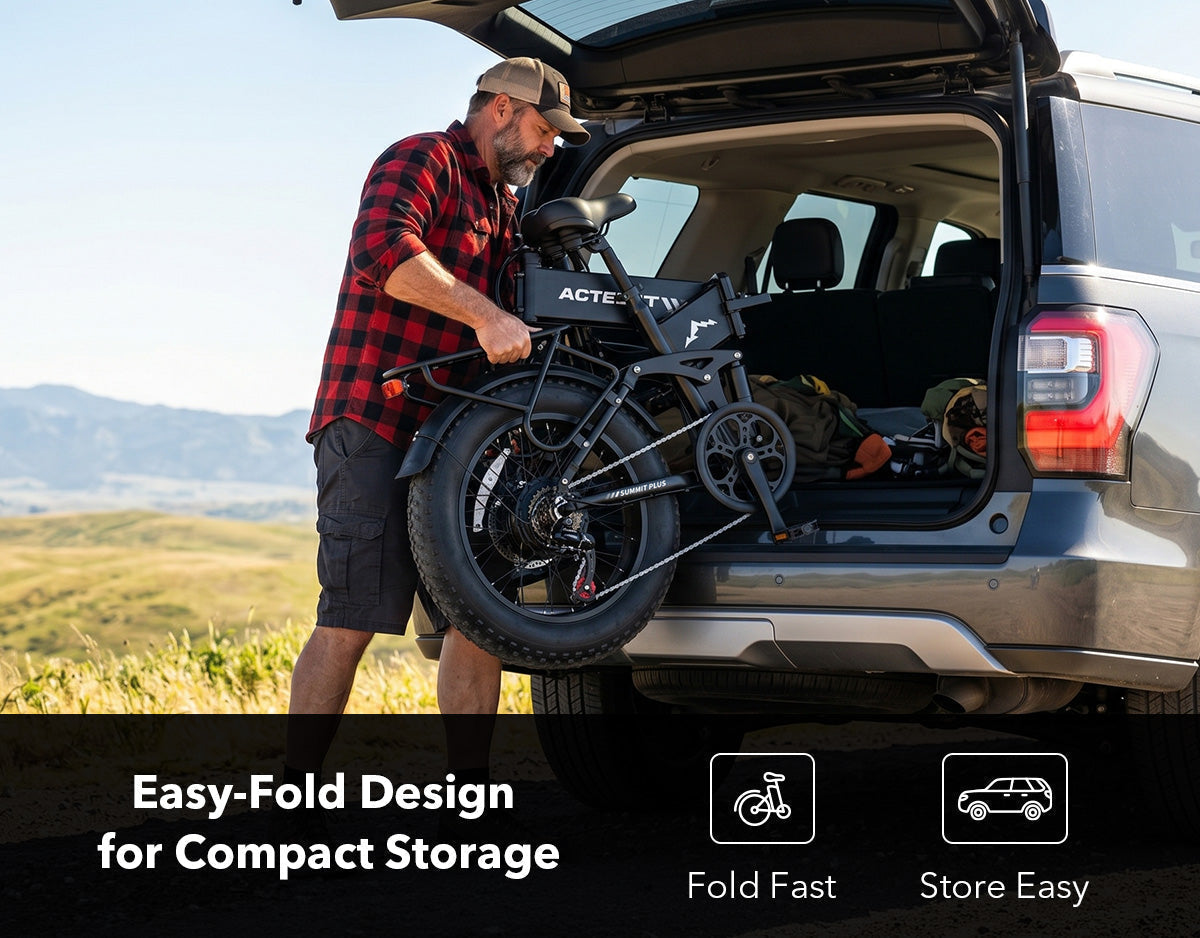
Maybe. Check the folded bike, the vehicle opening and loading route, and the person doing the lift. A sedan trunk, hatchback, SUV cargo area, and RV compartment have different lips, openings, corners, and anchor points. Interior cargo volume alone cannot answer the question.
Measure the usable width and height of the hatch or trunk opening. Include the lip, hinges, trim and sloping glass. Next, trace the turn the bike must make after entering. A bike can fit on the cargo floor and still be impossible to pass through the opening.
Measure the bike in its actual transport configuration, folded according to the correct model manual. Include the handlebars, pedals, rack, fenders and fitted accessories. Don't substitute unfolded product dimensions or packaging dimensions for the folded bike.
Bike, Vehicle and Rider Measurement Sheet
Use the same units throughout. Enter "unknown" when a measurement is missing; that is a reason to ask, not a reason to guess.
| Check | What to record |
|---|---|
| Bike identity | Exact model, version and installed accessories |
| Folded shape | Length, width and height, plus any protruding parts |
| Vehicle opening | Usable width and height at the narrowest point |
| Loading route | Trunk-lip height, turning space and room for your hands |
| Interior space | Available length, width and height with your usual seats and cargo |
| Lifting configuration | Actual weight as loaded, including or excluding the battery as confirmed |
| Handling | Who lifts, suitable handholds and whether reliable help is available |
| Restraint | Suitable vehicle anchor points and places on the bike that can take the restraint |
A cardboard outline can help rule out an obvious mismatch before purchase. It does not reproduce the bike's weight, moving parts or awkward corners. If the dimensions are close, request a demonstration with the actual configuration and vehicle. Don't force the hatch shut against a bike.
Best Foldable Electric Bikes for Commuting and Small Spaces
ACTBEST's current folding choices solve different riding problems. These are manufacturer-listed specifications checked on September 29, 2026, not a controlled side-by-side ride, lift, or car-fit test. Check the live listing for price and availability.
| Model | Listed weight and ride setup | Folded size on current listing | Best reason to shortlist it |
|---|---|---|---|
| Mars | 69.4 lb; 20 x 3.0-inch tires; adjustable front fork | Three-axis figure not confirmed for this setup | A front-suspension folding commuter when its storage and lift can be verified |
| Summit | 59.5 lb; 20 x 3.0-inch tires; front and rear suspension | 37.4 x 17.7 x 30.3 in, length x width x height | Rougher surfaces where you value full suspension and can confirm fit |
| Mars Plus ST | 79.4 lb; 20 x 4.0-inch tires; front suspension; step-through frame | 42.52 x 20.87 x 32.28 in, length x width x height | A lower step-over and utility layout, provided the heavier lift works |
Mars: Start here if you want a front-suspension folding commuter, provided storage, carrying, and service are workable. I wouldn't choose it for repeated stair carries without trying that task first.
There is also a storage conflict to resolve before buying for an apartment. The current Mars listing describes apartment storage, but the Mars-linked manual, labeled Mars ST says not to store the bike in residential buildings. We cannot determine from that mismatch which versions the instruction covers. Ask ACTBEST which instructions apply to your exact model and version before relying on an indoor storage plan. Don't assume removing the battery resolves a restriction on the bike.
Summit: Consider it when front and rear suspension are priorities. This is the current Summit, not the separate Summit Plus configuration. Its listed weight is lower than the Mars's, but a smaller number doesn't certify an easy lift or a comfortable ride. Use its explicitly labeled folded measurements for initial planning and ask us to confirm the configuration before a tight-fit purchase.
Mars Plus ST: The step-through frame and wider listed tires may suit a rider who values easier mounting or a different utility setup. Its listed weight makes the lift especially important to check. Measure with your actual accessories, not a bare-bike silhouette.
The listed weights are not a verified battery-in versus battery-out comparison. Before relying on battery removal to make lifting manageable, confirm the permitted procedure and resulting weight. Nor do the folded figures establish that any of these bikes fits a particular car.
Send your vehicle-opening measurements and chosen accessory setup through ACTBEST's contact page. Ask for the exact folded dimensions, how they were measured, and what the quoted weight includes. That is a much more useful question than "Will it fit an SUV?"
Load, Secure and Unfold the Bike Carefully
Before loading, follow the model's folding instructions, turn off the bike and secure anything that could swing during the lift. Remove the battery only through the approved procedure and only when you can handle it safely.
Keep your fingers away from the hinge. Don't use the display, brake cables or derailleur as handles or let those parts take the bike's weight. Use an agreed lift with a helper when needed; stop if you cannot control the movement.
Once inside the vehicle, protect contact points and secure the bike using suitable restraints and vehicle anchor points. It must not slide into passengers or glass during a turn or sudden stop. Follow the vehicle's loading instructions as well as the bike's handling guidance.
After unloading, unfold and lock the frame as instructed. Check the latch, steering, wheels, brakes and any part that took a knock before riding. An uncertain latch is a reason to stop, not to "see how it feels" on the way to work.
Who Should Choose a Foldable Electric Bike?
A folding e-bike makes sense when folding actually solves a permitted storage or transport problem and you like riding the bike the rest of the time. A ground-level storage spot and an occasional car trip are a different proposition from twice-daily stairs. If public transit is essential, get the operator's rules first. If an indoor spot is essential, settle the building and model-instruction questions first.
If you never need to fold or load the bike, compare a conventional-frame commuter as well. You may prefer its ride, fit, or simpler day-to-day handling. If the space works but the lift doesn't, change the transport plan, arrange reliable help, or choose a bike you can control. If the opening or folded configuration is still unknown, a real demonstration is worth more than another spec comparison.
For a daily commute, check the local repair and support route before ordering, too. Then browse our foldable electric bike range with your route, storage rules, and loading measurements in hand. The right bike should work at the doorway and at the end of the ride, not just in the product photo.
FAQ
Can a Foldable E-Bike Fit in a Car Trunk?
Some can, but no folded-size figure proves fit in your particular car. Measure the opening, trunk lip, turning path, and cargo space; then verify the actual folding configuration and a lift you can control.
Is a Folding E-Bike Too Heavy to Carry?
It depends on the bike and every lift your trip requires. Folding changes its shape, not its weight. The three listed models span 59.5 lb to 79.4 lb, but a number alone can't tell you whether a stair carry or car load is safe for you. Try the real task or arrange dependable help.
Does the Folding Design Affect Battery Range?
Not by itself in a way you can use as a range prediction. Battery, motor assistance, rider and cargo load, route, conditions, and how you ride all matter. Compare the exact model's stated conditions and plan a margin; don't treat an ideal pedal-assist maximum as your commute's assured distance.
Can I Take a Foldable E-Bike on Public Transport?
Only if that operator allows your bike and battery under its current rules. Check folded size, time-of-day limits, and where bikes may be carried before depending on a train or bus connection. Policies are not uniform across cities or services.
Can I Store a Folding E-Bike in an Apartment or Office?
Only if the building's rules and the instructions for your exact bike permit that storage location; charging permission is separate. The Mars listing and its linked Mars ST manual differ on residential storage, so get a model-specific clarification before buying for an apartment. Battery removal does not settle that conflict by itself.
What's the Difference Between the Mars and Summit?
The current Mars lists front suspension and 69.4 lb; the current Summit lists front and rear suspension and 59.5 lb. Both list 20 x 3.0-inch tires. Summit has a three-axis folded figure on its current page; Mars's exact current three-axis folded size still needs confirmation. Choose by riding fit, allowed storage, actual lifting, and measured clearance.
Can I Remove the Battery Before Loading?
Use the exact model's removal instructions and confirm how the battery should be transported separately. Do not subtract an assumed battery weight from the listed bike weight or assume removal changes indoor storage rules.
Share:
What Is Ghost Pedaling on an E-Bike and How Does It Feel?
Who Will Repair My E-Bike? Questions to Ask Before Buying Online