
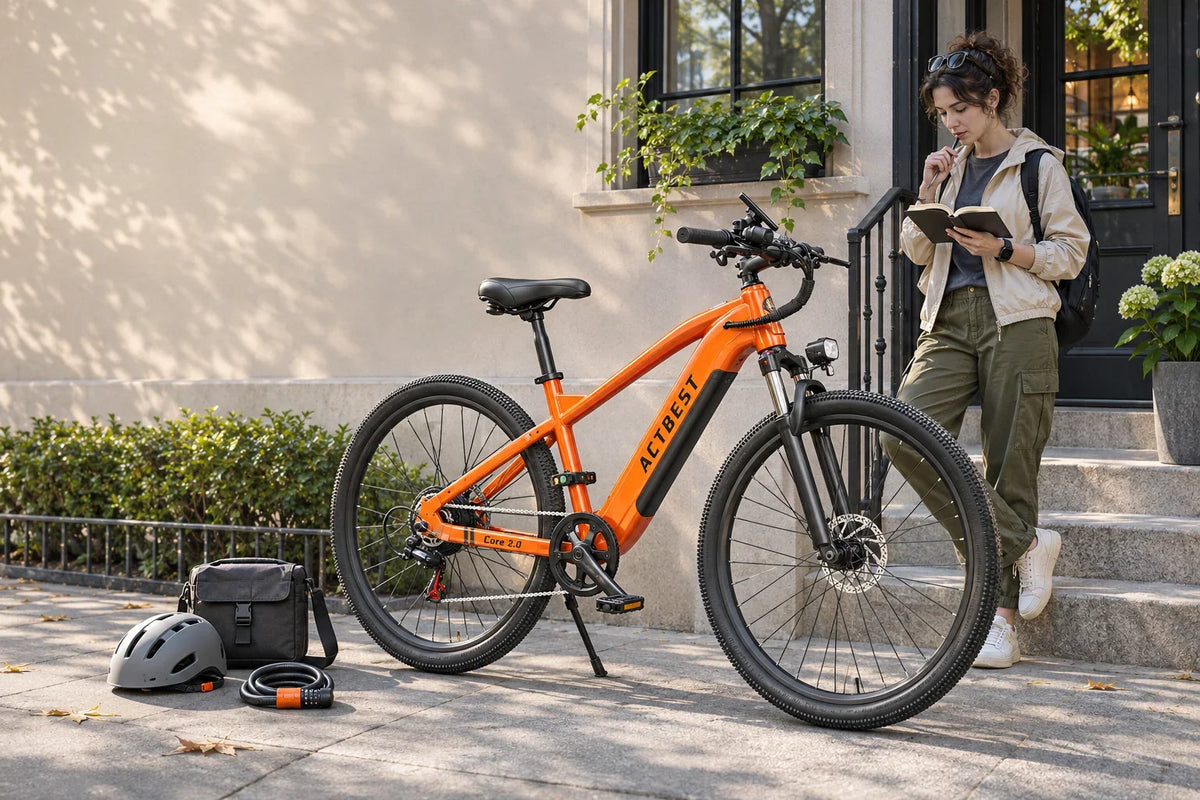
A $1,000 price cap is only useful if the bike actually fits your day. We put this guide together because "best" depends on whether you need to climb stairs with it, park it in a hallway, or ride it to work five days a week. This is a brand-owned comparison from ACTBEST, based on current manufacturer listings and product pages checked November 4, 2026. We did not run independent side-by-side road tests for this update.

Best Electric Bikes Under $1,000 at a Glance
| Model | Observed bike price, Nov 4, 2026 | Suited to | Important tradeoff |
|---|---|---|---|
| ACTBEST Core 2.0 | From $599 | Traditional-frame commuting, budget room for gear | 65.1 lb complete; not a proven lightweight carry |
| ACTBEST Core ST 2.0 | From $599 | Frequent mounting and dismounting | Step-through does not fit every rider height; 62.4 lb |
| ACTBEST Core 2.0 Plus 27.5 | $699 Standard | Paying more for torque sensing and larger wheels | 65.1 lb; not a weight-saving upgrade |
| ACTBEST Mars | From $569 Standard | Folding for limited storage space | 69.4 lb complete; folding does not solve stair carrying |
| Lectric XP4 500W Step-Thru White | $999 | Torque sensing and hydraulic brakes at the budget ceiling | $1,000 total budget leaves $1 before tax and gear |
Prices are current listed bike prices, not out-the-door totals. Color and configuration variants may cost more. The XP4 entry covers only the 500W Step-Thru White version, not the 750W or extended-range models.
What We Included, and What the Prices Mean
This is a focused brand comparison, not a claim that these are the only good e-bikes under $1,000. We included models with a current listed price at or below $1,000, a clear product page, and enough specification detail to compare meaningfully. Sale pricing, bundle offers, and model suffixes can change what you actually pay. We note the listed price, not a struck-through original or a promotional bundle total.
Which Budget E-Bike Suits Your Ride?

ACTBEST Core 2.0: Keep More Budget for the Rest of the Ride
Our Core 2.0 is the straightforward pick for riders who want a traditional step-over frame and the lowest entry price in this group. The 26 x 2.1-inch tires handle city pavement and light gravel without the rolling resistance of wider rubber. The 7-speed Shimano drivetrain gives you enough range to match the motor's assistance without forcing you to spin at an uncomfortable cadence on flat ground.
The removable 48V 10.4Ah battery locks into the downtube with a key. You can charge it on the bike or carry it inside, which matters if you park outside or in a shared garage. The 1200W peak motor provides strong assistance for city streets, but peak wattage is not a climbing guarantee. A 250W nominal motor with a torque sensor will often feel more responsive on a steep hill than a high-peak motor with a basic cadence sensor.
At 65.1 lb complete, this is not the bike you want to carry up a flight of stairs every day. The included rear rack supports up to 120 lb, which covers groceries, a work bag, or a small passenger seat if your local laws permit it. It is a solid commuter for ground-floor storage and riders who prefer a conventional frame.

ACTBEST Core ST 2.0: Spend for Access, Not More Peak Watts
The Core ST 2.0 shares the same $599 starting price, 48V 10.4Ah battery, and 1200W peak motor as the Core 2.0. What changes is the step-through frame, which makes frequent stops and starts easier for riders who find a high top tube awkward.
Step-through does not automatically mean "fits everyone." The standover height and seat tube angle still matter. A rider with a 28-inch inseam may find the lowest seat position too high, while a rider with a 34-inch inseam may find the maximum too low. Check the actual standover and seat-height range against your measurements before assuming it works. Our guide to e-bike sizing by height and inseam explains how to measure yourself and compare those numbers to a product page.
At 62.4 lb, the ST is slightly lighter than the Core 2.0 but still not a bike you want to haul upstairs regularly. The step-through frame adds convenience at stops, not portability.

ACTBEST Core 2.0 Plus: What the Extra $100 Changes
The Core 2.0 Plus 27.5 starts at $699 for the Standard version, $100 more than the base Core 2.0. That difference buys three specific changes: a torque sensor, 27.5 x 2.1-inch wheels, and a 48V 12Ah battery (576Wh versus the base model's 499.2Wh).
The torque sensor changes how the motor responds to pedal pressure. A cadence sensor detects that your cranks are turning and applies a fixed level of assistance. A torque sensor detects how hard you are pushing and adjusts the motor output proportionally. The difference matters most when starting from a stop, climbing, or accelerating through an intersection. It feels less like an on/off switch and more like a natural extension of your legs.
The larger 27.5-inch wheels roll over rough pavement, potholes, and trail debris differently than 26-inch wheels. The larger diameter reduces the angle of impact, which can feel smoother on broken city streets. Neither upgrade makes the bike lighter or cheaper to carry. At 65.1 lb, the Plus weighs the same as the base model.
The manufacturer's "up to 100 miles" range figure is a best-case claim under specific conditions. We have not independently verified that number, and it does not account for your weight, route, assist level, or weather. Use it as a relative indicator, not a planning guarantee.

ACTBEST Mars: Folding for Space, Not for Easy Carrying
The Mars starts at $569 and folds to fit in a car trunk, apartment corner, or RV storage compartment. The 48V 13.5Ah battery and 20 x 3.0-inch tires are unusual at this price. The three-axis folding mechanism collapses the frame, handlebars, and pedals into a package that fits where a full-size bike will not.
But folding solves storage volume, not weight. At 69.4 lb complete, the Mars is the heaviest bike in this group. The folding joints add weight and complexity. If your daily routine involves carrying the bike up a flight of stairs, folding does not fix that problem. It helps when you need to fit the bike into a tight space, not when you need to lift it regularly.
The 20 x 3.0-inch tires are wider than most folding bikes in this price range, which helps with stability on uneven pavement. The tradeoff is that wider tires add rolling resistance and weight. For riders who need a bike that fits in a closet or the back of a sedan, the Mars makes sense. For riders who need to carry it regularly, it does not.
Lectric XP4 500W: Torque Sensing and Hydraulics at $999
The Lectric XP4 500W Step-Thru White is the only non-ACTBEST model in this comparison. At $999, it sits at the top of the budget. It includes a torque sensor and hydraulic disc brakes, which are rare below $1,000.
The listed weight is 62 lb without the 7 lb battery, putting the complete bike at approximately 69 lb. That arithmetic comes from the manufacturer's own figures, but we have not independently verified the complete weight with all accessories attached. The XP4 folds, but like the Mars, folding does not make it easy to carry.
The torque sensor and hydraulic brakes are the real differentiators. The torque sensor provides the same proportional pedal response as the Core 2.0 Plus. The hydraulic disc brakes require less hand force than mechanical disc brakes, which matters on long descents or in stop-and-go traffic. We have not measured stopping distances for this comparison, and we do not claim that hydraulic brakes are universally shorter-stopping than mechanical brakes in every condition.
We include the XP4 because it shows what the top of this budget can buy. If torque sensing and hydraulic brakes matter more to you than having budget left over for a helmet and lock, it is worth considering. Just know that $999 leaves almost nothing for tax, assembly, or accessories.
Where the Next Dollar Makes a Difference
Pedal Response, Brakes, and Gearing
The Core 2.0 and Core ST 2.0 use cadence sensors. The Core 2.0 Plus and XP4 use torque sensors. A cadence sensor detects that your cranks are turning and applies a fixed level of assistance. A torque sensor detects how hard you are pushing and adjusts the motor output proportionally. The difference matters most when starting from a stop or climbing, but it is not a universal "better" for every rider.
Hydraulic disc brakes on the XP4 offer a different lever feel than the disc brakes on ACTBEST models. Hydraulic systems use fluid pressure to move the brake pads, which generally requires less hand force than the cable-actuated mechanical systems on the ACTBEST models. That difference matters on long descents or in stop-and-go traffic where you brake repeatedly. It does not mean every hydraulic brake outperforms every mechanical brake in every condition. We have not measured stopping distances for this comparison.
The 7-speed Shimano drivetrain on the Core 2.0, Core ST 2.0, and Core 2.0 Plus covers the range most riders need for city commuting. The Mars uses a similar 7-speed setup. More gears are not automatically better; what matters is whether the lowest gear is low enough for your steepest hill and the highest gear is high enough for your fastest flat section.
Battery Energy Is Not a Commute Guarantee
Battery voltage multiplied by amp-hours gives you watt-hours, a rough measure of stored energy. The Core 2.0's 48V 10.4Ah battery stores 499.2Wh; the Core 2.0 Plus's 48V 12Ah stores 576Wh. More watt-hours generally means more range, but the actual distance depends on your route, weight, assist level, tire pressure, and weather.
Do not apply a universal discount to advertised range figures. "Up to 55 miles" under ideal conditions does not become "exactly 44 miles" in the real world. Your mileage will vary. Plan your route with a reserve that accounts for your actual conditions, not a formula from an article.
A rider who weighs 150 lb on flat ground with low assist will get more range than a rider who weighs 220 lb on hilly terrain with high assist. The same battery will behave differently in January than in July. Cold temperatures reduce available power and range on most lithium-ion batteries, but the size of that effect varies by cell design and conditions. Track your own rides to build a baseline for your specific setup.
The Bike Still Has to Fit Your Home
A bike that fits your budget but not your hallway is not a good buy. Measure your storage space, your doorways, and any stairs you need to navigate. A folding bike that fits in a closet is only useful if you can get it there. If you cannot safely lift 60-70 lb, look for a lighter bike or a ground-floor storage solution. Do not buy a folding bike assuming it solves a weight problem.
The Mars folds to approximately 31.5 x 23.6 inches, which fits in most car trunks. The XP4 folds to a similar footprint. Both still weigh about 69 lb with the battery installed. If you need to carry the bike up stairs daily, neither is the right choice. A lighter non-folding bike or a ground-floor storage solution will serve you better.
A $1,000 Bike Budget and a $1,000 Total Budget Are Different
The listed price is not the final price. Tax, assembly, and accessories add up. Here is what remains after the bike itself:
| Configuration | Bike price | Remaining from $1,000 | What it means |
|---|---|---|---|
| Mars Standard | $569 | $431 | Enough for basic gear if you already have some equipment |
| Core 2.0 / Core ST 2.0 | $599 | $401 | Covers a helmet and lock if you assemble it yourself |
| Core 2.0 Plus Standard | $699 | $301 | Tight for gear; local assembly may exceed the remainder |
| XP4 500W | $999 | $1 | No realistic room for tax or accessories |
If you already own a helmet, lock, and basic tools, the lower-priced models leave room for local assembly or a professional fitting. If you are starting from zero, the XP4's $999 price leaves almost nothing for the rest. A $1,000 bike budget and a $1,000 all-in budget are not the same thing.
Service and Electrical Safety Are Part of the Value
A local bike shop can handle mechanical repairs like brake adjustments, wheel truing, and drivetrain work. Electrical diagnostics and battery service are different. Not every shop will work on direct-to-consumer e-bikes, and a manufacturer sending you a part does not mean they pay for the labor to install it.
Check whether a local shop will service your specific model before you buy. Ask about both mechanical and electrical work. A warranty that covers parts but not labor is still useful, but it is not the same as full coverage.
UL 2849 covers the electrical drivetrain, battery, and charger as a system. It does not evaluate whether a rider can maintain control or how the bike handles. A battery or charger tested to a standard is not the same as a complete certified e-bike. We reference our TUV Rheinland certification where it applies, but we do not claim independent verification beyond what the manufacturer documentation states.
Marketing speed figures like 28 mph or 35+ mph do not tell you whether that speed is legal on your local roads. Check your state and local regulations before assuming a bike's top speed is permitted where you ride.
Assembly and First Ride
All five bikes in this comparison ship partially assembled. The Core 2.0, Core ST 2.0, and Core 2.0 Plus arrive with the front wheel, handlebars, pedals, and accessories requiring installation. The Mars and XP4 require similar steps plus folding mechanism checks.
Budget time for assembly or plan for a local shop to handle it. A professional build typically costs $75-$150 depending on your area, which is worth it if you are not comfortable with brake adjustments, wheel truing, or electrical connections. A poorly assembled e-bike is not just inconvenient; it is unsafe.
Before your first ride, check the tire pressure, brake lever feel, battery lock, and display function. Test the pedal assist and throttle in a safe, open area before riding in traffic. The motor should engage smoothly without jerking or cutting out. If anything feels wrong, stop and contact the manufacturer before riding further.
When a Used Higher-Spec Bike Is the Better Comparison
A new bike under $1,000 comes with a warranty and known history, but a used bike with a higher original price can offer better components if the previous owner maintained it. The tradeoff is uncertainty about battery health, frame condition, and whether the seller actually owned it.
If you are considering a used e-bike, read our guide to buying a used e-bike for a checklist that covers ownership verification, battery inspection, and test-ride steps. This article does not duplicate that process.
Questions About E-Bikes Under $1,000
Which e-bike under $1,000 is best for commuting?
The best commuting e-bike under $1,000 depends on your route, storage, and how often you mount and dismount. The Core 2.0 and Core ST 2.0 offer the lowest entry price; the Core 2.0 Plus adds torque sensing; the Mars folds for tight storage. There is no single answer for every rider.
Does under $1,000 include tax and accessories?
No. The prices in this guide are listed bike prices before tax, assembly, and accessories. A $999 bike leaves almost no room for a helmet, lock, or professional assembly within a $1,000 total budget.
Is a torque sensor worth paying more for?
A torque sensor changes how the motor responds to your pedaling effort. Some riders prefer the feel; others do not notice the difference. The Core 2.0 Plus charges $100 more than the base Core 2.0 for the torque sensor and larger wheels. Whether that is worth it depends on how much you value the pedal response.
Can I get hydraulic disc brakes below $1,000?
Yes. The Lectric XP4 500W Step-Thru White includes hydraulic disc brakes at $999. Hydraulic brakes are not standard on ACTBEST models in this price range. The presence of hydraulic brakes does not guarantee shorter stopping distances in every condition.
Are folding e-bikes easier to carry upstairs?
No. Folding reduces storage volume, not weight. The Mars weighs 69.4 lb; the XP4 weighs approximately 69 lb with the battery installed. Neither is easy to carry up stairs regularly. Folding helps when you need to fit the bike into a small space, not when you need to lift it.
How much range will I actually get?
Actual range depends on your route, weight, assist level, tire pressure, wind, and temperature. The manufacturer's "up to" figure is a best-case claim under specific conditions. Build your own baseline by tracking your actual rides rather than relying on a single advertised number.
Should I wait for a sale or buy used?
If you need a bike now and the current price fits your budget, buy now. Sale timing is unpredictable, and a used bike with unknown history is not automatically a better value. Compare the total cost, including any repairs or battery replacement the used bike might need.
Choose the Tradeoff You Can Live With
Pick the bike that matches how you actually ride, store, and carry it. If you need the lowest price and ground-floor storage, the Core 2.0 or Core ST 2.0 covers the basics. If torque sensing matters more than budget remaining, the Core 2.0 Plus is the step up. If storage space is the constraint, the Mars folds. If you want torque sensing and hydraulic brakes at the top of the budget, the XP4 is there. The right choice is the one that fits your day, not the one with the longest spec sheet.
Share:
Cold-Weather E-Bike Battery Care: Riding, Charging, and Storage Are Different