
You can ride a cold e-bike battery when the exact model's operating conditions allow it and the bike behaves normally. Charging is a separate decision: the pack must meet its own charging conditions before you plug it in. This guide focuses on winter conditions; for the year-round connection and monitoring routine, see our e-bike battery charging guide.
Use the charger supplied with the battery or one specifically approved for it. Follow the model's instructions for charging temperature, connection order, removal, and storage. The U.S. Consumer Product Safety Commission (CPSC) advises staying present while charging and not charging while asleep or away from home.
If the pack is swollen, leaking, unusually hot, giving off an odor, hissing, or smoking, skip the routine winter steps. Stop using it, move away, keep others clear, and follow the emergency guidance below.

Cold-Weather E-Bike Battery Care: Four Situations, Four Decisions
Riding in cold air, bringing a cold battery indoors, parking at work, and storing a bike for weeks call for different decisions. Start with the situation in front of you:
| Situation | What to do |
|---|---|
| Riding in cold air | Check the bike before leaving, plan for less range than in mild weather, and leave a reserve that suits your route. |
| A cold battery after a ride | Power down, inspect it, and let a normal, dry pack warm naturally. Charge only when it meets the battery's specified charging conditions. |
| A wet bike or battery | Keep water away from the charge port. Do not charge if a connector or housing may be wet inside or the bike behaves differently. |
| A short stop at work or school | Bring a removable battery indoors only if the bike instructions and building rules allow it. Protect the parked bike from moisture and tampering. |
| A long pause or winter storage | Use the exact battery instructions for storage charge level, temperature, location, and check-in schedule. |
| Warning signs | Stop using and charging. Do not handle a hot, smoking, hissing, swollen, or leaking pack. Move away and call 911 from a safe place. |
When in doubt, the battery manual is your source for model-specific limits. Use it for charging and operating temperatures, storage charge level, and removal procedure. Do not substitute another brand's temperature or percentage.

Cold Air, a Cold Battery, Water, and Low Charge
Cold weather can reduce the range and available power you get from a lithium-ion e-bike battery. The amount varies with conditions: temperature, wind, hills, rider and cargo weight, tire pressure, assist level, and the battery itself all play a part. A shorter ride on a cold day does not, by itself, mean the battery has failed.
Keep four conditions separate:
- Cold air affects the ride and can change how far the bike goes. Plan a shorter route or a reserve when the weather turns.
- A cold-soaked battery needs to meet its own charging conditions before you connect a charger. The air temperature outside does not tell you the pack's exact internal temperature.
- Water or condensation is a connector and housing concern, not a temperature setting. A dry-looking exterior cannot rule out moisture inside a port or case.
- Low displayed charge is not a battery-health result. A display is useful for comparing similar rides, but its bars are not a capacity measurement.
If you ride the same route in winter, keep a simple record of distance, starting and ending charge, temperature, wind, assist level, tire pressure, and cargo. Compare rides under similar conditions. That gives you a useful baseline for your bike without turning one cold commute into a battery diagnosis. For more on range variables, see our guide to e-bike battery basics and how to check e-bike battery health.
Before a Cold-Weather Ride: A Five-Minute Check
Take a quick look before heading out. A cold morning is not the time to discover a loose battery mount, soft tire, or damaged port halfway through the ride.
| Check | Continue when | Stop and investigate when |
|---|---|---|
| Battery case and mount | The case looks intact and the battery sits securely as designed. | You see a crack, swelling, leakage, corrosion, unusual odor, or unexplained movement. |
| Charge port and connectors | Contacts look dry and intact, and the port cover closes normally. | A contact is wet, bent, burned, melted, or corroded, or the cover will not close. |
| Display and controls | The system starts normally, the display is steady, and controls respond. | You see an error, flickering, unexpected cutout, or an unresponsive control. |
| Tires and brakes | Tires are within their stated pressure range and both brakes feel normal. | A tire is visibly damaged or soft, or brake feel has changed. |
| Battery seating | The pack is locked in place and there is no new play or rattle. | The battery will not latch normally or moves in the mount. |
If the bike has an error, a loose electrical connection, or any battery warning sign, do not ride to see whether it clears. For ordinary cold-weather range planning, decide before you leave where you can turn back or stop safely.

What to Do When a Cold Battery Comes Indoors
There is no reliable wait time that works for every battery. Pack size, starting temperature, room conditions, and the model's charging limits differ. Use this sequence instead:
- Power the bike down. If the battery is removable, switch the system off and use the model's normal removal procedure. Do not pry a stuck latch or pull on a cable.
- Keep the pack dry and protected. Set it on a stable surface away from impact, direct heat, and combustible clutter. Do not leave it in a hot car or put it next to a heater.
- Check it before charging. Look at the case, contacts, and port without opening the pack. If you find swelling, a leak, unusual heat, odor, hissing, or smoke, stop and use the emergency response instead.
- Let a normal cold pack warm gradually. Bring it to a permitted indoor location and allow it to reach the conditions stated for that battery. Do not use a hair dryer, heat gun, radiator, or direct sunlight to hurry it.

- Charge only when the stated conditions are met. A fixed timer and a case that feels warm do not confirm the pack's internal temperature. The U.S. Fire Administration's general lithium-ion guidance gives 32°F (0°C) to 105°F (40°C) as a general guideline. That is a broad reference, not a substitute for your battery's specific charging range. If the manual gives a narrower or different range, follow it. If you cannot establish that the pack meets its conditions, contact ACTBEST with the bike model and battery label before charging.
This process is for a battery that is simply cold and otherwise normal. Water inside a port, physical damage, or unusual behavior is a different issue. For rain and water exposure, see our e-bike waterproofing and after-ride care guide.
How to Charge an E-Bike Battery Safely in Winter
Winter does not change the basics of safe charging. The extra check is whether the battery is within its permitted temperature range.
Match the Charger to the Battery
Use the charger supplied with the battery or a replacement explicitly approved for that exact model. A plug that fits and matching voltage do not prove compatibility.
Check the charger and battery labels against the model documentation. If the labels do not match or the original charger is missing, do not try a similar-looking charger. Send ACTBEST clear photos of the labels and the exact bike model through the support page to identify the approved replacement.
Choose a Safe Charging Location
Charge in a dry, permitted place with clear exits and away from combustible materials. Use a wall outlet directly rather than an extension cord, and do not charge in bedrooms or near exit routes, as FDNY recommends. Stay present while charging rather than charging while asleep or away from home, as the CPSC advises. Follow the rules for your apartment, workplace, or campus as well as the bike's instructions.
Stay close enough to notice a problem and leave safely. You do not have to watch the charger continuously, but do not hide the battery in a cabinet, leave it in a sleeping area, or charge it somewhere that blocks your way out.

Connect, Monitor, and Disconnect
- Check that the battery, charger, cable, contacts, and port are dry and undamaged.
- Confirm the battery meets its charging-temperature conditions.
- Follow the exact connection order for that model. If the connector resists, stop instead of forcing it.
- Use the charger's instructions to interpret its light or display. Red and green do not mean the same thing on every charger.
- When charging finishes normally, disconnect in the stated order and close the port cover if the bike has one.
An unfamiliar light, an unusually long session, or a charge that stops early is a reason to pause and check the model instructions. It does not identify which component has failed. Do not leave an unexplained charging problem running overnight.
Short Stops, Overnight Parking, and Winter Storage
For a short stop at work or school, a removable battery can make indoor storage easier. Remove it only as the bike instructions allow, carry it by its intended grip, and follow the building's battery rules. Removing the pack does not protect the bike's wiring, display, brakes, or connectors from rain, road salt, or temperature swings. Our e-bike maintenance guide covers the broader after-ride care routine.
For overnight parking, use a dry, secure location and protect the port from water. Do not assume that an available outlet means charging is allowed. If the bike must remain outside, check it for moisture or damage before reconnecting a battery or charger.
For a longer pause, use the exact battery's storage instructions for charge level, temperature, location, removal, and how often to check it. Another brand's storage percentage is not an ACTBEST instruction. If the battery is full and you need to store it for weeks, do not run the motor on a stand, connect improvised wires, or take an unsafe ride to lower its charge. Disconnect the charger as directed and follow the pack's storage guidance.
ACTBEST Models with Removable Batteries
- Core 2.0 Electric Commuter Bike: The product page lists a removable 48V 10.4Ah battery that can be charged on or off the bike.
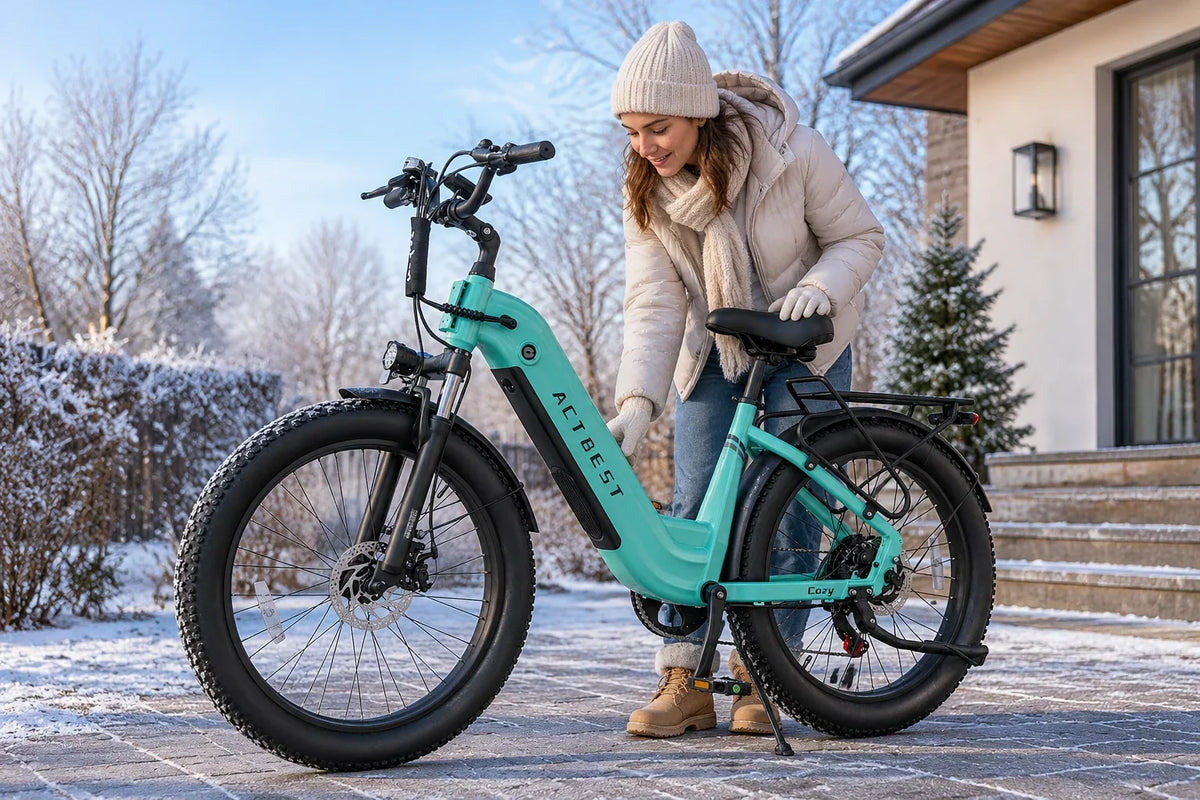
- Cozy Wide Tire Step-Through Commuter Electric Bike: The product page lists a removable battery in a step-through commuter format.
These examples do not mean every ACTBEST battery has the same temperature, charging, or storage instructions. Use the manual for your exact model.
Plan Winter Range with Your Own Ride Log
Do not plan a winter commute around the maximum range printed on a product page. Use a route you know, a realistic assist level, and a reserve that accounts for what happens if the battery runs low.
For several comparable rides, record:
- Route and distance.
- Starting and ending display level.
- Outside temperature and wind.
- Rider and cargo load.
- Assist level and throttle use.
- Tire pressure.
After a few rides, compare trips with similar conditions rather than a windy, hilly ride with a calm, flat one. If winter range is repeatedly below your own mild-weather baseline on the same route, inspect tire pressure and the bike for obvious issues, save the display or error details, and ask for a model-specific check. Do not use a generic drop percentage as a pass/fail rule: a one-day drop in cold weather is not enough to diagnose battery health.
Battery Warning Signs and Emergency Actions
Stop using a lithium-ion battery if it becomes unusually hot, changes shape or color, leaks, gives off an unusual odor, or makes odd noises. Do not charge it again to test whether it still works. The U.S. Fire Administration and FDNY both list these kinds of changes as warning signs.
FDNY says to stop using the battery and, if safe, move it away from anything that can catch fire and call 911. Safe means you can move the device without touching or approaching a hot, swollen, leaking, hissing, or smoking pack or entering smoke. Otherwise, get away and call 911 from a safe location. Do not approach it to unplug a charger or carry the pack outside.
If you find inactive physical damage without heat, odor, leakage, smoke, or other immediate warning signs, do not use or charge the pack. Keep people away and ask the manufacturer or local fire authority how to handle it. Do not open or ship a damaged battery without specific instructions.
Do not put a lithium-ion battery in household trash or general recycling. USFA advises using a local battery recycler. Call ahead for instructions if the battery is damaged or recalled.
Cold-Weather Battery Questions
Can I ride an e-bike with a cold battery?
Ride only if the battery is intact, installed correctly, and the exact model's operating conditions allow it. Expect range to change with the weather, and check the tires, brakes, display, and controls before leaving.
Can I charge an e-bike battery in the cold?
Only when the battery is within its specified charging conditions. The outdoor air temperature is not a reliable reading of the pack's internal temperature. Let a normal cold battery warm gradually, then follow its manual.
How long should I wait before charging a cold battery?
There is no universal number of minutes. Pack size, starting temperature, room conditions, and the model's charging limits differ. Use the method in the exact battery instructions, not a timer.
Can I charge a battery after riding in rain or snow?
Only when the battery, charger, port, and accessible connections are dry and the model instructions allow it. If water may have entered a case or connector, or the system behaves differently, do not charge until you get model-specific guidance.
Should I remove the battery for winter storage?
If the battery is designed to be removable, follow the exact removal and storage instructions. A removable pack does not make the rest of the bike suitable for prolonged outdoor exposure.
Why does my e-bike range drop in cold weather?
Cold can reduce available range, but the effect also depends on wind, hills, load, tire pressure, speed, assist level, and the battery. Compare similar rides and keep a log instead of treating one trip as a battery-health test.
What should I do if my battery is swollen, leaking, or unusually hot?
Stop using and charging it. Do not handle or test-charge the pack. Move away, keep others clear, and call 911 from a safe location if there are warning signs such as unusual heat, odor, leakage, hissing, smoke, or fire.
Final Winter Battery Checklist
[ ] Battery case and mount look intact; no swelling, leakage, odor, or unusual heat.
[ ] Battery, contacts, and charge port are dry and undamaged.
[ ] Bike starts normally; display, controls, tires, and brakes check out.
[ ] Battery is within its model-specific operating or charging conditions.
[ ] Charger is supplied with or approved for this exact battery.
[ ] Charging location is dry and permitted, with clear exits.
[ ] Winter range plan leaves a practical reserve for this route.
[ ] Storage charge level and check schedule come from the exact battery instructions.
[ ] If any warning sign appears, stop and follow the emergency guidance above.
For a model-specific question, start with the ACTBEST manual library. If the manual does not answer it, send the bike model and battery label through ACTBEST support.
Share:
Is a Used E-Bike Worth Buying? A Battery, Ownership, and Repair Checklist