
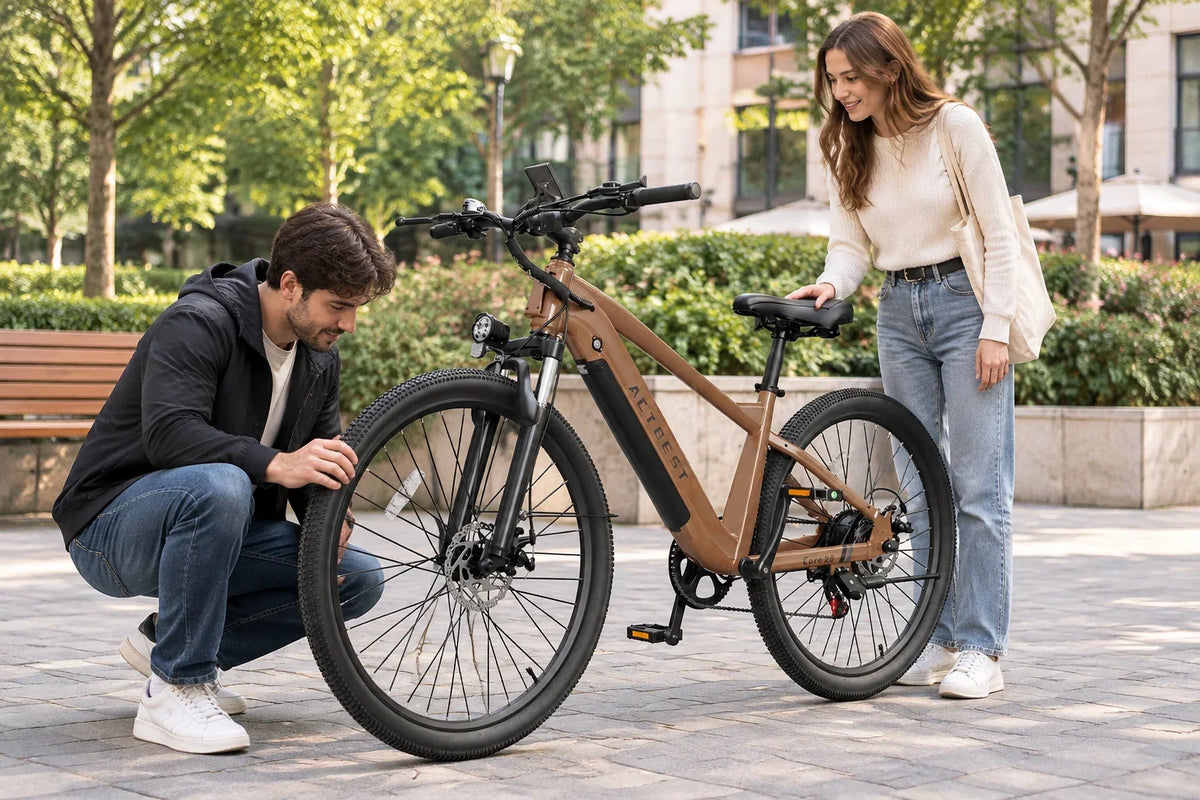
I treat the asking price as only the first line on the receipt. A worn battery or damaged frame can erase the savings quickly.
An e-bike is both a bicycle and an electrical system. Check the frame, wheels, and brakes, then verify the battery, charger, and model identity.

Quick Answer: A Used E-Bike Can Be Worth It, but the Price Is Not the Whole Deal
Yes, a used e-bike can be worth it, but only if you can verify its ownership story, confirm that the battery and charger are safe and matched, inspect the mechanical chassis, and tally up the immediate maintenance costs before you hand over cash.
Check service history and parts availability before paying.
Your decision usually lands in one of four buckets:
- Proceed to buy: Ownership is credible, the charger matches, the bike rides normally, and the total cost is clear.
- Negotiate known wear: Tires, chain, or brake pads need replacement, but the bike is otherwise safe to ride.
- Pause for diagnosis: Battery, electrical, wheel, brake, or frame damage is not yet understood.
- Decline: The serial appears deliberately altered, the battery is damaged or modified, the frame is cracked, or the seller refuses basic checks.
If a deal seems too good to be true, slow down and verify it.
The 90-Second Listing and Seller Screen
Review the listing photos and seller's answers before travelling. Battery, serial, and frame checks may still need to happen in person.
- Serial number missing or unreadable: Ask the seller to show it. If unreadable, pause and compare it with the purchase record. If deliberately filed off or altered, pass on the bike.
- Battery warning signs: If the pack is swollen, cracked, leaking, unusually hot, or giving off an odor or odd noise, do not charge, remove, or inspect it closely. The U.S. Fire Administration says to stop using a lithium-ion battery when these signs appear.
- Unclear ownership, charger, or keys: Ask for records and a charger-label photo. Verify model identity and replacement availability before arranging a visit.
- Visible electrical or structural damage: Exposed wiring or questionable modifications need assessment. A visible frame crack or bent fork is a reason to decline, not a reason to arrange a test ride.
- Seller refuses basic checks: Do not send a deposit or test an unsafe bike. Arrange an inspection in a safe public place or decline the listing.
Ask the Seller These Questions Before You Travel
Get clear answers before you travel:
"Hi [Seller Name], I am interested in the bike. Before I head your way to take a look, could you confirm a few quick details?
- How long have you owned it, and where was it originally purchased?
- Do you have the original receipt, order confirmation, or owner's manual?
- Does it come with the original manufacturer charger and all battery keys?
- Could you send a clear photo of the charger label, including its output?
- What is the exact model, motor wattage, and battery capacity (voltage and amp-hours) listed on the labels?
- Have any electrical parts (battery, display, motor, controller) been replaced or modified?
- Roughly how many miles are on the odometer, and how has the battery been stored during winter?
- Could you arrive with the battery fully charged using its original charger and allow a 15- to 20-minute test ride on a safe route?"
Clear answers and maintenance records help. Evasive answers or a vague ownership story are reasons to pause.
Verify Ownership and the Bike's Identity
At the inspection, compare the seller's ownership story and documents with the bike.
Photograph the serial number privately before sharing it publicly
Locate the serial number on the frame. Common places include the bottom bracket, headtube, rear dropouts, or folding-frame latch. Locations vary; ask the seller to point it out if you cannot find it.
Photograph it for your records. Do not post the number publicly. Share it privately with the manufacturer, registry, or local authorities if needed.
Match the serial number to the receipt, model, and seller story
Ask for a receipt, order confirmation, or other ownership record. If the name differs from the seller's, ask why and whether they have transfer paperwork.
Search the serial number through Bike Index. Check that any match corresponds to the bike in front of you. If it appears to match a stolen-bike record, pause the sale, save the listing and registry details, do not confront the seller, and contact the registry, marketplace, or local police for guidance.
Compare the seller's account with the bike's condition. If the wear does not fit the story, ask for an explanation.
Confirm the exact model and generation
Model suffixes can signal different frames, connectors, or battery mounts. An older Core ST is not automatically interchangeable with a Core ST 2.0 or Core ST 2.0 Plus. Use our guide to match the model and replacement part before assuming a part will fit.
Check the badge, decals, and spec sticker. Record the exact model suffix before asking about parts or service.

Check the Battery and Charger Without Pretending to Be a Battery Lab
The battery can be costly to replace, so its condition matters to the deal. Do not open or disassemble a pack during a driveway inspection. Check visible condition and ask for model-specific service information.
What a buyer can inspect
Start with a physical examination while the bike is powered down:
- The lock mechanism and cradle: If there are no warning signs or visible damage, check whether the battery key turns smoothly and the pack sits securely in its cradle without obvious play. Do not force a sticky lock or move a pack that is swollen, unusually hot, leaking, or otherwise damaged.
- Discharge terminals and charge port: With the bike off, inspect accessible contacts only if the battery can be removed normally. Look for bent, burned, melted, or corroded contacts. If the pack is damaged, unusually hot, or giving off an odor, stop. Do not unplug or remove it.
- Battery label and history: Record the production date if shown, total mileage if the display provides it, and any known replacement or storage history. These are clues, not a battery-health diagnosis.
Charger Label and Compatibility
Match the printed output to the battery and bike documentation. For common 4.2V-per-cell lithium-ion packs, use these screening values:
| Nominal battery | Full-charge screening value |
|---|---|
| 36V / 10S | 42.0V |
| 48V / 13S | 54.6V |
| 52V / 14S | 58.8V |
If output voltage does not match the pack's specified charger, rule it out. A match alone does not prove compatibility: current, polarity, connector, chemistry, and model approval still matter. FDNY advises using the manufacturer's cord and power adapter.
For more detail, see our guide to checking e-bike battery health.
Compare Battery Behavior on a Test Ride
Ask the seller to arrive with the battery fully charged using its approved charger. Record the label date, odometer, and starting display level. Ride the same short route at a normal pace for about 10 minutes, including a modest incline, and record the ending display level. At 15 mph, 10 minutes is about 2.5 miles, roughly 6% of a 40-mile stated range. If the display drops well beyond that rough comparison, investigate. This is not a pass/fail threshold: stated range varies with conditions, and many battery displays estimate charge from voltage, so readings are not linear. Treat it as a screening clue, not a capacity test.
When to pay for diagnostics
For a high-value bike or unclear battery history, get a pre-purchase diagnostic. Ask what was tested and what the result means.

Inspect the Bike Like a Bicycle, Not Just an Electronic Device
An e-bike is still a bicycle. Inspect the frame, wheels, brakes, tires, and drivetrain as carefully as the electrical system.
Use this component inspection breakdown to identify safety concerns and decide what needs a shop estimate:
| Area | What to check | Safety implication | Next step |
|---|---|---|---|
| Frame and Fork | Weld joints at headtube, dropouts, bottom bracket; folding-frame latches. Look for cracks, dents, or movement at joints. | Critical. A visible crack is a decline condition; suspected dents or looseness need assessment. | Assess suspected damage; decline a bike with a visible structural crack. |
| Wheels and Spokes | Check for loose or broken spokes, rim damage, axle movement, and a wheel that does not run true. | High. Wheel, axle, or hub problems can affect control. | Get a wheel or hub estimate, especially for a motorized wheel. |
| Tires and Tubes | Check tread, sidewall cracking, casing tears, and correct bead seating around the rim. | Moderate. A damaged tire can cause loss of control. | Include replacement and fitting in your cost estimate. |
| Braking System | Check lever feel, the brake maker's wear indicators, rotor damage, and fluid leaks on hydraulic lines. | Critical. Leaks, weak braking, or contaminated pads need attention before riding. | Ask for the required repair and parts estimate. |
| Drivetrain & Gears | Check chain wear with a gauge. Inspect cassette teeth for hooked profiles. Shift through gears without forcing the pedals. | Low to Moderate. Skipping under motor assist can cause loss of control and additional wear. | Ask whether worn parts need replacement now or later. |
| Headset & Bearings | Hold the front brake and rock the bike forward and back. Feel for play or a clicking "thunk" in the steering. Spin the bars smoothly. | High. Loose steering parts can create dangerous handling. | Have a shop check unexplained play or roughness. |
| Controls & Wiring | Inspect visible cables, lights, controls, and throttle return. Check that brake cutoffs, if fitted, stop assist. | Critical. Damaged controls or exposed wiring can cause loss of control or an electrical fault. | Confirm parts and service access before buying. |
Before you finalize your budget, check our guide on who will repair an e-bike. Ask a nearby shop whether it will service the exact brand and model, and what work falls within its scope.

The Test Ride: A Controlled Sequence
If the bike appears safe, get the seller's OK and ride in a clear, low-traffic area at a controlled speed.
- Stationary system start: Turn the display on. Note any warning or error messages. Check that the battery level, speed display, and assist controls respond.
- Low-speed assist and brake test: Select a low assist level and pedal in a clear area. Assist response varies by model but should be predictable. Test each brake at low speed. Many e-bikes cut motor power when a brake lever is pulled; if this model has that feature, confirm assist stops when you pull the lever at walking speed.
- Progressive gear shifting: Shift through the gears without forcing the pedals. Listen for grinding, skipping, or repeated chain drops.
- Motor and wheel check: Listen for new grinding, metallic screeching, rhythmic clicking, or rough wheel movement. Normal motor sounds vary by design.
- Load and control check: If equipped, test the throttle in a clear area at low speed. On a modest incline, watch for bogging, shuddering, cutouts, or warning messages. These symptoms merit a closer battery and electrical check.
- Braking and tracking: Test each brake separately, then together, at a speed where you can stop safely. The bike should slow predictably without pulling, pulsing through the lever, or severe vibration.
- Post-ride check: Look for new warnings, looseness, leaks, or unusual odor. A slightly warm motor or battery case can be normal. If either is hot enough to be uncomfortable to touch, heats rapidly, or gives off a burning smell, stop. Do not touch, remove, or charge a swollen, smoking, hissing, or visibly damaged battery.

Calculate the Real Cost Before You Pay
List each likely cost in the worksheet below: deferred maintenance, a compatible charger, unavailable parts, transport, and a professional inspection.
Use this simple worksheet to calculate your true first-year cost of ownership:
Listing Asking Price:                 $_______
+ Immediate Safety Repairs:             $_______  (Brake pads, new rotors, tire replacement)
+ Drivetrain Refresh:                   $_______  (New e-bike chain, cassette/freewheel)
+ Missing Essentials / Keys / Charger:  $_______  (OEM charger, lock cylinders, key blanks)
+ Professional Diagnostic / Tune-up:   $_______  (Local shop labor)
+ Battery / Charger Risk Allowance:     $_______  (Look up current OEM prices for this model before meeting)
=================================================
= True First-Year Out-of-Pocket Cost:   $_______
Before travelling, use our replacement-parts guide to request current OEM battery and charger prices and availability for this exact model. Add those quotes, repairs, diagnostics, transport, and parts availability before comparing the bike with a new one. See our total cost of e-bike ownership guide.

Current ACTBEST Bikes as a New-Bike Baseline
Before you decide, compare the full repair estimate and support path with a new-bike option. Check the current page for model details, availability, price, and warranty terms.
These current ACTBEST models can serve as category comparisons:
- Core 2.0 for a step-over commuter.
- Cozy for a step-through, wide-tire option.
- Triker for a three-wheel layout.
Note: Pricing, stock availability, and specifications on factory models can change over time. Always verify live details on the product pages.
Final Decision Matrix
Use this matrix after the in-person inspection. The listing screen finds reasons to pause; this table separates known wear from unresolved problems.
| Decision | Condition Checklist | What You Should Do |
|---|---|---|
| PROCEED TO BUY | Ownership is credible, the serial is intact, the charger and battery identity are confirmed, the ride is normal, and the total cost is clear. | Complete the transaction in a public place and write a signed bill of sale. |
| NEGOTIATE KNOWN WEAR | Tires, chain, or brake pads need replacement, and no unresolved battery, electrical, or structural concern remains. | Get a parts and labor estimate; negotiate that cost. |
| PAUSE FOR DIAGNOSIS | Battery, electrical, wheel, brake, or frame damage is not understood. | Get an assessment before making an offer. |
| DECLINE | Serial appears deliberately altered, battery is damaged or modified, the frame is cracked, or the seller refuses basic checks. | Do not buy the bike. |
Frequently Asked Questions
Is a used e-bike worth buying?
Yes, if ownership, battery and charger identity, mechanical condition, service access, and total cost all check out. Otherwise compare the repair estimate with a new bike.
How do I check a used e-bike battery?
Use the label-date and short-route comparison in the battery section above. A sharp drop is a reason to investigate, not a capacity reading. Do not handle, remove, or charge a swollen, leaking, unusually hot, or visibly damaged pack.
Can a full battery display prove battery health?
No. It shows a charge estimate, not the pack's remaining capacity.
What should come with a used e-bike?
Ask for ownership records, the approved charger, battery keys, and exact model information. If anything is missing, settle the ownership and replacement-parts path before paying.
How do I check whether a used e-bike is stolen?
Search the serial on Bike Index. Compare any match with the bike and ask the seller for ownership records.
Is a missing charger a deal breaker?
Not automatically. Verify a replacement charger for that model before buying, and do not test the bike with an unverified charger.
Should I buy a used e-bike with a replacement battery?
Only if its source and condition are documented and it is compatible with that model. Do not infer compatibility from voltage or plug shape alone.
How much should I budget for repairs on a used e-bike?
There is no one-size-fits-all figure. Get an itemized estimate for parts, diagnostics, labor, transport, and any battery or charger replacement.
Should I have a shop inspect it before buying?
Yes, when battery history is unclear or the bike has electrical, structural, brake, wheel, or parts-availability concerns. Ask whether the shop services that exact model and what its inspection covers.
Printable Used E-Bike Checklist
Use this short checklist on site.
[ ] BEFORE THE MEETING
    [ ] Ownership, model, battery history, charger, and keys discussed.
    [ ] Test ride arranged in a safe public place.

[ ] OWNERSHIP & IDENTITY
    [ ] Serial is readable, searched, and any match compared to the bike.
    [ ] Seller's story and ownership records make sense.

[ ] BATTERY & CHARGER
    [ ] No physical damage, swelling, leakage, unusual heat, odor, or odd noises.
    [ ] Battery and charger are identified for this exact model; charger output matches the battery specification.

[ ] MECHANICAL CONDITION
    [ ] Frame, fork, wheels, brakes, tires, steering, and drivetrain checked.
    [ ] Safety-critical repairs and shop estimates identified.

[ ] TEST RIDE & COST
    [ ] Controls, assist, steering, gears, and brakes behave predictably.
    [ ] Battery level recorded at the start and end of the fixed route.
    [ ] No new cutouts, grinding, leaks, or warning messages.
    [ ] Repairs, diagnostics, transport, and parts included in total cost.

[ ] DECISION
    [ ] Ownership, charger fit, service route, and total cost are clear.
    [ ] Unresolved safety or ownership concerns mean pause or decline.
If you find a bike worth buying, the next step is keeping it in your possession. Take five minutes to read our guide on how to protect an e-bike from theft so your new investment stays locked, registered, and secure.
Share:
How to Clean Road Salt Off an E-Bike After a Winter Commute