
If you're a woman looking for an electric bike and want one that fits how you ride day to day, this guide is for you.
Most e-bikes are designed for a general audience, which means they don't always get the details right for women, such as frame height, weight, and riding position. Those things make a bigger difference to daily use than motor power, and they're worth understanding and paying attention to before you buy.
What Makes an Electric Bike Good for Women?
In reality, the answer to this question is usually the same things that make a bike good for most people who commute. A good electric commuter bike should put you in an upright riding position and have a frame that makes it easy to get on and off. It shouldn't be too heavy, either, as a heavy bike can be a problem whenever you need to lift or store it. The motor assistance should also feel predictable, not jumpy.
Where it gets more specific is fit. Standover height and minimum seat height are the two numbers to check before anything else. Standover height tells you how much clearance you have when straddling the bike at a stop. Minimum seat height tells you the lowest the saddle goes. For shorter riders, both of these matter more than the general size range. If your e-bike is too tall or the seat is too high, you won't be able to stand over it with your feet flat on the ground.
Weight is another factor most buyers underestimate, as e-bikes are heavy. Most electric commuters come in between 60 and 68lbs. That's manageable when you're riding, but if you're carrying a heavy bike up stairs or lifting it into a car regularly, you'll soon get annoyed with it.
You should also pay attention to the fit and riding position before you buy a particular electric bike. If the handlebars are too low or too far forward, you end up hunched, which puts strain on your wrists and neck. After a few weeks of riding an uncomfortable bike every day, you'll get tired of it and potentially hurt your back and/or neck. Most step-through bikes are designed for an upright riding position, which suits commuting well, as you can stay comfortable and keep an eye on what's going on around you.
It's also a good idea to look for bikes that include practical extras. Things like integrated lights, a rear rack, and fenders aren't upgrades on a commuter bike; they're basics. Buying a bike without them and adding them separately adds $80 to $130 to the cost before you've ridden once.
Step-Through vs Step-Over: Which Frame Is Better?
A step-over frame has a high top tube that you swing your leg over to mount. It's stiffer and marginally more efficient for power transfer, which is preferable if you're doing long fitness rides. For city commuting, you won't notice much of a difference in performance.
 A step-through e-bike has a low top tube, or the manufacturer designs the bike so that it does not need one at all. This style of bike allows you to step through the frame to get on and off, making mounting and dismounting easier and quicker. This added convenience is especially useful if you wear skirts or dresses, carry bags, or need to get on and off the bike multiple times during your ride.
The step-through design isn't weaker or less stable. At normal commuter speeds on city roads, there's no real handling difference.
The one thing to check is that not all step-through bikes have a low minimum seat height. Some still start from a position that's too high for shorter riders to get a foot flat on the ground at stops. Look specifically at the minimum seat height to make sure you can still sit on the bike and touch the floor with your feet. A bike with a step-through frame can still not fit a shorter rider if the minimum position is too high.
How Much Motor Power Do You Need?
For most people who only spend time riding through cities, you don't need that much power, unless your city is particularly hilly.
Peak wattage is the motor's maximum burst output, not its sustained power. What matters more for daily use is the torque rating (Nm) and the type of sensor the bike uses.
Most affordable electric bikes use a cadence sensor. This detects when the pedals are turning and switches the motor on at whatever level you've set. It's functional, but the assist can feel abrupt when you pull away from a stop, and doesn't adjust when you're working harder on a hill.
You can also get electric bikes that use a torque sensor, which works differently. It measures how hard you're pushing on the pedals and adjusts the motor output to match. When you pedal harder going uphill, you get more help. Ease off on a flat section, and the motor backs off. The assist feels proportional to your effort, like a regular bike, but with your pedaling effort amplified.
If your rides are fairly short and flat, an electric bike with a cadence sensor should be fine. For regular riding with any hills or stop-start traffic, a bike with a torque sensor makes a noticeable difference. It's also better for battery range because the motor isn't running at full output when you don't need it, which makes it more efficient.
Electric bikes have their motors in one of two places, mid-drive (at the crank) or hub motor (in the wheel). Mid-drive motors feel natural and handle hills well, but cost more and are usually found on higher-end models. For everyday commuting, a hub motor with a torque sensor offers good performance at a reasonable price.
Battery Range: What to Expect
Claimed range figures are always measured under ideal conditions. Manufacturers usually obtain an e-bike's range figure with a light rider, on flat terrain, using a low assistance level, with no wind. In the real world, you should expect considerably less. A bike claiming 60 miles will typically deliver 35-45 miles on a mixed daily commute.
For most people, that's not a problem. The average US round-trip commute is under 20 miles. A 480Wh battery handles that with charge to spare. Where range becomes a real consideration is for longer commutes, hilly routes, or heavy throttle use.
Battery size is measured in watt-hours. A 48V 10Ah battery is 480Wh. A 48V 12Ah is 576Wh. The 480-600 Wh range is usually plenty of power for commuters. It's worth noting that bigger batteries add range but also add weight, so it's important to match battery capacity to your riding needs and not buy more than you'll use.
Another thing that you should know is that the PAS (pedal assist) and throttle ranges are different. Brands advertise the PAS figure because it's higher. If you mostly ride using the throttle, your actual range would be considerably lower.
Charging the battery of any electric bike is cheap and simple. Most e-bike batteries cost less than $0.10 to charge from a standard outlet, and a full charge typically takes 4 to 7 hours. You can charge the battery on the bike or remove it and charge it indoors, which is more convenient if you don't have outdoor storage.
Comfort Features Worth Paying Attention To
We've already mentioned the riding position, but it's worth elaborating on as it can make the difference between loving and hating your electric bike. The handlebar height and how far back they're set determine how upright you sit. An upright position is more comfortable for commuting, easier on your wrists and neck, and keeps you more visible in traffic. Most step-through bikes are designed for an upright riding position.
A great comfort feature that has come from mountain bikes is the suspension fork. Front suspension absorbs the bumps and cracks that city roads throw at you. It's not essential, but it makes a noticeable difference on longer rides or badly maintained roads. You can also get full-suspension electric bikes, which also have a shock absorber connected to the rear wheel. These bikes are great for off-road riding, but are often overkill for road use and add unnecessary weight.
The stock saddle on a budget bike is usually worth replacing. A wider, more padded saddle costs $30 to $50 and makes a real difference on rides longer than fifteen minutes. If you're buying an entry-level model, factor that in. You can also buy ergonomically designed saddles sized to your seatbone measurements. These are fantastic, but they cost significantly more money.
Tire width is another comfort feature that those new to electric bikes may not realize. Standard 2.1-inch commuter tires are a good all-rounder. But you can get electric bikes with wider tires that feel more stable at low speeds and absorb more vibrations from the road. Fat tires at 3 to 4 inches take that further, but add rolling resistance on flat ground and make the bike heavier.
Safety Factors
Electric bikes are generally faster and heavier than regular bikes, so you need to be able to stay in control. To do this, your bike needs good brakes, but there are a couple of types you need to know about. Mechanical disc brakes are standard at most price points and do the job. Hydraulic disc brakes need less hand effort and respond more precisely, which becomes noticeable at higher speeds or in wet weather. Most commuter models use mechanical disc brakes; hydraulic brakes start appearing on higher-end bikes.
Skills development is another thing beginners worry about. The motor removes some of the effort, but it doesn't help with technique, which catches some people out from time to time. It's important to learn the basics of handling, braking, reading the road, and staying balanced in tight spaces.
Best Use Cases
The right bike depends entirely on what you're going to use it for, so it's worth being specific about your needs.
For daily commuting, the priorities are reliability, range, and a full set of practical features out of the box. A commuter e-bike with integrated lights, a rear rack, fenders, and front suspension covers most scenarios well. You want something that works every morning without needing attention.
Carrying capacity should be a priority if you want an e-bike for shopping and errands. So check that the bike has sufficient rack capacity. A rear rack rated to 120lbs and the option to add a basket make a difference. Also, remember that extra weight reduces range, so factor in a larger battery if you plan to regularly carry heavy stuff.
 For beach and coastal riding, a fat tire electric bike handles sand and other soft surfaces much better than a regular commuter. The wide contact patch grips better on loose ground, and the upright geometry most fat tire bikes use suits a relaxed pace well.
 For weekend use or mixed commuting and leisure, a foldable e-bike is worth considering if you want to drive to a start point and ride from there. Most fold small enough to fit in a car or on public transport.
Best Electric Bikes for Women 2026 From actbest
These are the best options from the actbest range, covering a range of budgets and uses.
actbest Core ST 2.0
 If you're new to electric bikes, you might want to check out the Core ST 2.0. It has a low-step frame, an upright riding position, and a full commuter spec out of the box. So you get integrated LED lighting front and rear, a rear rack, disc brakes, and a front suspension fork. The 1200W peak hub motor produces 70Nm of torque, and the 48V 10.4Ah battery (500Wh) gives up to 55 miles on pedal assist. It weighs 62.4lbs and fits riders from 5'3" to 6'2". Minimum seat height is 29.5 inches. Available in seven colors, including white, pink, light blue, and cosmic purple. For most women who want a reliable daily rider, this is where to start.
actbest Core ST 2.0 Plus 27.5"
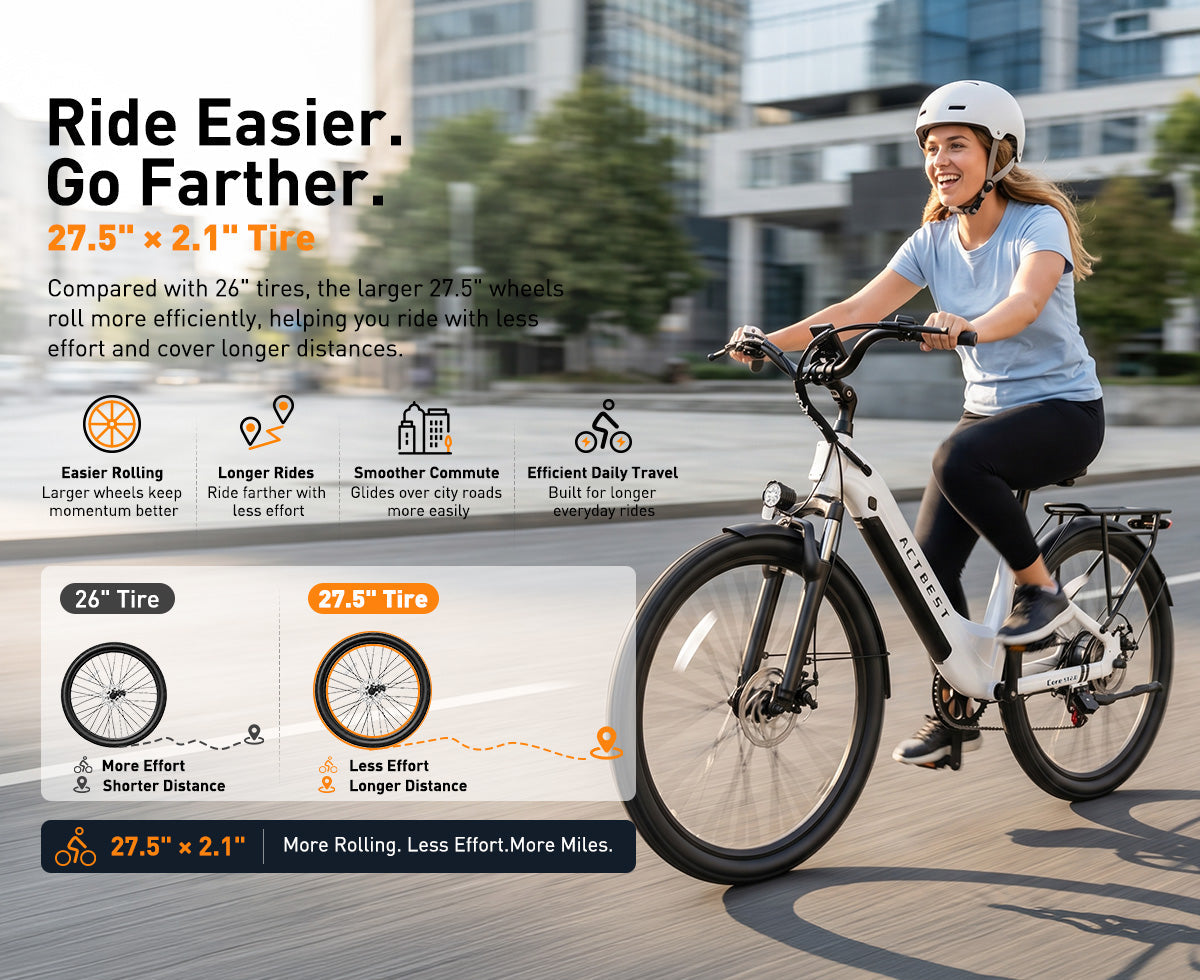
 This electric bike is an upgrade for riders who want the assist to feel more responsive. The main difference from the standard Core ST 2.0 is the torque sensor. Where the base model uses a cadence sensor, the Plus measures your pedaling effort and adjusts motor output accordingly. The difference is noticeable, especially on longer commutes and in stop-start traffic. The actbest Core Plus also has a larger 48V 12Ah battery (576Wh), 27.5-inch wheels, and 80Nm of torque. Claimed range is 100 miles under ideal conditions; a realistic daily figure is above 50 miles. Weighs 62.4lbs and fits riders from 5'3" to 6'3". Optional front and rear baskets are available for extra load carrying capacity.
actbest Mars
 The Mars is the right pick if you need your e-bike to have portability. It folds down small enough for an apartment, an office, a car, or public transport, which makes it useful for riders who commute partly by train, live in an apartment without storage, or travel with the bike. Despite the folding frame, the specs are still pretty good. It has a 1200W peak motor, a 48V 13.5Ah battery (648Wh), 55 miles of claimed range, and a 28 mph top speed. The 20x3.0-inch fat tires give a stable, cushioned feel that narrow-tire folding bikes can't match. The trade-off is a slightly less upright position than on step-through models, and the compact geometry suits riders 5'0" to 5'10" better than taller riders. For riders who need the bike to travel with them, the actbest Mars is the obvious choice.
actbest Summit

If you don't want to stick to paved roads, the actbest Summit should be on your shortlist. It has full suspension, 20x3.0-inch fat tires, a 1200W peak motor, and a 48V 12Ah battery (576Wh). Between the suspension and the wide tires, it handles potholes, gravel, and rough bike paths far better than any standard commuter. The frame still folds, so storage is manageable. It's heavier than the Mars, but for riders whose commute includes rough surfaces, or who want one bike for both daily riding and weekend exploring, the actbest Summit is the most capable option in the range.
Common Mistakes When Buying an E-bike
Choosing Based On Looks First
Color and style are the last things to consider, not the first. A bike that doesn't fit you or weighs too much is frustrating every single day. Check standover height, minimum seat height, and weight before anything else.
Buying More Battery Than You Need
A 480Wh battery easily covers most daily commutes. A bigger battery adds weight without much benefit in day-to-day use unless your route is long or steep.
Not Paying Attention To The Sensor Type
Most guides don't mention it, but the difference between a cadence sensor and a torque sensor is one of the biggest factors in how an e-bike feels. If you ride regularly with hills, the torque sensor is worth the extra cost. The actbest Core ST 2.0 Plus has one.
Not Checking The Minimum Seat Height
The general size range on a spec sheet doesn't tell you if your feet will reach the ground at a stop. Look up the minimum seat height in inches and compare it to your inseam.
Assuming Everything Is Included
Lights, a rear rack, and fenders should come standard on a commuter. Not all bikes include them. If you need to buy them separately, add $80 to $130 to the total cost.
Buying The Wrong Frame Type For How You Ride
A step-over is fine for longer fitness rides. For stop-start urban commuting in everyday clothing, a step-through makes daily riding considerably more convenient.
FAQ
Do I need a bike marketed specifically as a women's e-bike?
No. Most of them are identical to the standard version, just in a different color. What matters is fit: standover height, minimum seat height, weight, and riding position. Look for those, not the label.
What's a good weight target?
Under 60lbs if you need to carry or lift the bike regularly. Under 65lbs if it stays on the ground. Most full-spec step-through commuters land between 60 and 65lbs.
Is a step-through frame less stable?
No. The geometry is different, not weaker. At normal riding speeds on city roads, there's no practical difference in handling or stability.
Torque sensor vs cadence sensor: does it matter?
For flat, occasional use, a cadence sensor is fine. For regular commuting with any hills or stop-start traffic, the torque sensor makes the ride noticeably better. The Core ST 2.0 Plus is the step-through actbest model that includes one.
Can I use these bikes for carrying shopping?
Yes. The rear racks on actbest commuter models support 120lbs. Optional front and rear baskets are available on several models, including the Core ST 2.0 Plus.
How long does the battery last before it needs to be replaced?
Most e-bike batteries last 3 to 5 years or 500 to 1,000 charge cycles. Keeping it between 20% and 80% charge and avoiding 100% for extended periods helps extend the lifespan. Most batteries don't fail suddenly. They gradually hold less charge, so you notice the range dropping before anything stops working.
What's the difference between the PAS range and the throttle range?
PAS range is measured with the rider pedaling and contributing effort. The throttle range is lower because the motor is doing all the work. Brands advertise the PAS figure. If you ride mostly on throttle, your real-world range is lower, sometimes by 30 to 40 percent.
Final Thoughts
The best electric bike for women is the one that fits your body and suits your riding style.
For most daily commuters, the actbest Core ST 2.0 covers everything needed at a price that makes sense. The Core ST 2.0 Plus is the better bike if you ride regularly and want the torque sensor. The Mars is the right choice if the bike needs to fold and travel. The Summit is the one for rough roads and mixed terrain.
Think about commute length, storage, and how often you'll ride. Those three things narrow down the right choice faster than any spec comparison. Get those clear before looking at anything else.
Most people who switch to an e-bike for commuting don't go back to a regular bike. The combination of lower cost, faster journeys through city traffic, and the option to arrive fresh or get a workout, depending on the day, changes how you think about getting around.
Browse the full range of electric bikes for women from actbest and find a model that fits your commute and your budget.
Share:
Best Moped Style Ebikes: How to Choose the Right One
Are Moped Style Ebikes Good for Commuting?