
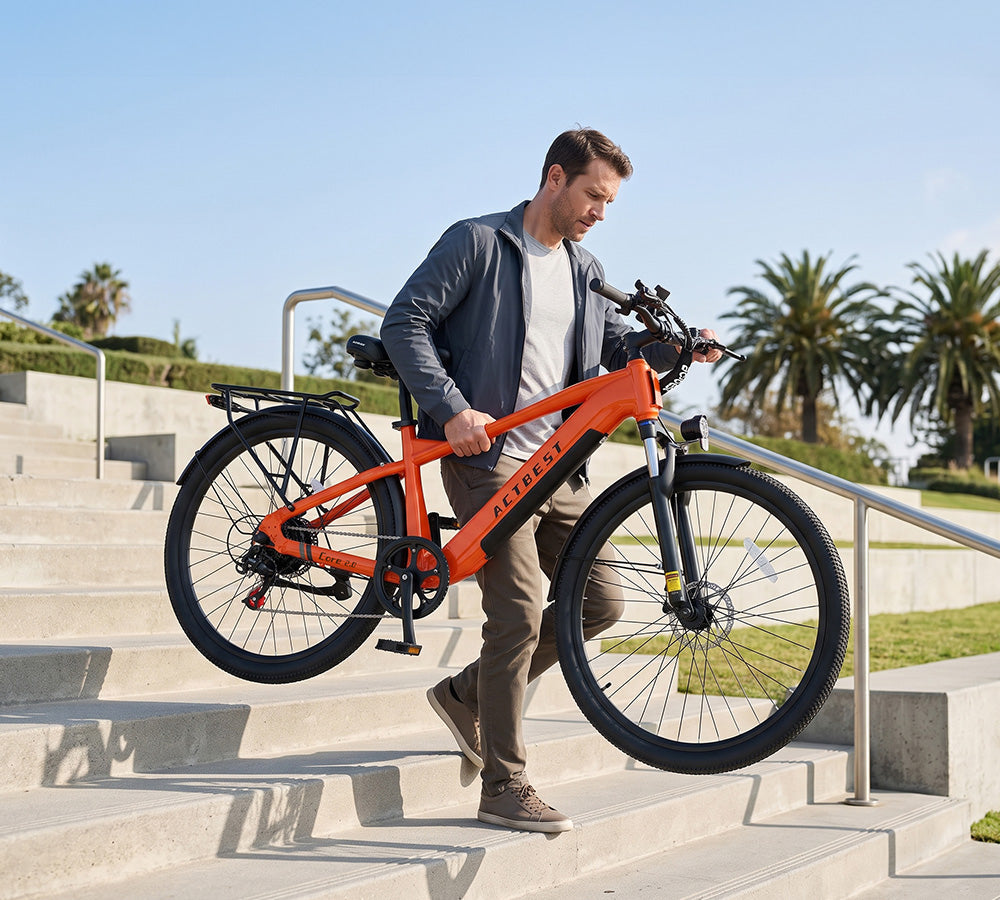
Inspect your new ACTBEST e-bike on arrival, document its condition, and keep the packaging while you check the delivery. Then complete assembly using the manual for your exact model. A bike that powers on is not necessarily ready to ride. Steering, brakes, wheels, and any folding joints need their checks first.
I'd separate delivery inspection from the first ride. It is much easier to explain a bent part while you still have the packing and photographs than after you've tried to straighten it.

At delivery: document the box and contents
Start by recording the actual receipt date. That date matters for a shipping-damage claim.
If the battery shows unusual heat, swelling, leakage, odor, odd battery noises, or smoke, stop the inspection. Get people clear and call 911 from a safe place. Don't charge, switch on, or approach the pack to unplug, move, or photograph it. The U.S. Fire Administration identifies these warning signs, and FDNY advises emergency escalation. A support email comes later.
For a delivery without those warning signs:
- Photograph the unopened carton. Include the shipping label, seals, and any punctures, crushed areas, or water damage. Keep label photographs private.
- Record the packing before clearing it away. Take pictures of the bike's position and the loose items as received.
- Compare the contents with the model's supplied list or order documentation. If no list is available, photograph everything received and ask about the specific item you believe is missing.
- Document damaged parts separately. Take a wider view showing the part on the bike and a close-up of the damage. Don't bend or adjust it first.
- Keep the carton and protective material while an issue is assessed. Ask for handling instructions before sending anything back, especially a battery.
If the bike itself may have become wet during shipping, use our water-exposure safety checks before switching it on or charging it. A wet carton alone does not establish what reached the bike.
Don't assume every ACTBEST model includes the same accessories, tools, or preassembled components. And don't treat an empty piece of packing as proof that a particular accessory should have been included. The order and model documentation are what you compare against.
Under ACTBEST's shipping-damage policy, section 3.4, inspect immediately and email clear damage photos or video to service@actbest.net within 7 days of receiving the shipment. The policy says later shipping-damage claims are not accepted. This is the shipping-damage reporting window, not the overall warranty period. Report missing items or other suspected defects promptly too, without labeling every problem as transit damage.
Assemble only to the instructions for your exact model
Find the matching document on our user manuals page. Compare the full model and variant with your order and the bike. If the listing doesn't cover your generation clearly, ask for the correct manual before assembling it.
Read the assembly sequence and tool requirements before starting. Work through the steps in order, including any specified torque checks. A similar-looking bike's video is not a source for your fastener settings, tire pressure, wheel installation, or folding-latch procedure.
If you don't have the required tool or cannot verify a safety-critical step, arrange assembly or inspection with a qualified mechanic. Send the model and manual when booking, and confirm which checks the job includes. Bring the delivery photos if you found damage.
Keep unfinished assembly separate from damage. A handlebar awaiting installation is an incomplete step. A cracked clamp is a damaged component, not something to tighten until it stops moving.
Stationary acceptance before power-on
With the bike stable and power off, work through the manual's checks and record the result. Use verified, not done, or stop in the note column:
- Verified: The required check is complete and the result meets the instructions.
- Not done: A required assembly step or check remains.
- Stop: You found damage, an unexpected condition, or a safety-critical result you cannot confirm.
Only verified items are ready for the next stage. "Not done" isn't a reason to take a short test ride.
| Area | What to check against the matching instructions | Status and note |
|---|---|---|
| Frame and folding joint, if fitted | Visible damage; correct assembly and latch engagement | ______ |
| Steering and handlebar | Alignment, fastening, control position, and no unexplained movement | ______ |
| Brakes | Both controls operate; the specified stationary stopping checks pass | ______ |
| Wheels and tires | Wheel retention, visible tire damage, and pressure checked with a gauge against the applicable instructions | ______ |
| Saddle and pedals | Installation, fastening, and adjustment within the marked or specified limits | ______ |
| Chain and drivetrain | Correct assembly and no visible damage or interference | ______ |
| Display and controls | Secure mounting and accessible controls without damaged housings | ______ |
| Battery, charger, and visible wiring | Matching equipment; no visible damage or trapped cables; battery secured as instructed | ______ |
| Lights and accessories, if fitted | Secure attachment and no interference with wheels, cables, or steering | ______ |
Don't open electrical housings or unplug connections to inspect their pins as part of this checklist. Keep hands clear of wheels and the drivetrain when operating controls.
An unresolved brake, steering, wheel, or folding-joint issue needs qualified assessment before riding. Visible battery, charger, or wiring damage means no charging or power-on test; contact ACTBEST support for handling instructions. Active battery warning signs follow the emergency steps above, not the ordinary support route.
Make the note specific. "Front brake check not completed" tells you what remains. "Front lever reaches the handlebar" records a concern to have assessed. Neither requires you to guess the failed component.
First power-on and a controlled first ride
Once assembly and stationary checks pass, follow the exact manual for battery, display, and control operation. If charging is needed first, use the matching approved equipment and the model's charging instructions. Our safe e-bike battery charging guide covers the location, supervision and warning-sign checks. Leave any damaged equipment unused.
At startup, observe the whole display before setting off. If a warning or unexpected behavior appears, photograph the screen while stationary and note the exact text or symbol. Stop there rather than interpreting the code through a discussion about a different bike.
For a safe way to document the warning and ask for the correct model-specific next step, use our ACTBEST error-code support checklist. Do not restart or ride to make the warning reappear.
For the first ride:
- Wear a properly fitted bicycle helmet and choose a clear, level area where riding is permitted, away from traffic and pedestrians.
- Familiarize yourself with the brake controls and the manual's starting procedure before moving. Begin gently using an appropriate low-assist setting.
- Keep the first ride short enough to focus on steering, stopping, and control response rather than reaching a destination.
- Stop safely if braking or steering feels wrong, assistance behaves unexpectedly, or you notice new rubbing, grinding, or another unexplained symptom. Don't keep riding to make a longer video.
Describe what happened without deciding the cause. "A rubbing sound as the rear wheel turns" is useful evidence. "Bad motor" may not be. Likewise, the display's battery bars are not a measured promise of remaining miles.
If the ride is uneventful, keep your inspection notes and continue the checks at the intervals specified in the model instructions. Adjustments and initial service requirements still apply after a successful first trip.
Report an issue with a clear timeline
For a non-emergency issue, send a concise record through ACTBEST's contact route. Use the email address and deadline above for shipping damage. Keep your order number, address, serial, and delivery label out of public posts.
This message puts the useful facts in order:
Subject: Delivery or first-use issue with [full model and order reference]
Shipment received: [date]
Bike and purchase: [full model, variant, seller, and order reference]
First noticed: [before opening, during unpacking, at assembly step, at startup, or on first ride]
Observation: [visible condition, exact message, or symptom]
Manual and step reached: [document and step]
Actions already taken: [checks, adjustments, charging, or riding, accurately stated]
Current condition: [what remains unresolved and why use stopped]
Attachments: [relevant carton, packing, component, or screen images]Please confirm the next safe step, any additional evidence needed, and whether inspection, repair, or replacement must be authorized before I arrange it.
Keep the sent email, case number, and response with your delivery record. If you have already ridden or charged the bike, say so. An accurate sequence helps more than an edited version of events.
Before the first ride, you should be able to account for the delivery condition, each required assembly step, and the stationary checks. If one remains unresolved, leave the bike unridden and deal with that specific issue first.
Share:
ACTBEST Replacement Parts: Match the Model, Generation, and Part
How to Verify E-Bike Certification for Campus Storage and Charging