
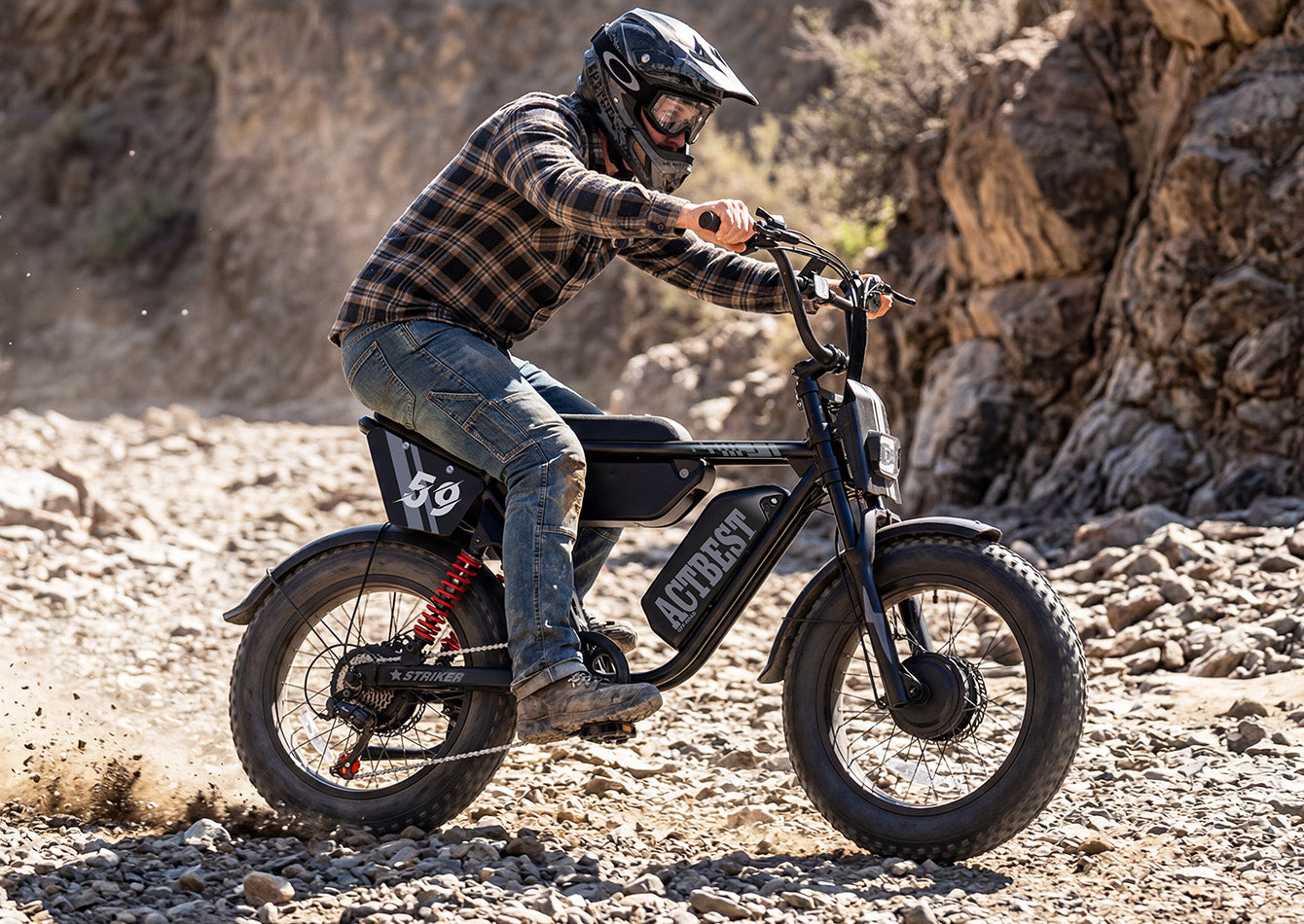
If you're trying to decide between a moped-style ebike, an electric moped, and an electric scooter, you're not alone in finding it confusing. They look similar, but the differences in how they're classified, where you can ride them, and what they cost to own are significant enough to make a difference in how you live with them.
This guide covers what each one actually is, how they compare on the things that matter for daily riding, and which one makes the most sense for different commutes and budgets.
Quick Definitions
Let's break down everything you need to know about these different types of electric vehicles.
Moped Style Ebike

A moped-style ebike is a pedal-assisted electric bicycle with a frame that resembles a moped or small motorcycle. It has a wide bench seat, an upright riding position, fat tires, and usually a throttle alongside the pedal assist. The main point is that it still has pedals, and that makes it an ebike under US law in states that use the three-class system. You usually don't need a license, registration, or insurance. It looks like a moped, but it's classified as a bicycle.
Electric Moped

An electric moped is a different beast. It typically has no pedals or pedals that are not really functional; they are more like footrests. It operates more like a small motorcycle and is usually classified as a motor vehicle, not a bicycle. In most US states, that means registration, a license plate, and often a valid driver's license or motorcycle endorsement. The rules differ substantially by state, and in California, for example, a moped is defined as having a top speed between 20 and 30 mph and an engine under 50 cc, and requires registration and a license. Electric versions of these vehicles often fall under similar rules.
Electric Scooters

Electric scooters are split into two categories. You have stand-up electric scooters, the kind you see people commuting on in cities, with a deck and handlebars. There are also seated electric scooters that are closer to a traditional moped or Vespa-style vehicle. When you ride one of these, you sit down and use footrests instead of standing on a deck.
Stand-up scooters are usually subject to local rules. Some cities allow you to ride them on cycle lanes and paths, but others only let them on regular roads, and some ban them from pavements entirely. Seated electric scooters with higher power or speeds are often classified the same way as mopeds or motor vehicles. This means you have to deal with registration and licensing implications.
Even though you can get versions of each of these all with similar looks, the legal category is not determined by their appearance. It's the presence of pedals, top-assisted speed, motor power, and whether the vehicle requires throttle-only operation.
Legal and Registration Differences
This is where the practical differences become most obvious, and where choosing the wrong category can cause a few problems.
A moped-style ebike classified as Class 1, 2, or 3 is treated as a bicycle in the 37 US states that have adopted the three-class framework. Class 1 and Class 2 bikes are permitted on bike paths, bike lanes, and roads in most states, just like other bicycles. Class 3 bikes, which assist up to 28 mph, are generally restricted to roads and bike lanes but not multi-use trails and paths. You don't need a license, registration, or insurance for any of them.
The actbest Striker and Striker Plus are moped-style ebikes that operate within Class 2 and Class 3 limits in their standard configurations. That means you get the look and feel of a moped with full bicycle-class access in states that have adopted the 3-class framework. But you should always check your specific state's rules, since the remaining states have their own definitions and rules.

An electric moped that is classified as a motor vehicle faces a different set of restrictions. You can ride them on roads, but not normally on cycle lanes or paths, as they are reserved for bicycles.
Registration and licensing requirements vary; for example, California requires moped riders to have an M1 or M2 license and registration, and many other states have similar frameworks. If you're planning a campus commute, a path-heavy route, or a multi-modal journey involving train stations with bicycle access, an electric moped creates complications you don't get with a moped-style ebike.
Stand-up electric scooters have the most variable legal situation of the three. Some US cities have specific ordinances that allow you to ride them on bike lanes, others ban them from paths and pavements but allow them on roads, and some require registration for higher-powered models. If you're commuting in a city with a clear e-scooter policy you can work with, they're a practical option. If the rules are unclear or frequently change, a more settled legal status for an e-bike is a practical advantage.
Ride Feel and Comfort
Legal categories aside, these three types of vehicles feel very different to ride, which matters for daily commuting.
A moped-style ebike like the actbest Striker sits you upright on a wide, padded bench seat. The 20x4.0-inch fat tires absorb road vibration that narrower tires pass straight through to your hands and back. It has full suspension, which handles potholes and rough road surfaces well. At 35+ mph with the 1800W peak motor, it has the performance to keep up with traffic. It's heavier than a regular ebike at 84.9 lbs, but the motor handles that weight on the road, and you only notice it when lifting or carrying it. The bench seat also means you can carry a passenger on some routes, which neither a stand-up scooter nor a regular ebike comfortably allows.
An electric moped typically feels more like a motor vehicle than a bicycle. You may notice that the acceleration can be more abrupt, the body position is sometimes further forward, and the overall experience is closer to a small motorcycle. That is fine if you want that style of riding, but if you want a relaxed, comfortable city commute, it can be more demanding.
A stand-up electric scooter is the most portable option but the least comfortable for longer rides. Standing on a deck for 30 minutes is fine for a short hop, but it becomes tiring on longer commutes or rough roads. When you have a model without suspension, the shock from riding over every pothole goes straight up through the deck. For commutes under 5 miles on decent roads, they're convenient and practical. But you probably won't want to use one for daily commutes of 10 miles or more, as comfort becomes an issue.
Cost of Ownership
The initial purchase price of the bike or scooter is only part of the story. The full cost of owning each type of vehicle over 12 months is where the differences really add up.
A moped-style ebike has no registration fees, no insurance requirements, no fuel costs, and low maintenance relative to a motorized vehicle. Electricity costs to charge the battery are minimal. Tire replacement, brake pads, and battery servicing are the main recurring costs. The actbest Striker starts at $699, and after that initial cost, ongoing expenses are low.
To ride an electric moped, you are subject to registration fees that vary by state but typically range from $50 to $150 per year. If your state requires insurance, you can expect to pay an additional $100 to $300 or more per year, depending on coverage and where you live. Although still cheaper than using a car, those costs stack up over time.
You'll also find that maintenance costs are generally higher for motor vehicle-classified vehicles. This is because they are more complex, and you have fewer opportunities to fix and maintain them yourself.
Stand-up electric scooters are less expensive to buy, but they require more maintenance if you ride them every day, adding to the cost of ownership. For example, tires on smaller wheels wear faster, and replacing the battery on cheaper models can cost nearly as much as the scooter itself. If the scooter breaks down, repair and parts availability vary considerably by brand.
Which One Fits Your Use Case?
All of these electric vehicles have their advantages and disadvantages. The right decision depends on your specific situation. Here's a straightforward breakdown of how you might use one:
A short campus or urban route under 5 miles on decent roads - a stand-up electric scooter is practical and portable. It folds, it's lightweight, and the range and speed are more than enough. If you need to bring it into buildings or onto public transport, it's the easiest option.
A daily commute of 5 to 20 miles on mixed roads - a moped-style ebike is the strongest all-round choice. You get the comfort of the bench seat, the stability of the fat tires, and the motor power to handle hills and traffic, all of which make it well-suited to this use case. You get bicycle-class legal access and none of the registration hassles. The actbest Striker can cover this range comfortably and handles varied urban terrain well.
Longer commutes above 20 miles with faster roads and fewer bike lane options - an electric moped offers more motor capability and road presence. But you're taking on the registration and licensing requirements that come with motor vehicle classification. If your state's rules work for your situation, it's a viable option. If they don't, the Striker Plus with its 52V 20Ah battery and 90-mile claimed range may well be a better answer without the administrative overhead.
Apartment storage with limited space - a moped-style ebike or folding stand-up scooter is far more practical than an electric moped. The actbest Mars and Summit are folding ebikes in the actbest range that offer a middle ground between portability and comfort.
Riding in mixed weather year-round - a moped-style ebike is the best choice for bad weather. The fat tires give better grip on wet roads than the narrow tires on most stand-up scooters, and the full suspension handles the uneven surfaces that rain and frost make worse. The upright riding position also keeps you more stable when braking in slippery conditions. An electric moped can handle wet weather, too, but the licensing overhead is the same regardless of the season. For riders who commute through winter and don't want to stop, the actbest Striker Plus with its hydraulic brakes is the strongest all-weather option in the range.
Best actbest Moped Style Ebikes
For most commuters who want the moped look and feel without the licensing complexity, the actbest Striker is the starting point. At $699, the 1800W peak motor, 48V 15.6Ah battery, 75-mile claimed range, full suspension, and 20x4.0-inch fat tires give you a capable and comfortable daily commuter with full bicycle-class legal access. It fits riders from 5'3" to 6'3" and handles a 360 lb payload without issue.
For longer trips or riders who want hydraulic brakes and more battery capacity, the actbest Striker Plus at $999 is the upgrade. The 2000W peak motor and 52V 20Ah battery deliver a claimed range of 90 miles and a top speed of 38+ mph. The hydraulic brakes replace the mechanical disc brakes of the standard Striker and make a real difference on faster roads or in wet conditions. If your commute is 30 miles or more round-trip, or you ride in all weather, the Striker Plus is worth the extra cost.
Browse the full moped style ebike range at actbest to find the right model for your commute.
FAQ
Is a moped-style ebike the same as an electric moped?
No. A moped-style e-bike has pedals and is classified as a bicycle under US e-bike law in most states. An electric moped typically doesn't have functional pedals and is usually classified as a motor vehicle, requiring registration and, in many jurisdictions, a license. The frame style looks similar, but the legal category is completely different.
Which can use bike lanes?
In most US states that have adopted the three-tier ebike classification, Class 1 and Class 2 moped-style ebikes can use bike lanes. Electric mopeds classified as motor vehicles generally cannot. Stand-up electric scooter access to bike lanes varies by city and state. Always check your local rules.
Which is cheapest to maintain?
A moped-style ebike has the lowest ongoing cost in most cases. No registration fees, no insurance requirement, and maintenance is comparable to that of a regular bicycle. Electric mopeds add registration and insurance costs to mechanical servicing. Stand-up scooters can be cheap to run but expensive to repair if something goes wrong.
Which is better for riding in the rain?
A moped-style e-bike with fat tires and full suspension handles wet roads better than either a stand-up scooter on narrow tires or an electric moped with smaller contact patches. The wider tires give more grip on wet surfaces, and the upright riding position keeps you more stable when braking in the wet. None of the three should be ridden through deep standing water.
Share:
How Far Can a Moped-Style Ebike Really Go? Battery and Range Guide
Is Full Suspension Worth It on a Moped-Style Ebike?