
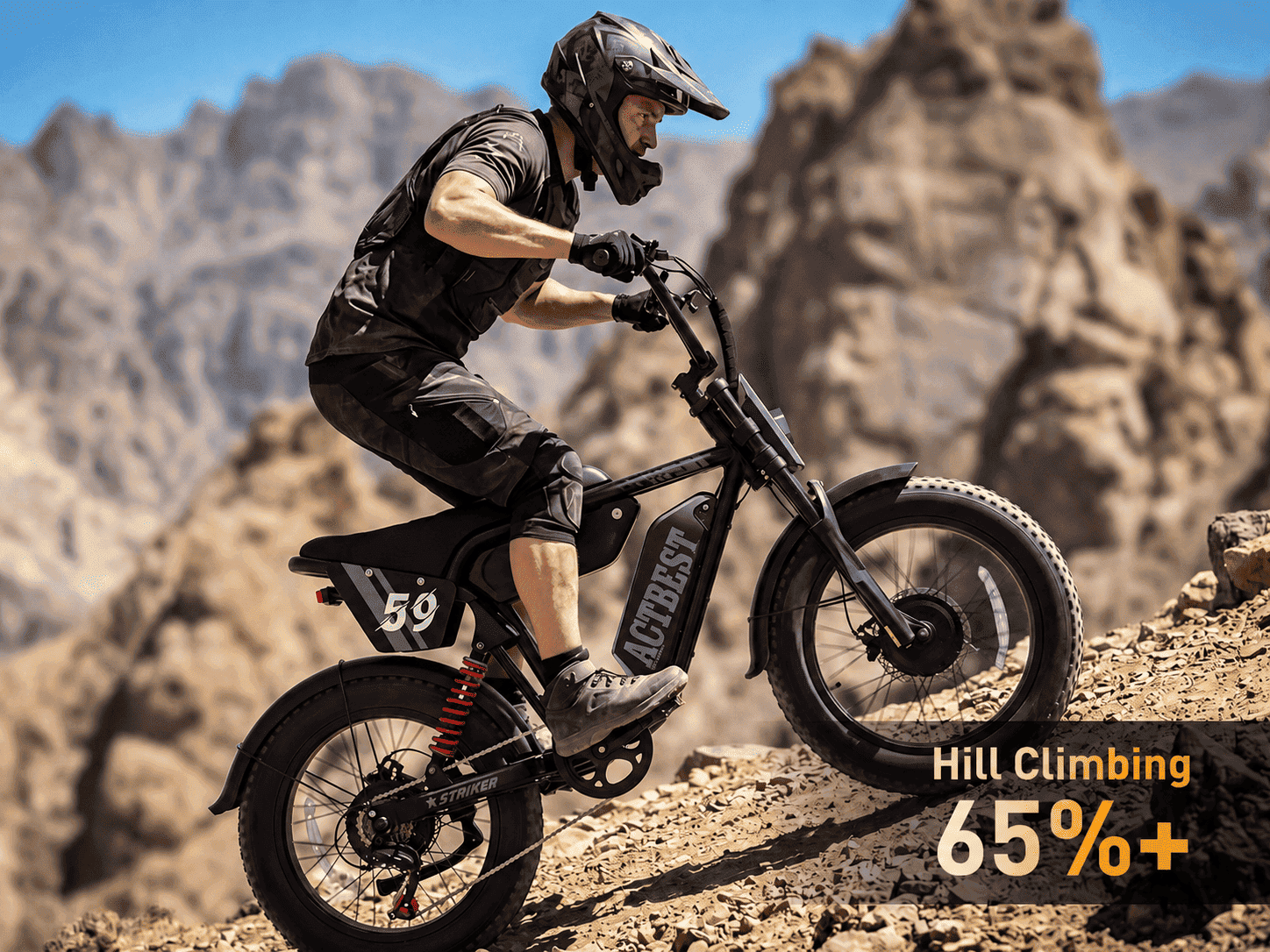
A moped-style ebike in a hilly area requires a few characteristics to be effective, fun, and safe. It has to have the grunt to get up the hill, but also the composure and control for the ride down the other side.
This guide covers what really gets you up and down a hill safely, and which actbest models you should consider if hills are a regular part of your route.
Quick Answer: What Makes an Moped Style E-Bike Good for Hills?
When it comes to riding in a hilly area, your ebike needs strong torque to pull you up a slope without straining, even from a standstill. You need good battery voltage, as a battery that sags under load loses power exactly when you need it the most. And don't overlook brakes and tire grip for fast and confident descending.
Torque vs Watts on Hills
Watts is often the most prominent figure stated by ebike manufacturers, but torque is what gets you up a hill. Torque, measured in Newton-meters, is the twisting force the motor applies to the wheel. It's what helps you start moving from a standstill on an incline and what keeps you moving steadily once you get going.
Peak wattage tells you the motor's maximum short burst of power, which is useful for quick acceleration but doesn't tell you much about sustained climbing. Two motors can share the same peak wattage yet behave completely differently on a long hill. This is usually down to how much torque each motor has. A motor with 100Nm of torque climbs with noticeably less strain than one with 70Nm, even if both are rated at similar peak wattage.
Think about it in terms of a car. A small engine that revs high can hit a decent top speed on flat ground, but put it on a steep hill with a full load, and it labors. A diesel car with lower peak power but far more torque can get up the same hill without breaking a sweat. Electric bike motors work on the same principle. You should see peak wattage as the top-speed number, and torque as the number that determines how comfortably the motor handles resistance: a hill, a heavier rider, or a headwind.
There's a third figure to know, too: rated power, also called nominal power. Peak power is the motor's brief output, but rated power is the maximum power it can maintain without overheating. A motor with a high peak power figure but a weak rated figure can feel strong for the first few seconds of a climb, then lose momentum as it manages heat.
For sustained climbing, the rated power and torque figures together give a more complete picture than the peak wattage alone. If you're regularly tackling hills, you want an ebike with a high torque figure. And this is the first number to check, not top speed or peak watts alone.
Battery and Range on Climbs
When you ride uphill, your battery uses more energy, as the motor works harder. So, with this in mind, your real-world range on a hilly route will always be lower than the same distance on flat terrain. A ride that would use 20 percent of your battery on flat ground can easily use 30 to 40 percent on a hilly equivalent, depending on the profile of your route and how much throttle you're using.
Voltage sag is part of this, too. Under heavy load, like when you're on a steep climb, using a high assistance level, or using the throttle aggressively, battery voltage can dip temporarily, reducing available power right when you need it most. You'll see this more with lower-voltage batteries, since they have less headroom to begin with.
Higher voltage batteries, like the 52V ones on the Striker Plus and Striker Max, perform better under sustained load than the 48V batteries on the Blaze and Striker. This is because there's more voltage available before sag becomes a problem.
Cold weather makes all of this worse, since battery performance drops at low temperatures regardless of the battery's voltage. Lithium batteries lose a significant amount of their usable capacity when the temperatures drop below freezing, so a hilly winter commute will eat into your range more than the same route in summer. This is something to pay attention to if you ride in hilly areas in the winter, so you can manage your battery level to get home.
A conservative way to plan a hilly route is to budget for 50 to 60 percent of the claimed flat-terrain range, rather than the usual 60 to 70 percent used for mixed riding. If a bike claims 75 miles, plan your hilly route around 40 to 45 miles of usable range, with a bit of reserve on top of that for the return leg. It's better to arrive home with charge to spare than to find out halfway up the last hill that you've misjudged it.
Brakes Matter as Much as Motors
Most people just think about how easy it will be to get up a hill, but you also need to think about getting down safely.
When you're riding a heavy moped-style e-bike downhill at speed, you need sustained stopping power. A long descent puts continuous load on the brakes, which generates lots of heat, and brakes that fade under heat lose stopping power exactly when you're relying on them most. This is where hydraulic brakes have the advantage over mechanical disc brakes. Hydraulic systems deliver more consistent stopping power and require less hand effort. You'll be thankful for this on long descents when your hands are already tired from holding the brake lever the whole way down. Hydraulic brakes also give you more control, as they are easier to modulate, allowing you to fine-tune the pressure you're applying.
Mechanical disc brakes aren't a poor choice, and they're perfectly adequate for shorter or more moderate hills where sustained heavy braking isn't a regular part of the ride. But on longer, steeper descents ridden often, the difference between mechanical and hydraulic becomes more noticeable, particularly if you're a heavier rider or carrying cargo, both of which add to the momentum the brakes need to control.
Another thing to think about is your tire choice. Wet roads or loose gravel on a fast descent reduce braking effectiveness regardless of brake type. Most moped-style ebikes have fat tires, which offer you a significant advantage. The wider contact patch with the ground gives you more grip than a narrower tire in the same conditions. But don't forget that you still need to use your brakes carefully to stay fully in control.
When you ride a heavier moped-style electric bike you need to pay more attention to stopping than with a standard bicycle. The combination of bike weight, rider weight, and speed on a descent means it takes longer to stop than most new riders expect. It is best to brake earlier than you think you need to and give yourself more room than feels necessary at first. Practicing on a familiar, quiet hill before you rely on it for a real commute is a great way to build confidence in how the bike behaves under braking.
actbest Hill-Climbing Notes
Starting with the actbest Blaze, this has a 1500W peak motor with 70Nm of torque, which handles moderate hills reasonably well for a compact 16-inch frame. It's a sensible option for rolling suburbs or the occasional short climb, but riders facing steep, sustained hills regularly should look at the higher-torque models in the range instead. Its 48V 10.4Ah battery is also the smallest in the lineup, which compounds the range reduction hills already bring.

Step up to the Striker, and you get 85Nm of torque with an 1800W peak motor, giving noticeably more confidence on steeper streets than the Blaze. The larger 20-inch frame and full suspension also help on rougher hilly terrain, where the extra wheel size rolls over cracks and potholes more easily than the Blaze's smaller wheels.

For more still, the Striker Plus brings 100Nm of torque, a 2000W peak motor, and a 52V 20Ah battery that holds voltage better under sustained climbing load. Its hydraulic brakes are also a bonus if your hilly route includes any long or fast descents, since they give you the stopping confidence to match the extra climbing power. For riders doing a daily hilly commute rather than the occasional incline, this is the model in the range that delivers excellent climbing power and braking confidence.

At the top of the range, the Striker Max is built for the most demanding terrain, with a 3000W dual-motor system and 200Nm of combined torque. The dual-motor system and hydraulic brakes make it the strongest option for steep, sustained climbs or off-road terrain. Still, its higher weight, at just under 110 lbs, and power output mean it's best suited to riders who are confident managing a heavier, more powerful bike at low speed as well as on the climb itself. If you're planning to use higher-power modes for seriously demanding terrain, you'll need to stick to private property or permitted off-road trails rather than public roads, and always check your local ebike class rules before riding at full power on the street.

Final Thoughts
No single characteristic makes a bike good on hills. You need to look at torque, battery voltage under load, brake strength, tire grip, and how you ride the thing. Leaving any one of them out of the equation is how riders end up disappointed with a bike that looked great in the advert. A big peak-wattage number with nothing to back it up will struggle on the exact climb it's supposed to handle, which is frustrating to find out after you've already bought it.
The good news is that once you know what to look for, matching a bike to your route isn't complicated. The Blaze covers moderate hills fine, and there's no need to overspend if that's really all you're dealing with. The Striker or Striker Plus are better for steeper or more frequent climbs, as they both have more torque, and the Striker Plus adds stronger brakes into the bargain.
If you're dealing with the toughest terrain out there, steep off-road climbs, loose surfaces, or routes that would leave a lesser bike struggling, the Striker Max has the most torque and power in the lineup, though it's best kept off-road or on private land where you can put that power to use.
And whichever one you end up with, don't forget the climb is only half the story. Plenty of riders put all their attention into getting up a hill and none into getting back down. The way down deserves just as much thought as the way up, if not more, since that's where speed builds, and mistakes get expensive.
Browse the full moped style ebike range at actbest to compare torque, battery, and brake specs before you buy.
FAQ
How much torque do I need for hills?
For occasional moderate hills, 70 to 85Nm is usually enough. For steeper or more frequent climbs, 100Nm or more makes a noticeable difference in how strained the motor feels. For serious off-road or very steep terrain, a high-torque dual-motor system like the Striker Max's 200Nm combined figure gives you the most headroom.
Are hub motors good on hills?
Yes, for most riders. Hub motors on moped-style ebikes are tuned for this kind of riding and handle moderate to steep hills well, provided the torque figure is strong enough for your route. They're reliable and low-maintenance compared to some alternative motor types.
Is AWD necessary for hills?
Not for most riders. A single motor with strong torque, like the Striker Plus's 100Nm, handles the vast majority of hilly routes without issue. Dual-motor AWD systems like the Striker Max earn their cost if you're regularly riding steep, loose, or off-road terrain where extra traction makes a real difference.
Will hills cut my range?
Yes, noticeably. Climbing draws significantly more power than flat riding, so budget for around 50 to 60 percent of the claimed flat-terrain range on a hilly route, rather than the 60 to 70 percent that applies to mixed riding.
Share:
Best Moped Style Ebike for Teens: Parent Buying Guide
How Far Can a Moped-Style Ebike Really Go? Battery and Range Guide