
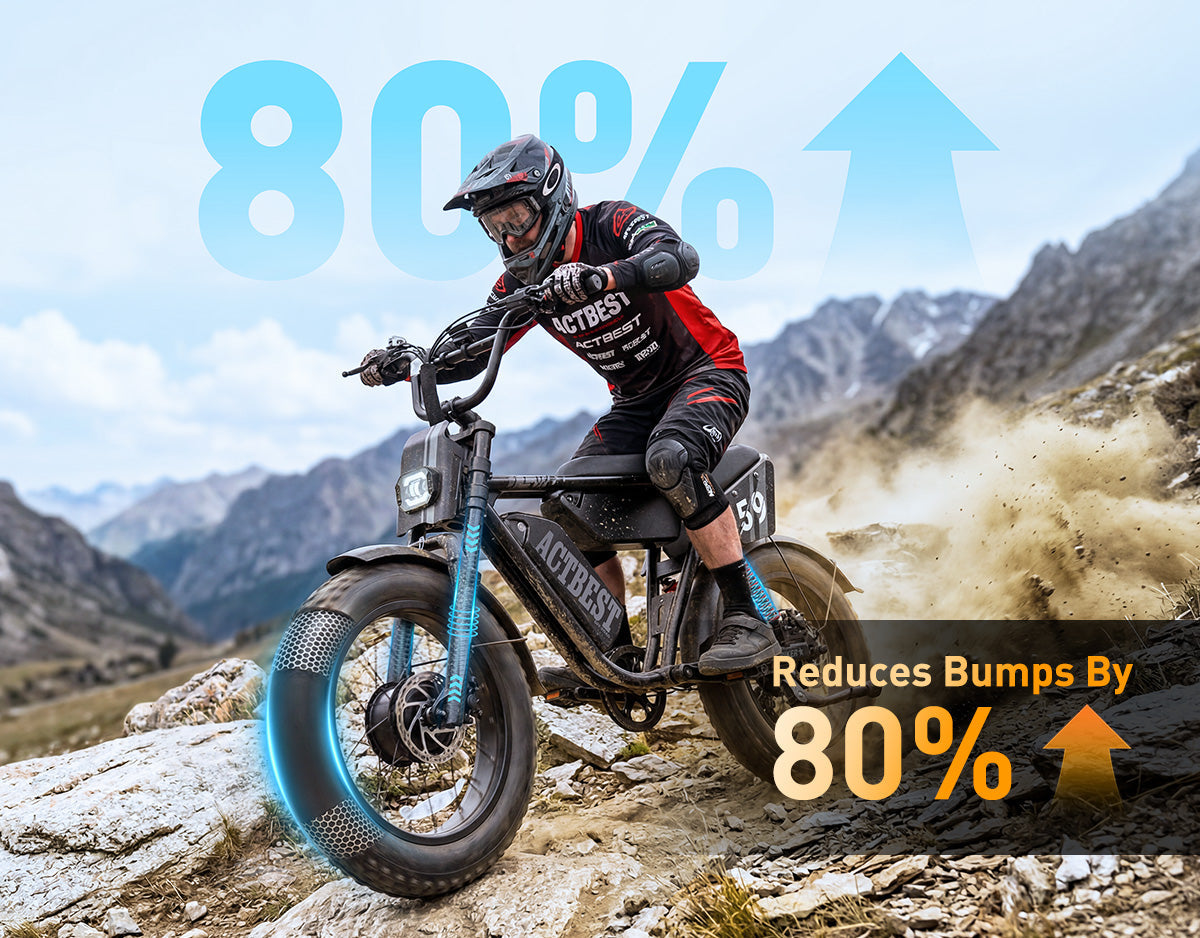
The moped style ebike market has grown fast in the last couple of years, and it's not hard to see why. These bikes combine a retro, motorcycle-inspired look with the practicality of a pedal-assisted ebike. More riders are choosing them over standard commuters, and the models available now include everything from teen-friendly entry-level bikes to high-powered adult commuters with full suspension and hydraulic brakes.
Buying the wrong one is easy if you're going on looks alone. Motor power, battery size, tire type, and suspension all affect how the bike performs. This guide covers what to look for, which actbest models are worth considering, and the mistakes most buyers make before they've ridden a single mile.
 What Is a Moped Style Ebike?
A moped style ebike is a pedal-assisted electric bicycle with a frame inspired by classic mopeds and motorcycles. It has the low-slung geometry, bench seat, wide tires, and often has the bodywork of a retro scooter, but it uses a battery and still has pedals. You can ride it entirely on pedal assist, use the throttle alone, or combine both, just like any other ebike.
If you're looking at buying one of these electric bikes, you need to understand how they are categorized, as the legal distinction matters. A moped style ebike is not an electric moped. In the 37 US states that use the three-tier classification system, a compliant moped style ebike is a bicycle under state law. You don't need a license, registration, or insurance. The frame looks like a moped, but it's classified as an ebike.
That affects where you can ride. Bike lanes, bike paths, roads: all accessible on the same basis as any other bicycle.
Why Moped Style Ebikes Are Becoming Popular
The look of a moped style electric bike is what attracts most buyers. A moped style ebike's aesthetics make it stand out in a way a regular commuter doesn't, which is incredibly appealing to cyclists who want something a little bit different. Some people want a bike that reflects their personality, and the moped style does that in a way a regular step-through commuter that looks like every other bike never will.
It's not just the looks, though, as they give you a different style of riding, too. The bench seat is wider and more comfortable than a standard saddle. They often have fat tires that absorb road vibration that narrower tires can't do as well. The riding position is upright and relaxed, which is easier on your back and wrists over time.
This type of electric bike is also more stable than you may think. The wide tires and lower center of gravity give moped style ebikes a planted feel at speed that lighter bikes don't always have. New riders in particular find that moped style ebikes instill more confidence than the slightly skittish feel of a lightweight commuter on uneven surfaces. Riders new to ebikes or returning to cycling after a long break, like that the extra confidence makes early rides more enjoyable and less stressful.
Moped Style Ebike vs Regular Electric Bike
On a regular ebike, you sit over the pedals in a more traditional cycling position. The frame is lighter, the tires are slimmer, and it's easier to lift, store, and carry. For dense urban commuting, filtering through traffic, or any situation where you carry the bike upstairs, a standard commuter is a better choice due to its user-friendliness. A foldable ebike is designed precisely for that kind of use.
 A moped style ebike puts you in a more relaxed riding position, further back, with your feet slightly more forward. The bench seat is designed to create a more comfortable ride, not to improve pedaling efficiency. Comfort is enhanced by fat tires and suspension that dampen road imperfections. The riding experience is more relaxed and more comfortable over longer distances, but you need to be prepared for the bike to be heavier and take up more space.
So, in summary, the moped style is more enjoyable to ride, but harder to live with. The standard commuter is the opposite. Which one you choose would depend entirely on your storage situation, the kind of riding you do most, and your personal style. If you commute five days a week through dense city traffic and store the bike in a small flat, a standard commuter is the more practical answer. If you have storage sorted and want a more comfortable daily ride, and something with a bit more personality, the moped style wins.
Key Features to Look For: Motor, Battery, Tires, Seat, Suspension
Motor and Battery
You need to understand motor power before you compare models. The figure on the spec sheet is the bike's peak output, not sustained power, and most moped style ebikes fall somewhere between 1500W and 2000W peak. For everyday commuting on flat to moderately hilly roads, 1500W is more than adequate. Where the extra power makes a practical difference is on steeper climbs with a heavy load, or on longer routes where you need consistent performance. The actbest Blaze's motor starts at 1500W peak, while the Striker and Striker Plus are more powerful, so you'd notice a significant difference in performance.
 Battery capacity is what most directly affects how useful a moped style ebike is for your particular commute. The number to pay attention to is watt-hours, which is the voltage multiplied by the amp-hours. A 48V 15.6Ah battery gives you 749Wh, and a 52V 20Ah battery gives you 1040Wh. In practice, it's sensible to budget for around 60-70% of the claimed range, since manufacturers measure under ideal conditions that are not always achievable in real-world use. If that reduced figure comfortably covers your round trip, you're in good shape. If it doesn't, you'll need to go up to the next battery size.
Comfort and Safety Features
Tires on most adult moped style ebikes are 20x4.0-inch as standard, while models for teens usually have 16x4.0-inch tires. The wider tire is more stable at speed and better equipped for poor road surfaces. If you're an adult buying for yourself, the smaller 16-inch models are noticeably less planted at higher speeds and don't absorb road vibration quite as well.
The bench seat is one of the defining features of a moped style ebike, but what catches shorter riders out is the minimum seat height. The general fit range in the spec sheet doesn't tell you how low the saddle can go, so it's worth looking for the minimum seat height figure specifically and checking it against your inseam before buying.
Suspension is something you'll appreciate more on rough surfaces. Full front and rear suspension is worth having for any regular commute on poorly maintained surfaces, while front-only suspension is adequate for well-maintained roads or casual weekend use.
When it comes to brakes, mechanical disc brakes are pretty good and do the job well for most riders, while hydraulic disc brakes are easier to modulate and perform better. At the speeds these bikes are capable of, hydraulic brakes are worth paying for if you ride in variable weather or plan to commute year-round.
Best Moped Style Ebikes
 Starting at $569, the actbest Blaze is designed for teens and younger riders. It has a 1500W peak motor, 48V 10.4Ah battery, 16x4.0-inch fat tires, and a 25+ mph top speed. Its compact 16-inch frame suits smaller riders well, and the price point makes it the most accessible model in the range.

For teens who will be covering more varied terrain, the actbest Blaze Plus is a better option. At $649, the 2000W peak motor and 30+ mph top speed give it more performance, and the dual soft-tail suspension and hydraulic brakes are significant upgrades over the base Blaze, making a real practical difference on uneven surfaces.
 Most adult buyers should start their search with the actbest Striker. At $699, you get a 1800W peak motor, 48V 15.6Ah battery, up to 75 miles of claimed range, full suspension, and 20x4.0-inch fat tires. It fits riders from 5'3" to 6'3", can carry 360 lbs, and handles most daily commutes.
 Riders who need more from their daily commuter should look at the actbest Striker Plus. At $999, the 2000W peak motor and 52V 20Ah battery push the claimed range to 90 miles and the top speed to 38+ mph, and hydraulic brakes replace the mechanical disc brakes of the standard Striker. If you're covering 30 or more miles a day, riding regularly in wet conditions, or simply want the best specification in the lineup, this is the one to go for.
How to Choose Based on Your Riding Scenario
If you want an ebike for weekend leisure riding, the Striker is a good choice for most adults. Two hours on a bench seat with full suspension is a noticeably different experience from the same ride on a narrow commuter saddle. Additionally, the fat tires give you extra cushioning and grip. If budget is the main consideration and the rider is on the smaller side, the Blaze will do the job at a much lower price.
For daily commuting of up to 30 miles round-trip, the Striker is more than capable. For longer commutes or riders who commute year-round in wet conditions, the Striker Plus costs more, but it has better range and hydraulic brakes that perform consistently in the rain.
The Blaze or Blaze Plus will be the right choice for teens who want a moped style ebike. The 16-inch compact frame suits smaller riders, and the lower top speeds are appropriate for riders who are still building their experience and confidence. The Blaze Plus is worth the extra $80 for any rider who regularly rides on varied or uneven surfaces.
For mixed commuting and leisure use, the Striker handles both comfortably. The range is sufficient for a daily commute and a weekend ride without needing a mid-day charge, and the full suspension and fat tires make it equally at home on a rough urban commute and a relaxed coastal ride.
Common Mistakes to Avoid Before Buying
Buying on looks alone is the most common mistake, and it's easy to understand why, given how distinctive these bikes are. The problem is that a bike that looks great, but if you can't store it or it doesn't suit your commute, it will soon become frustrating. It's better to sort out the practical questions first: motor, battery, weight, and seat height, and confirm that the look works once those boxes are checked.
Weight is something that most first-time buyers underestimate or don't think about at all. The Striker weighs 84.9 lbs, which isn't noticeable while you're riding since the motor makes up for it, but it can be a problem the moment you need to carry it up stairs, load it into a car, or haul it through a narrow doorway. If those situations are likely to be part of your routine, it's worth thinking through carefully before you commit. A lighter commuter ebike is the more practical answer for riders without dedicated ground-floor storage.
It's also important not to take the range figures at face value. Manufacturers measure range under ideal conditions. By this, I mean the bike is ridden by a light rider on flat terrain at low assistance, so you get the maximum range figure possible. It's best to expect 60-70% of the claimed range as a realistic figure. The Striker's 75-mile claim translates to roughly 45-52 miles in practice, which still comfortably covers most commutes. But if your route is at the edge of those limits, the Striker Plus's larger battery is worth the additional cost.
Buying a bike with a higher spec than you really need is a mistake, too. The Striker Plus is better than the Striker in every measurable way, but for a 10-mile daily ride at moderate speeds, you're paying for performance you'll rarely use. The Striker covers the needs of most riders, and the Striker Plus is there for those it doesn't.
Before buying, check the minimum seat height and not just the general fit range. The fit range in the spec sheet indicates the frame size, but the minimum seat height tells you whether your feet will reach the ground comfortably at stops. For shorter riders, it's the more important number.
FAQ
What is the difference between a moped style ebike and a regular ebike? The main differences come down to geometry, seat, and tires. A moped style ebike has a more relaxed riding position, a wider bench seat, and fat tires, making it more comfortable over longer distances. A regular ebike is lighter, narrower, and easier to store and carry. Both are pedal-assisted bicycles under US law within Class 1 to 3 limits, and which one makes the most sense depends on your storage situation and the type of riding you do day to day.
Are moped style ebikes legal on public roads? Yes, in most US states. A Class 1, 2, or 3 compliant ebike is treated as a bicycle under state law, with no license, registration, or insurance required. The legal classification is based on motor output and speed limits, not the frame design. A few states have their own rules for higher-powered ebikes, so it's worth checking your state's rules before you buy.
Are fat tires necessary? They're not essential, but they make a noticeable difference on rough urban roads. The 20x4.0-inch tires on the Striker and Striker Plus absorb vibration that passes straight through a narrower tire, and the wider contact patch adds stability at lower speeds. Most urban commute routes are rough enough to make fat tires worth having, though on well-maintained roads the advantage is less pronounced.
Is full suspension worth it? On rough roads, yes. Fat tires and full suspension together mean you feel considerably less of what's under the wheels, and the difference becomes most obvious after a week of daily commuting on rough urban surfaces. For well-maintained routes or occasional weekend use, front suspension alone is perfectly adequate.
Which actbest moped style ebike is the best for commuting? The Striker covers most commuters' needs well at $699, with a 75-mile claimed range, full suspension, and a comfortable bench seat. The Striker Plus is the better option for longer commutes or for riders who want hydraulic brakes and more battery capacity. For teens or shorter adult riders who need a more compact frame, the Blaze Plus is a strong option at $649.
How heavy are moped style ebikes? The Striker weighs 84.9 lbs, which is fine for riding but worth considering when lifting and storing. It's a good idea to sort out dedicated storage before you buy and to consider any carrying your commute involves before committing to a moped style frame.
Share:
Moped Style Ebike vs Regular Ebike: Which One Should You Choose?
Best Electric Bikes for Women: How to Choose the Right One