
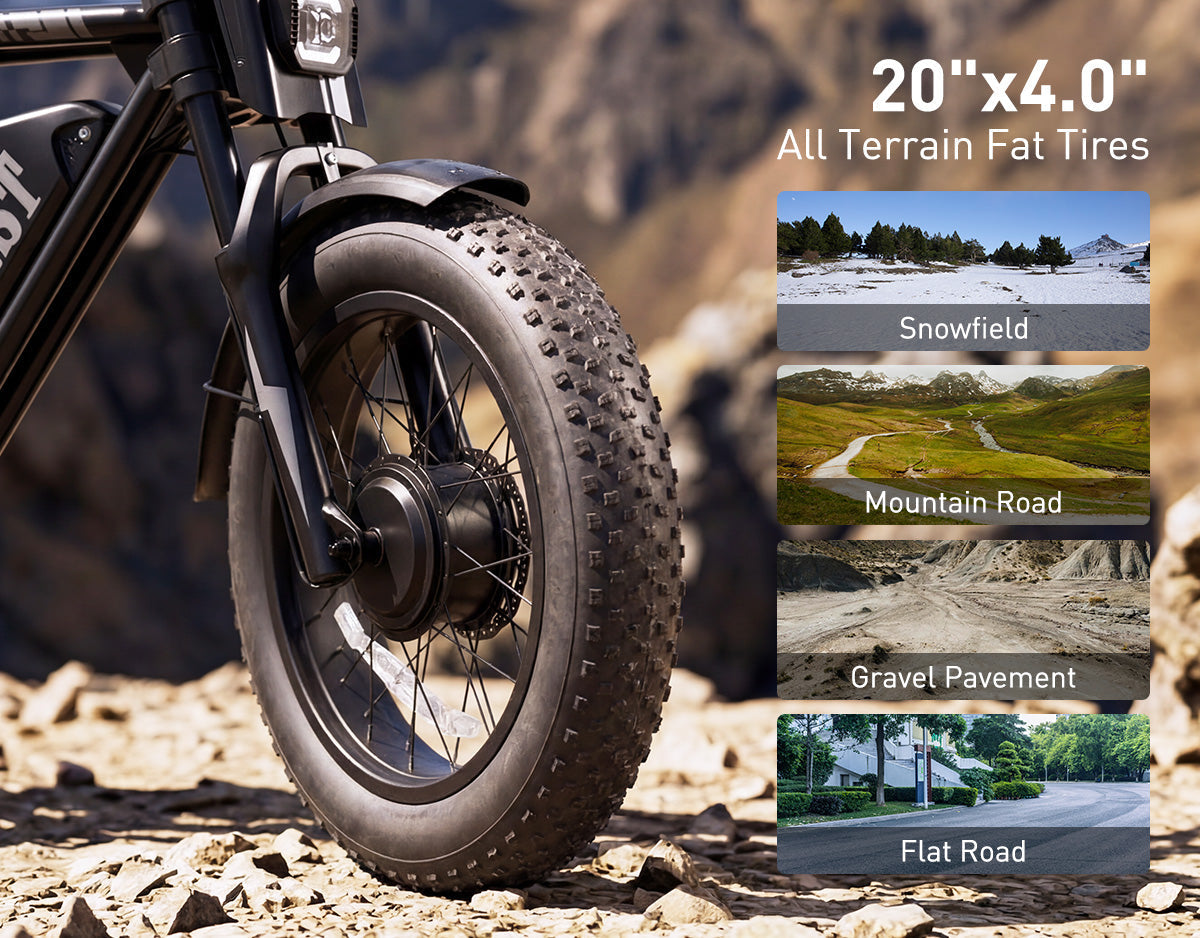
When you're shopping for a moped-style ebike, you'll notice that they commonly come with two wheel sizes, 16x4 and 20x4. Both use the same 4-inch-wide fat tire, but the wheel diameter changes how the bike handles, how it fits through your door, and who it suits best. Neither size is better across the board. It comes down to your height, your storage space, and the kind of roads you ride.
Quick Answer: Which Tire Size Should You Choose?
A 16x4 wheel lowers the whole bike to the ground, making it easier to swing a leg over and get your feet flat once you've stopped. This smaller wheel diameter is usually the better choice for shorter riders or teens. A 20x4 wheel is larger and feels more planted at speed and over rough ground.
Which one's better depends on your height, where you'll store the bike, your route, how fast you like to ride, and your personal preference.
If you're still not sure, think about where the bike lives day to day. Squeezing it through a narrow apartment doorway every evening is a different job than parking it in a garage with room to spare.
What 16x4 and 20x4 Mean
The first number is wheel diameter in inches, and the second is tire width. A 16x4 wheel is 16 inches across with a 4-inch tire. A 20x4 wheel is 20 inches across with the same 4-inch tire.
The width is what gives both sizes that fat, cushioned look. These high-volume tires have more give over bumps and better grip on gravel, sand, snow, or wet roads. It's also part of what gives these bikes their moto-inspired aesthetics.
Diameter is what really separates the two. A smaller wheel weighs less at the rim and spins up quicker, so the bike turns and changes direction more easily. A bigger wheel carries more weight around its edge, so once it's rolling, it holds its line better. It also meets the edge of a pothole or a crack at a shallower angle, so it rolls straight over instead of dropping into it. You can't have both. A wheel that turns quickly won't roll over rough ground as well, and a wheel that rolls over rough ground well won't turn as quickly.
You notice this the moment you wheel either bike out of a garage. A 16x4 bike is short enough end to end that it goes through a standard doorway and turns into a hallway without much thought. A 20x4 bike is longer because the bigger wheels stretch the wheelbase. A longer bike takes more room to line up straight for a doorway or swing it around a tight corner. Once you're riding, that extra length and bigger wheel pay off. Potholes and bumps register less through the frame, since the larger wheel rolls over rough spots instead of dropping into them.
16x4 Strengths and Trade-Offs
A 16-inch wheel keeps the whole bike lower, which makes it easier for shorter riders and teens to swing a leg over and get on and off. That's the main reason the actbest Blaze and Blaze Plus use this size.

The smaller wheel also steers more quickly, since there's less weight out at the rim to turn. You'll notice it in tight corners, narrow streets, or anywhere you're weaving through crowds near a school.
Another way a smaller wheel is easier to live with is when it comes to storage. The shorter wheelbase that comes with a smaller wheel means the whole bike is shorter end to end, so it goes through a normal doorway and turns around in a hallway without much trouble. It's lighter too, which makes carrying it up steps easier.
The slight disadvantage of the smaller wheel is how it deals with rough ground. A smaller wheel meets the edge of a pothole or a crack at a steeper angle, so it's more likely to drop into the gap instead of rolling straight over it the way a bigger wheel does. You'll feel more of that through the frame. It also feels a touch less stable at higher speeds than a 20-inch wheel. Nothing dangerous, just something to keep in mind if you're riding patchy pavement regularly.
20x4 Strengths and Trade-Offs
A 20-inch wheel rolls straight over holes and cracks instead of dropping into the gap the way a smaller wheel does. That's the main reason the actbest Striker, Striker Plus, and Striker Max use this size.

The bigger wheel also holds its line better at higher speeds, since there's more weight out at the rim, keeping it steady. You'll notice it most on faster routes, since the Striker family reaches higher speeds than the Blaze does.
Another way a bigger wheel is easier to live with is fit. It suits a taller, adult-sized frame properly, and riders over about 5'8" tend to prefer the reach and position that comes with it.
The slight disadvantage of the bigger wheel is size. The longer wheelbase that comes with it means the whole bike is bigger to store, heavier to lift, and needs more room to turn than a 16x4 bike. Getting it through a doorway or down a hallway takes a bit more care. Nothing that negatively affects the ride itself, it's just something to keep in mind if space is tight at home.
Curbs, Bike Racks, and Tire Pressure
There are a few practical details that don't fit neatly under storage or ride comfort, but they still make a difference to day-to-day ownership.
Curbs work the same way as the potholes and cracks already covered above. The bigger wheel rolls up and over; the smaller one is more likely to catch, especially if you hit it slowly or at an angle. If you're on a 16x4 bike, approaching curbs a little more square-on and with some speed helps avoid that.
Bike racks are worth checking before you buy, especially if you're planning to transport the bike by car. Standard hitch and trunk racks are usually designed for the wheel sizes you get with regular bicycles. A 20x4 wheel with its wider tire and larger diameter can be a tighter fit on some rack designs than a 16x4 wheel would be. It's worth measuring your specific rack's wheel tray or arm clearance against the tire width before assuming either size will fit without adjustment.
Tire pressure changes the numbers slightly too. The stated wheel diameter is measured at standard pressure, but running the tire softer for extra cushioning flattens it a little at the contact patch, which shrinks the effective rolling diameter by a small amount. It won't change which wheel category you're riding, but it's why the real-world diameter can vary a bit between bikes, brands, and even day to day depending on how firm you keep your tires.
Actbest Model Examples
The Blaze and Blaze Plus have the smaller 16x4 wheel sizes. The Blaze is the cheaper one at $569, with a 1500W motor and a 48V 10.4Ah battery. It has a range of about 55 miles and a top speed of 25+ mph. The Blaze Plus costs $649 and gets you more of everything. It has a 2000W motor, powered by a bigger 15.6Ah battery, which gives you 75 miles of range per charge and a top speed of 30+ mph. Both have full suspension, weigh 77.2 lbs, and fit riders from about 5'1" to 6'3".
The Striker, Striker Plus, and Striker Max have the larger 20x4 wheel size. The Striker is the entry-level model at $699, with a 1800W motor and a 35+ mph top speed. It has a range of about 75 miles, and there's a dual battery option if you want more.
At $999, the Striker Plus steps things up again. It has a 2000W motor powered by a 52V battery, giving you 90 miles of range and a top speed of 38+ mph, with hydraulic brakes instead of mechanical. The Striker Max sits above both with its dual motor system and a 52V 40Ah battery, giving you 120 miles of range at the same 38+ mph top speed. It's the heaviest bike in the range, but that is to be expected. Prices change from time to time, so check the current price before you buy.
Height is one place the two wheel sizes differ. The Blaze and Blaze Plus fit riders from about 5'1" to 6'3", while the Striker, Striker Plus, and Striker Max fit riders from about 5'3" to 6'3". That two-inch gap at the shorter end is worth factoring in if you're closer to 5'1" or 5'2", since it's part of what makes the 16x4 models the more comfortable fit for shorter riders.
Weight is what changes more across the range: the Blaze and Blaze Plus weigh 77.2 lbs, the Striker weighs 84.9 lbs, the Striker Plus weighs 92.6 lbs, and the Striker Max weighs 109.8 lbs. If you're lifting the bike onto a rack or up a step a lot, that difference is worth thinking about.
FAQ
Are 16-inch fat tires only for kids?
No. The Blaze and Blaze Plus are aimed at teens and shorter riders, but plenty of adults ride them too. Anyone under about 5'8" who wants a lower, more compact bike will probably like this size.
Are 20x4 tires faster?
Not by themselves. Top speed depends on the motor and the mode you're riding in. The bigger wheel gives you more stability at speed, so a fast ride is more controlled.
Which tire size is better for sand or snow?
Both cope reasonably well because of the 4-inch width. But the 20-inch wheel handles deep sand or snow a bit better, since its bigger diameter rolls over the surface instead of digging in.
Can I swap tire sizes later?
Check with actbest support before you try. Frame geometry, fork clearance, and brake mounts are all matched to one wheel size, so it's not always a simple swap even if the tire width is the same.
Final Thoughts
Neither tire size is better outright. 16x4 suits shorter riders, tighter storage, and quicker handling. 20x4 suits taller adult riders, rougher roads, and a more planted ride at speed.
Think about your height, where you'll store the bike, and the kind of roads you ride on most before you decide. Browse the full moped-style ebike range from actbest and put the Blaze next to the Striker family to see which one fits you best.
Share:
Best Commuter Electric Bikes for Adults: Range, Comfort, and Daily Use
Best Moped Style Ebike for Teens: Parent Buying Guide