
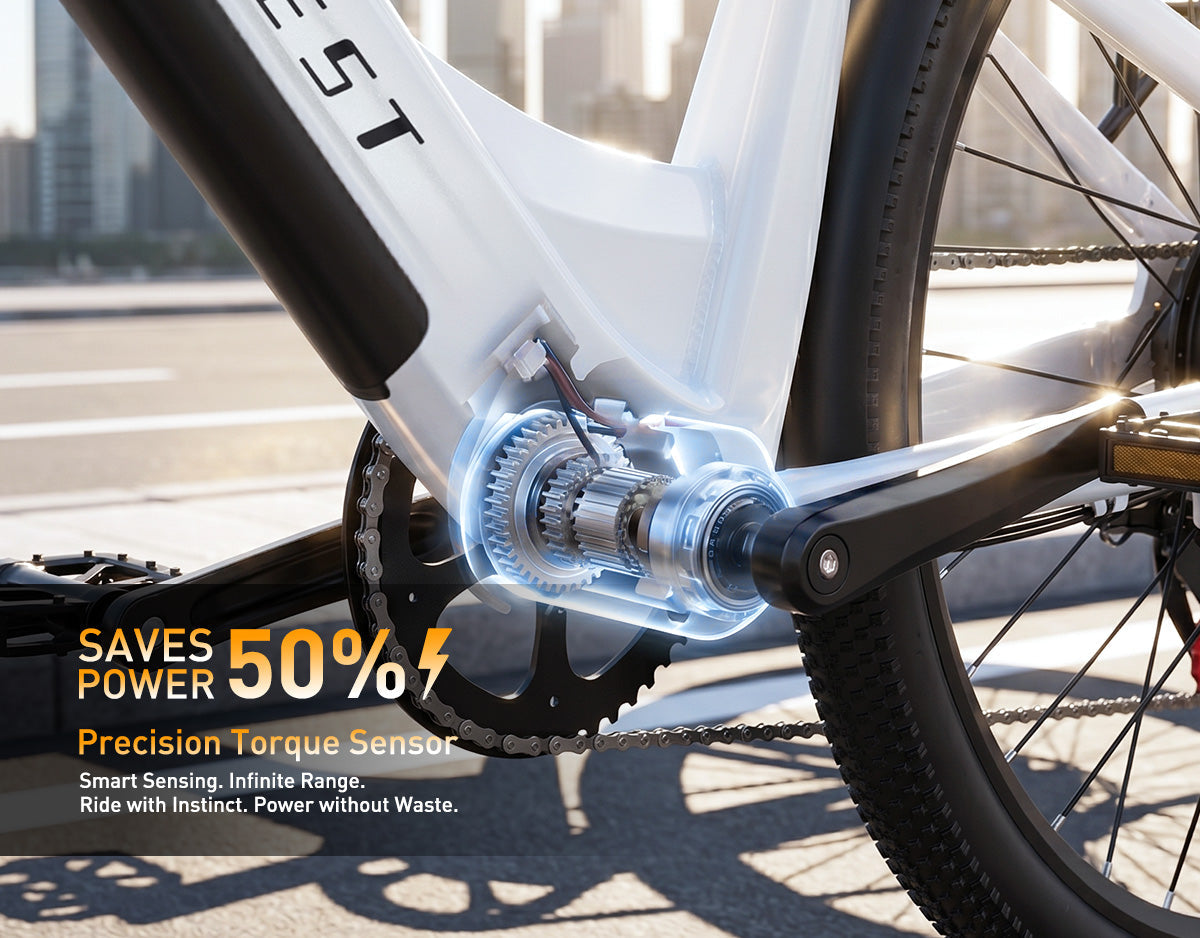
What is a torque sensor on an e-bike? It's one of those things most people never think about until they realize that electric bikes use different systems that give them different characteristics.
Most e-bikes use a cadence sensor. This detects when the pedals are turning and switches the motor on at whatever level you've selected. This system is simple, cheap, and functional. But it doesn't know how hard you're actually pedaling, and that's where the cadence sensor starts to fall short for some types of riding. You get power when you don't need it, and there is a disconnect between your effort and what the bike does, which becomes more noticeable the more you ride.
A torque sensor addresses this by working differently. It reads the force you're putting through the pedals and adjusts the motor output to match in real time. The result is assistance that responds to you rather than just running on a preset program.
In this guide, we'll break down exactly what a torque sensor does, how it works, and what difference it makes on a real ride.
 What Does a Torque Sensor Actually Do?
The job of a torque sensor is to measure pedaling force, not just pedaling motion. Every time you push on the pedals, the sensor measures the pressure you're applying and sends that information to the motor controller. The motor then adjusts its output to match.
When you pedal lightly, you get light assistance, and you get more when you push harder. When you back off, the motor backs off. It's a continuous process that keeps the power delivery proportional to your effort.
Most torque sensors take hundreds of readings per pedal stroke to make the response fluid and immediate. That sampling rate is part of why a torque sensor e-bike feels so different from a cadence sensor one, even at the same assist level.
How Does a Torque Sensor Work?
There are two main types of torque sensors used in e-bikes, and they work differently.
Rear hub sensors use a strain gauge. When force is applied to the drivetrain, the gauge flexes slightly. That movement is converted into a signal that the motor can read and use.
Bottom bracket sensors use magnets. As you apply pressure to the cranks, the torsional stress changes the magnetic field around the spindle. That change is read as a voltage and sent to the motor controller.
Both types work well. The main difference is placement and how they integrate with the motor. Mid-drive motors use bottom bracket sensors as they are in the same area and can measure force closer to where it's applied. Hub motors, like the one on the actbest Core ST 2.0, use rear sensors. Either way, the outcome is power that scales with the effort you put in.
Torque Sensor vs Cadence Sensor: What's the Real Difference?
When you're buying an electric bike, you really need to know the difference between a torque sensor and a cadence sensor. This is to help you understand how potential e-bikes will behave and what they would be like to live with. Here is what you need to know:
Riding Uphill
When climbing a hill, you naturally push harder on the pedals. A torque sensor picks that up and increases motor output to match, so the bike responds to the gradient without you having to adjust anything. A cadence sensor doesn't know you're working harder; it just holds the same level regardless of what the terrain is doing.
Riding In A City
When you're riding around in a city, it usually means you spend a lot of time stopping and starting, and the difference between the two sensors is just as noticeable. A torque sensor gradually ramps up the power when you pull away from a junction, which feels controlled. A cadence sensor can deliver a jolt of power the moment the pedals start turning, which can get tiresome when riding in traffic a lot.
Mountain Biking
When you're riding an electric mountain bike on proper off-road terrain, you need precise power delivery and a natural feeling through the pedals. Too much assistance at the wrong moment can unsettle the bike, so having a motor that responds to your input gives you better control when the trails get technical.
When you're riding along a flat section that doesn't need you to pedal hard, a torque sensor backs off naturally because you're not asking for help. On the other hand, a cadence sensor keeps pushing at whatever level you've selected, which wastes battery and can make the ride feel less intuitive.
A Torque Sensor Is Better For Range
Because the motor only delivers power proportional to your effort, it's not running at full tilt when it doesn't need to. With a cadence sensor, the motor runs at a fixed output whenever the pedals are turning, even if you're barely pedaling downhill or cruising on a flat stretch where you don't really need help.
That inefficiency adds up over a long ride. An e-bike torque sensor usually contributes to a greater usable range from the same battery because the system is more responsive and less wasteful. You'll notice this advantage if you ride a commuter e-bike every day, especially if you're trying to make it through a long round-trip on a single charge.
A Torque Sensor Gives You A More Engaging Ride
A torque sensor e-bike doesn't do the work for you. It amplifies your effort. That means you still get a workout if you want one, the bike just makes it feel more rewarding and less of a slog.
For riders who use their e-bike to commute and want to arrive without being drenched in sweat, a torque sensor helps you manage effort more precisely. You can cruise at a comfortable pace without the motor suddenly dropping off or surging. For riders who enjoy a more active ride, the responsiveness makes the experience more engaging.
Who Should Get a Torque Sensor e-bike?
Torque sensors work well for most riders, but they make the biggest difference in a few specific situations.
Daily Commuters
Choose an e-bike with a torque sensor if you're riding to work every day and you want the bike to feel like an extension of your effort rather than something you constantly have to manage. A torque sensor makes the assistance come and go naturally, so you can focus on the ride rather than which level you're on.
Hilly Routes
If your regular rides include any gradients, a torque sensor is beneficial. Power delivery adjusts as the terrain changes, so you're never underpowered on a climb or overassisted on the way down.
Riders Who Care About Range
If you're trying to get the most out of every charge, a torque sensor helps by only using the power you actually need. Over a long ride or a full week of commuting, that efficiency adds up in a way that a cadence sensor simply can't match.
If you're mostly doing short, flat rides occasionally, a cadence sensor bike might be enough. But for regular use, the torque sensor offers a better experience, and once you've ridden one, it's hard to go back.
actbest Torque Sensor e-bikes Worth Considering
actbest has two torque sensor models built for city riding, both priced at $899.
The Core ST 2.0 27.5-Inch is the step-through version. It has a 1200W peak motor, 27.5-inch wheels, and a range of up to 100 miles, which puts it well above most bikes in its price range. The low-step frame makes it easy to get on and off, which is useful when you're stopping frequently in traffic.

The Core 2.0 27.5-Inch is the step-over version. Same torque sensor, same motor, same battery, same range. The better fit for riders who prefer a traditional frame or find a step-over more comfortable for longer distances.

Both are practical, well-specified bikes that don't require you to pay a premium for torque sensor assist. For most city commuters, either one covers everything you'd need from a daily rider. You can see the full actbest torque sensor e-bike range here.
FAQs
Do all e-bikes have torque sensors?
No. Many budget e-bikes use cadence sensors, which are simpler and cheaper to produce. Torque sensors are more common in mid-range and above models, though they're becoming more accessible as prices drop.
Is a torque sensor e-bike worth the extra cost?
For regular riders, yes. The improvement in ride feel and battery efficiency makes a noticeable difference over time. For very occasional use on flat terrain, a cadence sensor bike may be enough.
Does a torque sensor affect top speed?
No. Top speed is determined by the motor and local regulations. The sensor only affects how power is delivered, not how much the motor can produce.
Are torque sensors reliable?
Yes. Modern torque sensors are well-built and low-maintenance. As with most components, quality matters, so it's worth sticking to reputable brands rather than the cheapest option available.
Final Thoughts
So, what is a torque sensor on an e-bike?
It's the component that makes pedal assist feel proportional and intuitive. For riders who commute regularly, tackle hills, or just want a better day-to-day experience, it's one of the most significant components an e-bike can have. The technology isn't new, but it's only recently started appearing at more accessible price points, which makes it worth paying attention to if you're buying now.
A cadence sensor will get the job done for light, occasional riding. But if you're going to rely on your e-bike, a torque sensor is worth having.
If you're looking for an e-bike that gets this right without a premium price tag, it's worth taking a look at the actbest torque sensor range and finding a model that fits your commute.
Share:
The Ultimate Sub-$600 e-bike Catalog: Performance for Every Riding Style
Best Fat Tire Electric Bike in 2026