
More people are looking for alternative ways to commute, leaving their cars at home or even replacing them altogether. One of the most popular solutions is the commuter e-bike.
It's not hard to see why. Fuel costs keep rising, parking is a headache, and sitting in traffic is one of the more reliable ways to ruin your morning. An e-bike allows you to avoid most of that. This is because you can leave when you want, take routes a car can't, and arrive at your destination without the stress.
But replacing your car isn't something you do on a whim. There are practical questions that need real answers. How far can you actually go on a charge? What happens when it rains? And how do you stop your bike from getting stolen? This guide covers all of it.

Is the Range Good Enough?
Range anxiety is the first thing most people bring up when they consider switching from a car to an e-bike. It's a fair concern, but it's not as stressful as you may first think when you look at the numbers.
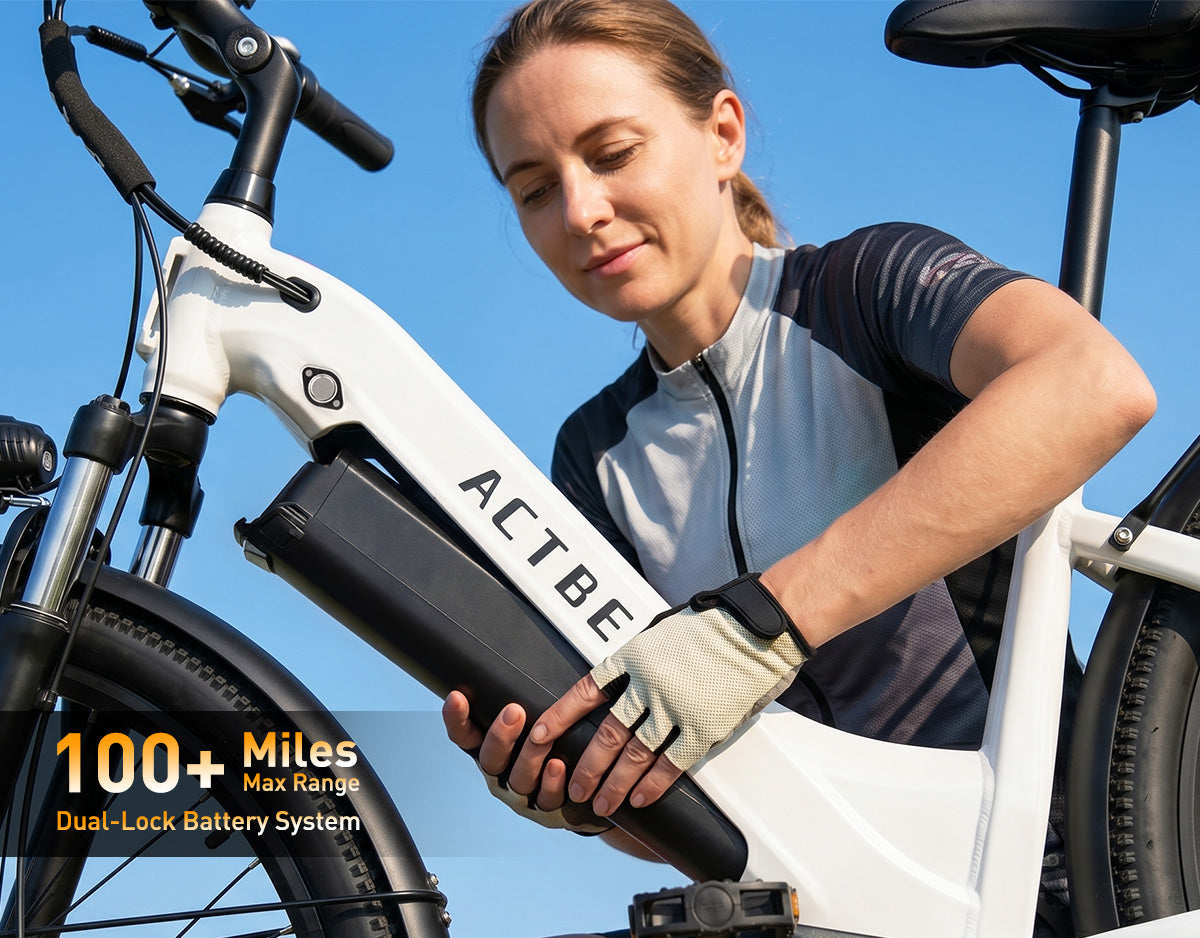
The average American commute is around 16 miles each way. Most modern commuter e-bikes can cover up to 55 miles on a single charge, depending on the conditions and your circumstances. That's a full round trip with a comfortable buffer for most riders, even accounting for hills, stop-start traffic, and carrying a bag.
The range you get from an electric bike depends on a few things. The first thing is the assistance level you choose. Using maximum power the whole time will drain the battery more quickly than if you selected moderate or low assistance levels, because you're demanding more from your battery.
Terrain affects range, too. A flat city route doesn't require the motor to work as hard as a route with lots of climbs, so it uses less battery power. The figures manufacturers quote in their spec sheets are typically achievable under moderate conditions, so treat them as a realistic ceiling rather than a guarantee.
The other thing worth knowing is that you can charge at work. If your commute is on the longer side, plugging in during the day turns range into a non-issue. A standard charger takes three to five hours for a full charge, and most bikes can be partially charged in much less time.
If you're replacing a car for a commute of 20 miles or under each way, range is unlikely to be a problem. For longer distances, it's worth checking the specific battery capacity of any bike you're considering.
Riding in the Rain: What You Need to Know
Rain is the most common objection among people considering switching from a car to an e-bike. And it's true that riding in wet weather requires a bit more thought than hopping in a car. But it's also far more manageable than most people expect.
You Can Ride an e-bike in the Rain
Well-built commuter e-bikes are designed with everyday use in mind, including riding in the wet. The motor, battery, and electrical components are well sealed against rain and road spray. Riding through a downpour on a quality commuter bike isn't something you need to worry about.
Adapt Your Riding to the Conditions
What does change in the rain is your stopping distance, so giving yourself more space to brake is essential, just as if you were driving your car. Hydraulic disc brakes handle wet conditions better than mechanical disc or rim brakes, so it's worth knowing what your bike has before you rely on it in the wet.
Check Your Tire Type
Tires make a difference, too. A commuter tire with some tread pattern gives you more grip on wet tarmac than a completely slick road tire. Most commuter e-bikes come fitted with something suitable, but it's worth checking if you're buying a bike with smooth tires and plan to ride year-round.
Dress for the Occasion
The other half of riding in the rain is staying dry yourself. A good waterproof jacket, waterproof trousers or overshoes, and either a helmet with a visor or a cap underneath make a significant difference. Once you have the right kit, riding your e-bike in the rain becomes less of an issue.
Fit Mudguards
Mudguards are worth having if you're commuting daily. They are surprisingly good at keeping road spray off your back and out of your face, which makes wet rides considerably more comfortable. Many commuter e-bikes include them as standard. If yours doesn't, they're an easy and cheap addition.
Most regular cyclists ride through rain without a second thought. An e-bike makes it easier because you don't have to work as hard, which means you arrive fresh and less likely to be uncomfortable, regardless of the weather.
Theft Prevention: Taking It Seriously
In most cities, bike theft is a real problem, and e-bikes are attractive targets, even more so than regular bikes, because of their value. Taking theft seriously is part of owning something worth stealing.
Buy a Good Lock
The most important thing you can do is use a good lock. A high-quality D-lock or a heavy-duty chain lock rated by a recognized security organization is the minimum for leaving a bike unattended in a public place. Cheap cable locks can be cut in seconds and offer almost no real protection. Also, if you use a chain-type lock, make sure you buy a good padlock for it; these are often the weakest part.
Lock Your e-bike Properly
How you lock the bike matters as much as the lock itself. Always lock the frame, not just the wheel, as the wheel is easily removed. Lock the frame and rear wheel to a railing, rack, or fence. You could also use a second lock on the front wheel. Two locks of different types are harder and slower to defeat than one, which is often enough of a deterrent. If you can remove your battery, your e-bike is less attractive to thieves, so take it into your workplace if possible.
Choose a Good Location
Think about where you leave your e-bike, too. Busy, well-lit areas are harder places to steal from than quiet side streets. If you can, find somewhere with CCTV coverage, which adds another layer of deterrence. If you can, lock your bike somewhere visible rather than tucked away.
Home Security
If you store your e-bike in a shed or garage, it's a good idea to install a ground anchor. A ground anchor and a heavy chain make it much harder for a thief to take your bike. An e-bike left unlocked in a garage is still vulnerable if someone gets in, so don't rely on four walls alone.
GPS trackers are a sensible addition for any e-bike used daily. They won't prevent theft, but they significantly increase the chance of recovery, and some insurance providers offer better rates if your bike is fitted with one.
You may also want to consider a dedicated e-bike policy if you're using the bike as a car replacement. Standard home contents insurance often has low limits for bikes stored outside the home, or doesn't cover them at all. A specialist e-bike policy can cover theft, accidental damage, and third-party liability for a reasonable cost. Finally, register your bike on a national database and keep a record of the serial number. If it is stolen and recovered, this is often the only way to prove ownership.
The Real Cost Comparison
Once you start looking at the numbers, replacing a car with an e-bike makes a lot of financial sense for urban commuters.
The average cost of running a car in the US sits well above $10,000 a year when you factor in fuel, insurance, maintenance, depreciation, and parking. Even a mid-range commuter e-bike costing $1,000 to $1,500 pays for itself quickly when set against those figures.
Charging an e-bike doesn't cost much. Most batteries can be fully charged for less than $0.15 at average electricity rates. Even if you ride every day, your monthly electricity cost is tiny. Maintenance is much easier and cheaper, too. Just keep an eye on your chain, brake pads, and tires, and book your bike in for occasional servicing, all of which are far cheaper than car servicing.
For riders who can't fully replace a car but want to cut costs, using an e-bike for most daily trips and keeping the car for when you need it is usually doable. Even a partial replacement makes a meaningful dent in annual transport costs.
actbest Commuter e-bikes Worth Considering
If you're making the switch, it's worth choosing a bike that's built for daily use. actbest's commuter e-bike range is a good place to start.
The Core 2.0 is a step-over commuter with a 1200W peak motor, 48V 10.4Ah battery, a range of up to 55 miles, and a top speed of 28+ mph. It's well-suited to riders who want a traditional frame and a confident, upright riding position for city streets. Priced from $599.
The Core ST 2.0 shares the same motor and battery in a step-through frame, making it easier to get on and off in stop-start traffic. Priced from $619.
For riders who want an e-bike with a torque sensor, the Core ST 2.0 27.5-inch is a separate model that adds torque sensor assist alongside larger wheels, offering a slightly smoother ride on city roads. Priced from $899.
 All three are practical, reliable options for anyone making the transition from four wheels to two.
FAQs
Can an e-bike fully replace a car for commuting?
For most urban commuters, yes. If your commute is under 20 miles each way, a good commuter e-bike can comfortably cover the journey on a single charge. If you have to ride further, you may be able to charge at work.
What happens if it rains on my commute?
Modern commuter e-bikes are water-resistant and handle rain without any issues. Just adapt your riding and clothing to suit the conditions.
How do I stop my e-bike from getting stolen?
Use a high-quality D-lock or chain lock, always lock through the frame to a fixed object, and consider a GPS tracker. At home, a ground anchor in a locked garage is a strong deterrent.
Is e-bike insurance worth it?
For a bike you're using as a car replacement, yes. A specialist policy covers theft, damage, and liability.
How much does it cost to charge an e-bike?
Less than $0.15 per full charge at average US electricity rates. For daily commuting, your monthly charging cost is unlikely to exceed a few dollars.
Final Thoughts
Replacing your car with a commuter e-bike is more practical than you may first think. There is often enough range for most commutes, wet weather is manageable with the right preparation, and theft prevention is straightforward once you take it seriously.
You can also save yourself quite a lot of money. The cost of a good e-bike is a fraction of the cost of annual car ownership, and the ongoing costs are minimal by comparison.
If you're ready to make the switch, or just want to see what's available, take a look at the actbest commuter e-bike range and find a model that fits your route.
Share:
What is a Step Through E-Bike?
Why Electric Bikes Are Transforming the Future of Commuting