
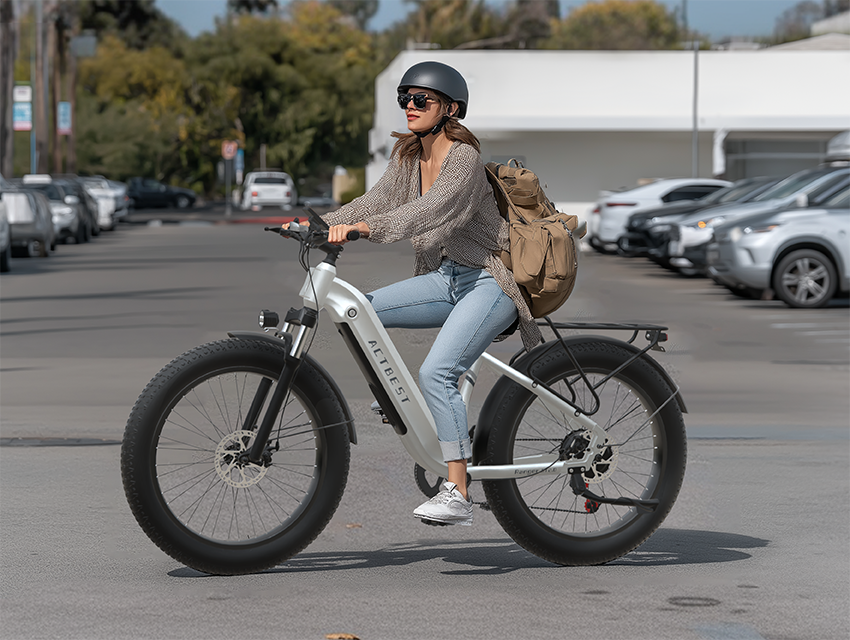
Nobody enjoys riding for hours (or even minutes) along a bumpy road on a stiff, rigid bike. Even worse, when you’re reaching the top speeds of the average e-bike. It feels like your very bones are being jolted. That’s where a fat tire e-bike comes in.
Fat tires offer greater comfort, traction, and stability wherever you ride. The thicker, bulkier tire contains more air, cushioning you (and acting as a secondary suspension), whether you’re riding on gravel, over potholes, or down difficult hillside terrain.
But are fat tire e-bikes really the best option for all-terrain? Or do the drawbacks mean they’re not worth the extra money? Find out below.
 What Is a Fat Tire e-Bike?
A fat tire e-bike is an electric bike fitted with oversized tires — typically 4 inches or wider. Thicker tires increase the contact between the e-bike and the ground. That means greater traction, stability, and comfort across difficult terrain like sand, snow, mud, gravel, or rocky trails.
What Makes a Fat Tire e-Bike Different?
Most e-bikes are designed for commuting and light road riding. As such, manufacturers opt for thinner tires that increase the bike’s range and efficiency. In contrast, fat tires involve a lower tire pressure and more air between you and the ground. It cushions every revolution, increases grip, and offers more stability.
The downside? More contact with the ground increases rolling resistance. Put simply, it takes more energy to turn the wheel. That’s fine on an e-bike with pedal assist. However, it will drain the battery faster than a comparable commuter e-bike.
Typical Features of a Fat Tire Electric Bike
· Most fat tire e-bikes use either hub or mid-drive motors. Hub motors are common on affordable models, while mid-drive systems usually offer better climbing performance and a more natural riding feel.
· Suspension helps smooth out rough terrain. Some bikes use front suspension forks, while more premium models add rear suspension for greater comfort on rocky or uneven trails.
· Large batteries support longer rides and tougher terrain. Fat tire e-bikes often need bigger battery capacity to handle the added weight and rolling resistance of oversized tires.
· Hydraulic disc brakes improve stopping power and control. They perform especially well in wet, muddy, or steep off-road conditions where reliable braking matters most.
· Wide handlebars and upright geometry create a stable riding position. This improves comfort, handling, and confidence during long rides or technical off-road cycling.
Why Fat Tire e-Bikes Perform So Well Off-Road
Increased Traction on Loose Terrain
Most cyclists are used to roads or bike trails. There, the ground is stable and solid. That changes once you head off-road; it only takes a little bit of gravel, sand, snow, or mud to send the average commuter bike tire sliding sideways.
The larger tire contact patch spreads the rider’s weight and improves grip. It means that it can stand up to a wider variety of conditions.
Better Stability and Control
Beginners can find normal tires a little precarious. Fat tires offer more confidence. Riders can handle uneven terrain without fear of slipping. Plus, it’s a lot more comfortable in the saddle after an hour or so of riding.
Lower Tire Pressure Creates a “Floating” Effect
One of the first things riders notice is how much more cushioned fat tires feel compared to standard e-bikes. The lower PSI creates a floating effect that absorbs bumps and reduces trail chatter. It’s a smoother, less jarring experience.
Best Terrain for a Fat Tire e-Bike
Sand and Beach Riding
Normal tires sink into the sand. They can spin helplessly on dry sand, struggling to push the bike forward. Fat tires offer both greater grip and a floating effect on wet sand, making riding much easier.
Snow and Winter Conditions
You never know what the weather holds. If you’re a commuter who has to deal with snow or ice, fat tires give you the confidence that you’ll get to work without slipping out of control.
Gravel, Forest Trails, and Rocky Terrain
Loose gravel, root-covered trails, or dry mud can all give way or catch narrower wheels. Fat tires hold tight to the trail so that you can ride without issue.
Urban Riding and Bad Roads
Even on urban roads, conditions aren’t perfect. Potholes, curbs, or just poor road surfaces can present a challenge that only a fat tire e-bike can truly master.
Are Fat Tire e-Bikes Good for Beginners?
You might think a heavier bike with a more expensive price tag isn’t the best choice for beginners. Indeed, fat tire e-bikes are often positioned as the choice for seasoned, all-terrain riders.
But that’s not necessarily the case.
Beginners can benefit from greater balance, traction, and stability than narrower bikes, especially on uneven or loose terrain. On a standard bike, the extra rolling resistance can make them feel sluggish. But with pedal assist, that’s not a problem. It’s a great option if you want versatility, a more stable, comfortable ride, and easier climbing.
That being said, the frame is often a lot heavier, and you won’t get the same quick acceleration as lighter commuter bikes. It’s a challenge if you’re bringing your bike onto public transport or dealing with the stop-start riding typical of urban centers.
Fat Tire e-Bike vs Traditional Mountain Bike
Fat tire e-bikes often get compared to mountain bikes. They’re both designed for loose, uneven terrain. However, there is a difference.
Fat tire electric bikes excel on loose terrain. They offer a cushioned ride that reduces vibration. But it comes at the cost of range and high-level performance.
In contrast, mountain bikes are designed for aggressive technical riding. They’re built specifically for technical terrain, capable of handling tough descents, uneven paths, and other challenging environments — especially if they’re full suspension.
Things to Consider Before Buying a Fat Tire e-Bike
Motor Power and Battery Range
Motor power and torque affect how well a fat tire e-bike climbs hills, accelerates, and handles rough terrain. Battery range also varies depending on rider weight, terrain, temperature, and assist level, so real-world performance is often lower than advertised figures.
Tire Width and Tread Pattern
Here, you’ll need to balance how your bike is going to be used. Smoother tires work well on roads and gravel, while aggressive tread patterns are needed on mud, snow, or loose trails.
Frame Size and Rider Comfort
Find a bike that’s correctly sized for your frame. It makes a big difference during longer rides or technical sections, ensuring the center of gravity is right for maximum performance.
Suspension vs Rigid Setups
Most beginners can survive with a hardtail e-bike. However, if you’re an off-road fanatic, you’re going to need more than just a front suspension fork. Full suspension comes with a rear shock so that you can tackle difficult descents.
Weight and Storage
Fat tire e-bikes are a lot heavier than standard bikes. If you’re going to transport them regularly or bring them onto public transport, it can be a problem. There’s also the issue of storage if you live in the city.
Should You Buy a Fat Tire e-Bike?
Fat tire e-bikes are first and foremost for riders who want greater comfort, stability, and traction as they ride. While you’ll take a hit on bike range and weight, many people find they’re a great option for both urban and off-road riding.
 actbest offers a range of fat tire electric bikes with some pretty impressive specs. The Ranger ST 2.0, for example, has a powerful 1,800W motor and a top speed of 38 mph. Meanwhile, the step-through Blazer offers similar specs with a larger battery, making it ideal for balancing commuting and off-road riding.
Browse the full collection of fat tire e-bikes to find the model that’s right for you.
FAQs
Are fat tire e-bikes harder to pedal?
Fat tire e-bikes have a higher rolling resistance. That means it takes more energy to turn the wheels. Without pedal assist, riders will notice a big difference in how hard it is to ride.
What terrain are fat tire e-bikes best for?
Fat tire e-bikes are best for sand, snow, gravel, mud, rocky trails, and poor road conditions.
Are fat tire e-bikes good for long-distance riding?
Yes and no. Fat tire e-bikes offer a more cushioned, comfortable ride, which can make long distances more pleasant. However, the additional weight can drain the battery, reducing the range of the bike.
Can you ride a fat tire e-bike on normal roads?
Yes, there’s no reason you can’t ride a fat tire e-bike on normal roads.
Do fat tire e-bikes require more maintenance?
They might. Fat tire e-bikes are heavier and have more tire contact with the ground. That can increase tire wear, place greater pressure on the battery, and require more cleaning after off-road riding.
Share:
Portability vs Performance: Do Folding E-Bikes Compromise on Ride Quality?
Moped Style Ebike vs Regular Ebike: Which One Should You Choose?