
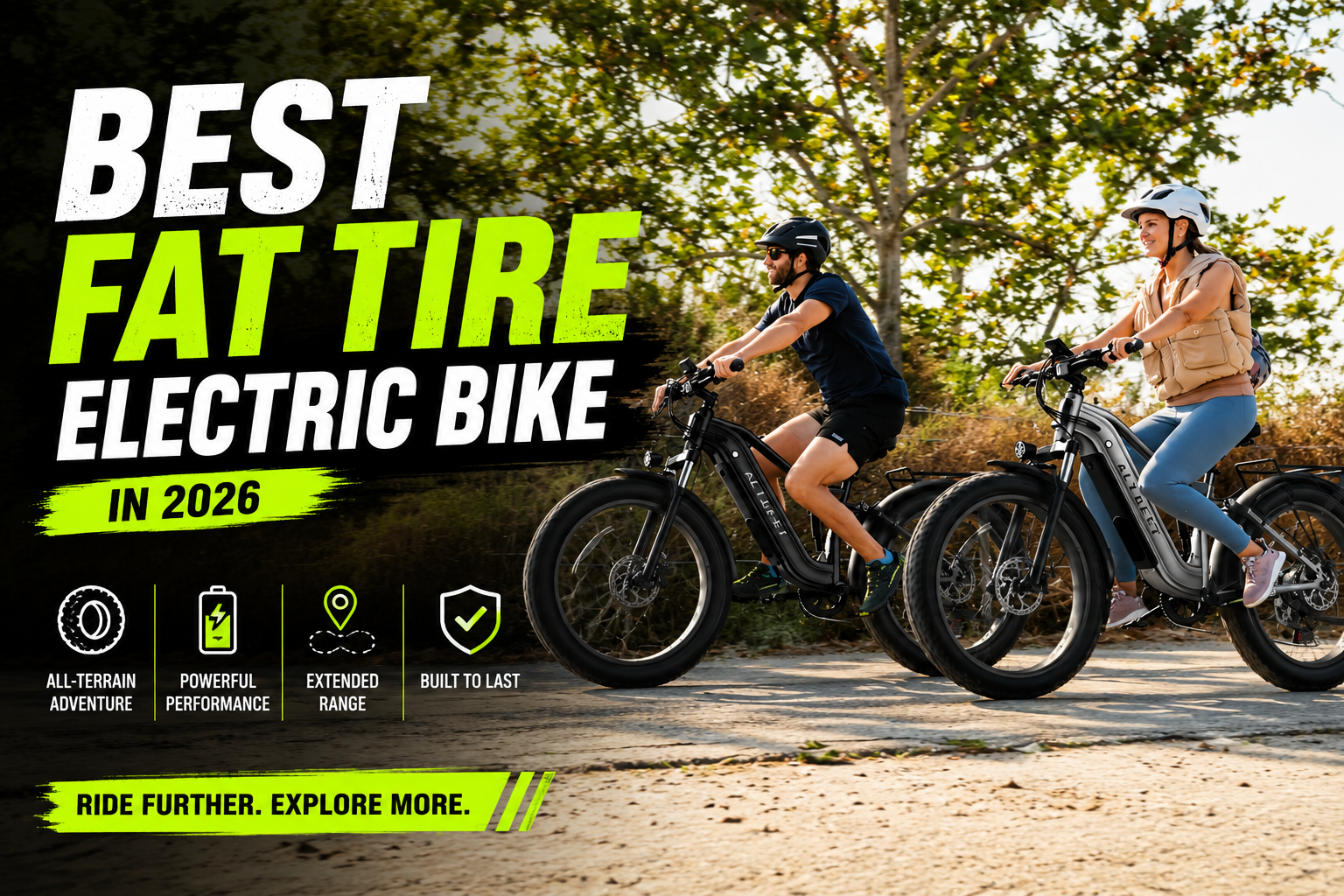
Fat tire e-bikes are everywhere at the moment. Gone are the narrow, uncomfortable wheels once so common. Now, people are opting for the comfort, grip, and stability that fat tires offer. That’s all down to the rise of e-bikes, which help offset the higher rolling resistance of fat tires.
Whether you’re riding in snow, sand, off-road, over potholes, or just your regular commute, fat tire e-bikes are a great option. But fat tires alone aren’t the only feature to consider. The best fat tire e-bikes range from full-on mountain bikes to commuter-friendly models (and everything in between).
Below, we’re looking at power, ride comfort, suspension, battery, range, and value to determine the best fat tire e-bikes in 2026.

Best Fat Tire E-Bikes in 2026: Overview
- actbest Ranger 2.0 — Best for budget all-around performance
- Heybike Hero — Best for premium off-road riding
- Aventon Aventure M — Best for commuting and smart features
- Mokwheel Obsidian 2.0 — Best for heavy-duty trail riding
- Lectric XPeak 2 Step-Thru — Best value fat tire e-bike
- actbest Blazer Ultra — Best for raw power and acceleration
- Aipas M1 Pro Xterrain ST — Best budget high-power option
- Jasion Thunder Pro ST — Best moped-style fat tire e-bike
- Puckipuppy GoldenR — Best dual-motor AWD e-bike
- Mokwheel Basalt — Best for comfort and everyday riding
What Makes a Good Fat Tire Electric Bike?
Fat tire e-bikes didn’t just become popular because they look cool. (And they do.) There are a few obvious advantages that you don’t get with the average electric bike.
But what makes a good fat tire electric bike? What should you look for? Here’s the lowdown:
- Motor power and torque. Torque matters a lot more than raw wattage; it’s what helps drive your e-bike up hills and over tough terrain.
- Battery size. Fat tires increase rolling resistance, draining the battery faster. Bigger batteries can help increase range, but they’ll also increase the bike’s weight.
- Suspension. Fat tires can help absorb vibration. However, if you’re a serious off-road rider, you’ll want a full suspension setup.
- Weight and practicality. Fat tires add weight to the bike — many models now exceed 80 lbs. If you’re planning on commuting, the extra weight can be an issue.
Best Fat Tire E-Bikes in 2026
actbest Ranger 2.0

The actbest Ranger 2.0 is a seriously heavy-duty mountain bike. Equipped with a 1,800W motor and a 48V 13Ah battery, it strikes a strong balance between power and range. Despite the e-bike’s heavy, durable frame and 500lb payload capacity, it still has a range of up to 75 miles. So, if you’re planning a long-distance off-road adventure, it’ll keep going for mile after mile.
Plus, the model has an adjustable front fork suspension that you can fine-tune to your riding experience. For the price, it’s as good as a fat tire electric bike gets.
Available in step-over and step-through models.
Specs
· Peak 1800W rear hub motor with 100Nm torque
· 48V 13Ah / 624Wh removable battery
· Up to 75-mile claimed PAS range
· 26” × 4” fat tires with adjustable front suspension
· Shimano 7-speed drivetrain, up to 28mph top speed
Pros
· Strong power and hill-climbing for the price
· Fat tires + suspension make rough terrain comfortable
· High payload capacity and large rider fit range
Cons
· Heavy and bulky for urban portability
· Mechanical components/brakes may need upgrading long-term on budget builds
Heybike Hero E-Bike

The Heybike Hero is the brand’s flagship model. While the price is much steeper than many others in this list, the e-bike is packed with features.
From the 1,800W motor and 35 mph top speed to the carbon fiber frame and full suspension, it’s the definition of a premium model. Most impressive are the mid-drive (750W) and rear-hub (1,000W) motors that deliver a high level of torque. That power helps with rough terrain and challenging inclines, continuing on where other bikes would stall out.
Best of all, the bike only weighs 75 lbs — you can find foldable e-bikes for similar weights.
Specs
· Carbon fiber full-suspension frame
· Up to 1800W peak power
· 864Wh battery
· 26×4” fat tires
· Hydraulic disc brakes
Pros
· Premium lightweight frame
· Strong climbing power
· Very comfortable ride
Cons
· Expensive
· Mixed support reputation
Aventon Adventure M E-Bike

The Aventon Adventure M E-Bike is a good all-around balance of features. While its top speed and 750W motor don’t excite as much as some models, it still delivers 100Nm of torque — the factor that really matters when you’re driving uphill.
Perhaps the most impressive feature is the electronic shifter with autoshift technology, which ensures you’re always in the right gear. It’s one less thing to worry about when you’re tackling tough terrain.
Specs
· 750W peak mid-drive motor
· 100Nm torque
· 733Wh battery
· Electronic auto-shifting
· GPS + anti-theft features
Pros
· Extremely refined ride feel
· Smart tech and security features
· Excellent hill climbing
Cons
· Expensive for a fat-tire bike
· Heavier than standard commuters
Mokwheel Obsidian 2.0 E-Bike

The Mokwheel Obsidian 2.0 is a full suspension fat tire e-bike built for serious off-road comfort. If you hate the bumps and vibrations that come with uneven ground, it’s a solid pick. The motor peaks at 1,300W with over 105Nm of torque. That’s enough for most slopes and terrain.
Where it excels is the full suspension system, designed to absorb the impacts from gravel, potholes, and steep slopes. Alongside the 4” fat tires, it’s like riding on air. The only real downside is the price and weight — some might argue the components aren’t quite top-tier for the money.
Specs
· 1300W peak motor
· 105Nm torque
· 940Wh battery
· Full suspension setup
· Shimano 10-speed drivetrain
Pros
· Extremely high torque
· Very comfortable on rough terrain
· Huge payload capacity
Cons
· Very heavy
· Components aren’t premium-tier for the price
Lectric Bike XPeak2 Step-Thru E-Bike

The Lectric XPeak2 is one of the cheaper models on the list. You don’t get full suspension, a lightweight frame, or high speeds. What you do get, however, is a reliable fat tire e-bike with 1,310W of peak power, up to 60 miles of range, and a decent suspension system.
Considering the e-bike sells for less than $2,000, it’s by no means a bad option for a beginner. The only real weak spot is the small payload capacity — just 330 lbs. But unless you’re planning on hauling a lot of cargo, it’s big enough for most riders.
Specs
· 1310W peak motor
· Torque sensor pedal assist
· 720Wh battery
· 26×4” fat tires
· 8-speed Shimano drivetrain
Pros
· Excellent value for the spec
· Natural pedal feel from the torque sensor
· Stable all-terrain setup
Cons
· Very heavy
· Step-thru version has reported wobble issues at speed
actbest Blazer Ultra

The actbest Blazer Ultra is similar to the Ranger 2.0. With a 1,800W motor and a top speed of 36+ mph, it doesn’t compromise on power or speed. It even comes with a few extra features.
First, there’s the impressive 85 miles of range, which allows you to cover more ground than ever, even at higher speeds. Second is the full suspension system. Designed for urban commutes and off-road trails, the front fork and rear shock absorber provide an exceptionally smooth, comfortable ride — whatever the road throws at you.
Specs
· Peak 1800W rear hub motor with 95Nm torque
· 48V 15.6Ah removable battery for extended range
· Full-suspension electric mountain bike setup
· Hydraulic disc brakes with fat all-terrain tires
· Shimano 7-speed drivetrain with high-speed tuning
Pros
· Noticeably more powerful and aggressive than the Ranger ST
· Larger battery is better suited to long off-road rides
· Full suspension improves comfort on rough terrain
Cons
· Considerably heavier and less practical for commuting
· Higher power setup may feel excessive for casual riders
Aipas M1 Pro Xterran ST E-Bike

Aipas is known for extremely tough, rugged e-bikes. The M1 Pro Xterrain is no exception. The e-bike comes with a 1,800W BLDC motor and a 5-level pedal assist system (PAS). The motor controller is designed to deliver smoother, quieter power delivery than many competing models. That means fewer maintenance issues long term.
The hydraulic brakes are another plus. Alongside the full suspension system, they give you more control and confidence on difficult trails. Just be aware that the bike itself is bulky and heavy, which can compromise some maneuverability.
Specs
· 1800W peak rear hub motor
· 110Nm torque
· 48V 17.5Ah battery
· Full suspension frame
· 26×4” fat tires
Pros
· Extremely powerful for the price
· Long claimed range
· High comfort on rough terrain
Cons
· Very heavy and bulky
· Question marks around marketing claims/QC
Jasion Thunder Pro ST

The Jasion Thunder Pro ST lives up to its name. It promises and delivers on power, speed, and range. In fact, it’s one of the more impressive specs for the price. Inside the frame there’s a 2,000W motor and 52V 20Ah battery that together deliver 35 mph top speed, 115Nm torque, and up to 90 miles in range.
But its biggest advantages are also something of a downside. For a lot of riders, it’s just too much power (more like a moped than a typical electric fat tire bike). Even with the step-through design, it’s probably overkill for the majority of riders.
Specs
· 2000W peak motor
· 115Nm torque
· 52V 20Ah battery
· Full suspension setup
· Hydraulic disc brakes
Pros
· Extremely fast acceleration
· Huge range potential
· Strong braking performance
Cons
· Very heavy
· More moped-like than bicycle-like
Puckipuppy GoldenR Pro E-Bike

The Puckipuppy GoldenR Pro comes with dual motors that deliver power to both wheels, so you’ve always got traction. It’s a level of control you won’t find with most e-bikes. Indeed, while the 1,600W peak power doesn’t look like a lot on paper, it’s more than enough when you understand how that power is distributed.
The e-bike also has a full suspension system and 80 miles of range, suitable for city streets and rough trails. It also has anti-theft protection with an electronic key, which adds an extra layer of security when parked.
Specs
· Dual-motor AWD setup
· 1600W peak power
· 48V 20Ah battery
· Full suspension frame
· 400lb payload capacity
Pros
· Excellent traction on loose terrain
· Huge pulling/load capability
· Very stable at speed
Cons
· Extremely heavy
· Brand reliability/support concerns
Mokwheel Basalt 2.0 E-Bike

The Mokwheel Basalt 2.0 is a classic fat tire e-bike. The price tag is a little more reasonable, offering riders on a budget a chance to enjoy the perks of thicker tires. Think of it not as a pure off-road e-bike, but more as a dependable, go-anywhere bike that balances the demands of roads, trails, and everything in between.
That balance is reflected in the specs: 750W motor, 450 lbs payload capacity, and 28 mph top speed. It’s not enough to impress performance-focused riders. However, as a mid-range model, it’s still a decent model — and you can’t ignore the 80 miles of range.
Specs
· 750W motor (1100W peak)
· 48V 19.6Ah battery
· 26×4” fat tires
· Hydraulic disc brakes
· Torque sensor pedal assist
Pros
· Smooth, natural power delivery
· Strong real-world range
· Comfortable upright geometry
Cons
· Less aggressive than high-power rivals
· Heavy for daily carrying
FAQs
Are fat tire electric bikes harder to pedal?
Yes. Fat tires create more rolling resistance, and the bikes are usually heavier. However, pedal assist largely offsets this while riding.
How fast do fat tire e-bikes go?
Most fat tire e-bikes reach 20–28mph depending on motor power, local laws, and bike class.
Are fat tire e-bikes good for commuting?
Yes — especially on rough roads, potholes, gravel, or poor weather. They’re comfortable and stable, though often heavier than standard commuter e-bikes.
What is the ideal motor power for a fat tire e-bike?
For most riders, 750W–1000W offers the best balance of power, range, and usability. Higher-power bikes suit steep hills and aggressive off-road riding.
Are dual-motor fat tire e-bikes worth it?
They can be if you regularly ride steep hills, sand, snow, or rough trails. For normal commuting, they’re often heavier and more expensive than necessary.
Share:
What is a Torque Sensor on an e-bike?
Can You Bring a Foldable Electric Bike on Planes, Trains, and Public Transit?